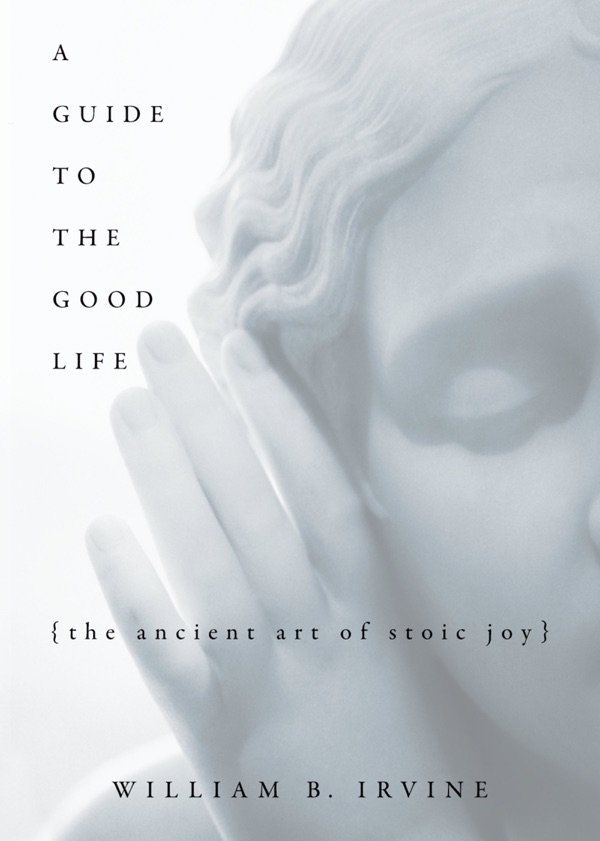
A Guide to the Good Life: The Ancient Art of Stoic Joy
von William B. Irvine
Before Socrates, philosophers were primarily interested in explaining the world around them and the phenomena of that world—in doing what we would now call science. Although Socrates studied science as a young man, he abandoned it to focus his attention on the human condition. As the Roman orator, politician, and philosopher Cicero put it, Socrates was “the first to By laughing off an insult, we are implying that we don’t take the insulter and his insults seriously. To imply this, of course, is to insult the insulter without directly doing so. It is therefore a response that is likely to deeply frustrate the insulter. For this reason, a humorous reply to an insult can be far more effective than a counterinsult would be.
Before Socrates, philosophers were primarily interested in explaining the world around them and the phenomena of that world—in doing what we would now call science. Although Socrates studied science as a young man, he abandoned it to focus his attention on the human condition. As the Roman orator, politician, and philosopher Cicero put it, Socrates was “the first to
By laughing off an insult, we are implying that we don’t take the insulter and his insults seriously. To imply this, of course, is to insult the insulter without directly doing so. It is therefore a response that is likely to deeply frustrate the insulter. For this reason, a humorous reply to an insult can be far more effective than a counterinsult would be.
He will instead concern himself with things over which he has complete control and things over which he has some but not complete control. And when he concerns himself with things in this last category, he will be careful to set internal rather than external goals for himself and will thereby avoid a considerable amount of frustration and disappointment.
I saw no need to ponder a philosophy of life. I instead felt comfortable with what is, for almost everyone, the default philosophy of life: to spend one’s days seeking an interesting mix of affluence, social status, and pleasure. My philosophy of life, in other words, was what might charitably be called an enlightened form of hedonism.
When assessing the “costs” associated with practicing Stoicism or any other philosophy of life, readers should realize that there are costs associated with not having a philosophy of life. I have already mentioned one such cost: the danger that you will spend your days pursuing valueless things and will therefore waste your life.
"Before Socrates, philosophers were primarily interested in explaining the world around them and the phenomena of that world—in doing what we would now call science. Although Socrates studied science as a young man, he abandoned it to focus his attention on the human condition. As the Roman orator, politician, and philosopher Cicero put it, Socrates was “the first to"
"By laughing off an insult, we are implying that we don’t take the insulter and his insults seriously. To imply this, of course, is to insult the insulter without directly doing so. It is therefore a response that is likely to deeply frustrate the insulter. For this reason, a humorous reply to an insult can be far more effective than a counterinsult would be."
"He will instead concern himself with things over which he has complete control and things over which he has some but not complete control. And when he concerns himself with things in this last category, he will be careful to set internal rather than external goals for himself and will thereby avoid a considerable amount of frustration and disappointment."
"I saw no need to ponder a philosophy of life. I instead felt comfortable with what is, for almost everyone, the default philosophy of life: to spend one’s days seeking an interesting mix of affluence, social status, and pleasure. My philosophy of life, in other words, was what might charitably be called an enlightened form of hedonism."
"When assessing the “costs” associated with practicing Stoicism or any other philosophy of life, readers should realize that there are costs associated with not having a philosophy of life. I have already mentioned one such cost: the danger that you will spend your days pursuing valueless things and will therefore waste your life."
"What Stoics discover, though, is that willpower is like muscle power: The more they exercise their muscles, the stronger they get, and the more they exercise their will, the stronger it gets. Indeed, by practicing Stoic self-denial techniques over a long period, Stoics can transform themselves into individuals"
"In behaving fatalistically with respect to the past and present, we refuse to compare our situation with alternative, preferable situations in which we might have found or might now find ourselves. By doing this, the Stoics think, we will make our current situation, whatever it may be, more tolerable."
- →In behaving fatalistically with respect to the past and present, we refuse to compare our situation with alternative, preferable situations in which we might have found or might now find ourselves. By doing this, the Stoics think, we will make our current situation, whatever it may be, more tolerable.
- →We humans are unhappy in large part because we are insatiable; after working hard to get what we want, we routinely lose interest in the object of our desire. Rather than feeling satisfied, we feel a bit bored, and in response to this boredom, we go on to form new, even grander desires.
- →What this means is that it is entirely possible these days for someone to have been raised in a religion and to have taken philosophy courses in college but still to be lacking a philosophy of life. (Indeed, this is the situation in which most of my students find themselves.)
- →He realized that in many cases, we work hard to obtain something because we are convinced that we would be miserable without it. The problem is that we can live perfectly well without some of these things, but we won’t know which they are if we don’t try living without them.
Ähnliche Bücher gesucht?
Beschreibe deine Situation. Die Suche findet das passende Buch aus der gesamten Bibliothek.