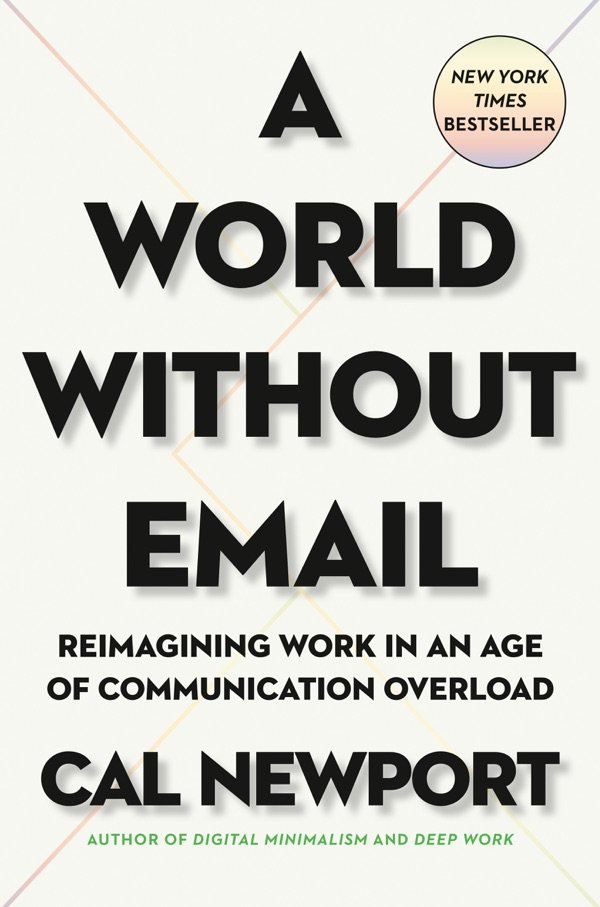
A World Without Email: Reimagining Work in an Age of Communication Overload
von Cal Newport
Because email counts as “desk work” in these studies, we see time spent on desk work grow as time spent in scheduled meetings falls. Unlike scheduled meetings, however, conversations held through email unfold asynchronously—there’s usually a gap between when a message is sent and ultimately read—meaning that the compacted interactions that once defined synchronous meetings are now spread out into a shattered rhythm of quick checks of inboxes throughout the day. In Mark and González’s study, the average scheduled meeting took close to forty-two minutes. By contrast, the average time spent in an email inbox before switching to something else was only two minutes and twenty-two seconds. Interaction now occurs in small chunks, fragmenting the other efforts that make up the typical knowledge worker’s day. A key insight preached in Carpenter’s book is the need to involve those who are affected by a new work procedure in the design of that procedure. His staff wrote 98 percent of the procedures currently in place and had a “heavy hand” in shaping the remaining 2 percent that Carpenter created himself. As a result, his employees are “fully vested” in these processes. Perhaps even more crucial, Carpenter made it easy to instigate further improvements. “If an employee has a good idea for improving a procedure, we will make an instant modification—with no bureaucratic hang-ups,” he explains.23 He takes this employee involvement so seriously that he now requires his service representatives to submit at least a dozen proposed improvements before they qualify to receive their annual performance bonus.
One study estimates that by 2019 the average worker was sending and receiving 126 business emails per day, which works out to about one message every four minutes.2 A software company called RescueTime recently measured this behavior directly using time-tracking software and calculated that its users were checking email or instant messenger tools like Slack once every six minutes on average.
This tool is mainly used for two purposes. The first is to “celebrate wins”: if someone accomplishes something important, either professionally or personally, they might share it on the company Slack channel. Johnson describes this as a chance to virtually “high-five” one another. Because the company is virtual, he explained, it’s important to have some outlet for social interaction.
In early 2017, a new French labor law went into effect that attempted to preserve a so-called “right to disconnect.” According to the law, French companies with fifty employees or more are required to negotiate specific policies about email after work hours, with the goal of significantly reducing the time workers spend in their inbox in the evening or over the weekend.
To summarize, we often overestimate the rational nature of our workloads. If a task is on our plate, we believe, it’s because it’s important—part of the job. But as I’ve just argued, both the type and quantity of the efforts that make up our day can be strongly influenced by less rational factors, such as the relative cost of asks for someone else’s time and attention.
This vignette of the frustrated scientist and his distracting boss underscores an important cost of email that we often miss. Tools like email almost completely eliminate the effort required—in terms of both time and social capital—to ask a question or delegate a task. Viewed objectively, this seems like a good thing: less effort equals more efficiency.
"Because email counts as “desk work” in these studies, we see time spent on desk work grow as time spent in scheduled meetings falls. Unlike scheduled meetings, however, conversations held through email unfold asynchronously—there’s usually a gap between when a message is sent and ultimately read—meaning that the compacted interactions that once defined synchronous meetings are now spread out into a shattered rhythm of quick checks of inboxes throughout the day. In Mark and González’s study, the average scheduled meeting took close to forty-two minutes. By contrast, the average time spent in an email inbox before switching to something else was only two minutes and twenty-two seconds. Interaction now occurs in small chunks, fragmenting the other efforts that make up the typical knowledge worker’s day."
"A key insight preached in Carpenter’s book is the need to involve those who are affected by a new work procedure in the design of that procedure. His staff wrote 98 percent of the procedures currently in place and had a “heavy hand” in shaping the remaining 2 percent that Carpenter created himself. As a result, his employees are “fully vested” in these processes. Perhaps even more crucial, Carpenter made it easy to instigate further improvements. “If an employee has a good idea for improving a procedure, we will make an instant modification—with no bureaucratic hang-ups,” he explains.23 He takes this employee involvement so seriously that he now requires his service representatives to submit at least a dozen proposed improvements before they qualify to receive their annual performance bonus."
"A good production process, in other words, should minimize both ambiguity about what’s going on and the amount of unscheduled communication required to accomplish this work. Notice, nothing about these properties restricts the knowledge worker’s autonomy in figuring out how they get their work done; the focus remains on coordinating this work. Also notice that these properties are unlikely to lead to stifling bureaucracy, as the processes they produce are optimized to reduce the overhead—in terms of both context shifts and time—surrounding the actual act of producing valuable things. Workers at the highly systematized Optimize Enterprises likely feel much more empowered and much less overwhelmed than those shackled to the status quo of the hyperactive hive mind workflow."
"What she uncovered was a social feedback loop gone awry—a process she named the cycle of responsiveness. The cycle begins with legitimate demands on your time. Perhaps it’s 2010, you’ve just started using a smartphone, and you realize it’s now possible to answer client questions that arrive after work hours or respond quickly to colleagues in different time zones. These clients and colleagues now learn that you’re available at these new times and begin to send more requests and expect faster responses. Faced with this increased influx, you check your phone more often so you can keep up with the incoming messages. But now the expectations for your availability and responsiveness increase further, and you feel pressured to respond even quicker. As Perlow summarizes:"
"Here are a few other odds and ends I learned about Optimize’s processes. Though they forbid internal email, they do use email to communicate with external partners. Their interaction with these inboxes, however, is highly structured. Johnson says those responsible for these external-facing email addresses have “discrete blocks” in which they check for messages, typically once a day. To handle customer service, Optimize deploys a tool called Intercom that streamlines the process of responding to the most common requests and prevents pileups of ambiguous emails from customers. Optimize also hosts a company-wide meeting every Monday (using teleconferencing software) to synchronize efforts."
"One of Optimize’s more intricate processes, for example, involves the production of the daily lesson videos that get delivered to multiple platforms each morning. The work required for this production is substantial. Johnson is responsible for actually coming up with and writing the lessons. He’s also the person who delivers the lessons on camera for the video. But beyond this, other tasks lurk: the text versions of the lessons must be edited, the videos must be filmed, the film clips must be edited, and everything must be launched to multiple platforms at just the right time. Around a half dozen people are involved in executing these varied steps."
"As 150 years of economic theory has taught us, to solve the tragedy of the commons, you cannot expect substantially better behavior from the herders; you need instead to replace the free-for-all grazing system with something more efficient. The same holds for the hyperactive hive mind: we cannot tame it with minor hacks—we need to replace it with a better workflow. And to do so, we must soften Peter Drucker’s stigma against engineering office work. Drucker was right to point out that we cannot fully systematize the specialized efforts of knowledge workers, but we shouldn’t apply this to the workflows that surround these efforts."
- →Imagine the frustration of shifting from the steady reliability of the craft method to a process that forced you to stop working completely again and again. To make matters even worse, the assembly line also required the addition of more managers and engineers to supervise. It was not only more annoying but also much more expensive to operate!
- →The late Nobel Prize–winning physicist Richard Feynman famously told an interviewer that his strategy for minimizing committee work was to do it really poorly so that people would eventually stop asking him for help. Few people would be comfortable with such brazen misanthropy. Do we really want to reward those who are?
- →Before PTO was introduced, only 27 percent of the consultants reported that they were excited to start work in the morning. After the reduction in communication, this number jumped to over 50 percent. Similarly, the percentage of consultants satisfied with their job jumped from under 50 percent to over 70 percent.
- →The implication of the RescueTime data set is striking: the modern knowledge worker is almost never more than a few minutes away from sending or receiving some sort of electronic communication. To say we check email too often is an understatement; the reality is that we’re using these tools constantly.
Ähnliche Bücher gesucht?
Beschreibe deine Situation. Die Suche findet das passende Buch aus der gesamten Bibliothek.