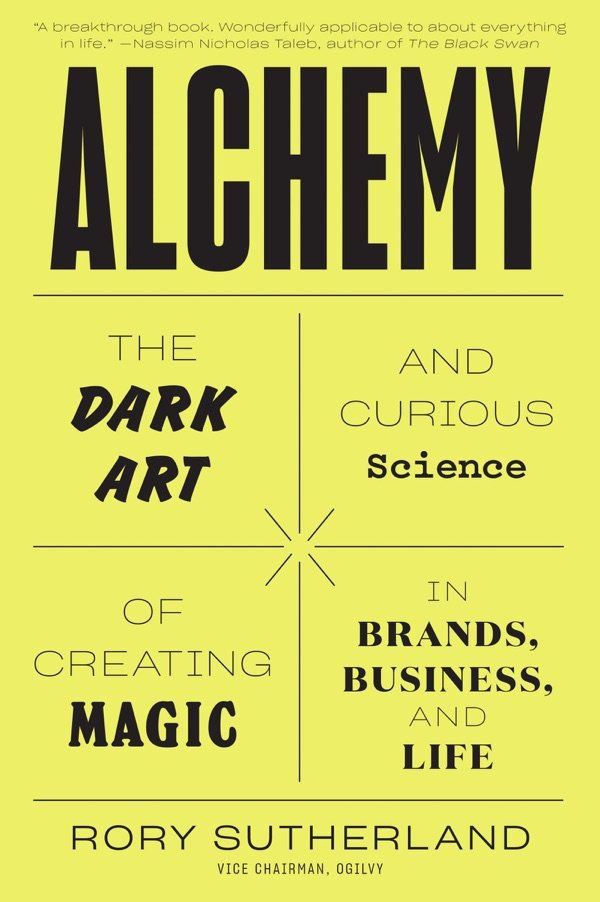
Alchemy: The Surprising Power of Ideas That Don't Make Sense
von Rory Sutherland
Deploy the ‘Goldilocks effect’ – the natural human bias that means that, when presented with three options, we are most likely to choose the one in the middle. Washing detergent manufacturers use language that normalises the lower and middle usage of the product, while implicitly stigmatising overdosing. For example, ‘Half a capful for light–normal wash’; ‘One capful for a full or heavy wash’; ‘Two capfuls for extreme soiling.’ This creates the impression that one would only use more than one capful if they had committed some brutal crime: as a result, even overdosers will likely use only one cap. According to economic theory, this makes no sense at all, but in the real world it is perfectly plausible. After all, any theatre selling tickets at a discount clearly has plenty to spare, and from this it might be reasonable to infer that the entertainment on offer isn’t all that good. No one wants to spend £100–£200 on tickets, a meal, car-parking and babysitting, only to find that you would have had more fun watching television at home; in avoiding discounted theatre tickets, people are not being silly – they are showing a high
The same applies in interpersonal relations; being rude isn’t so different from being polite, but it requires less effort. Politeness demands that we perform hundreds of little rituals, from opening doors to standing up when someone enters the room, all of which are more effortful than the alternative. By such oblique means we convey that we care about their opinion – and about our reputation.
The GPS device has provided a brilliant answer to the wrong question. In the same way, companies can, for instance, optimise their digital advertising spend to a huge degree of precision, but this does not necessarily mean that they have answered the wider marketing questions, such as ‘Why should people trust me enough to buy what I sell?’
Like bees with flowers, we are drawn to reliable signals of honest intent, and we choose to do business where those signals are found. This explains why we generally buy televisions from shops rather than from strangers on the street – the shop has invested in stock, it has a stable location and it is vulnerable to reputational damage.
By contrast, the great thing about Walmart, which investors tend to overlook, is that people turn up, buy 47 different things and then transport them home at their own expense. Amazon can be a very big business selling one thing to 47 people, but if it can’t sell 47 things to one person, there’s a ceiling to how large it can be.
Add intricacy: simply adding coloured flecks to a plain white powder will make people believe it is more effective, even if they do not know what role these flecks perform. Similarly, tablets that consist of a mixture of liquids, gels and powders help people believe that less is doing more. Remember stripy toothpaste.
"Deploy the ‘Goldilocks effect’ – the natural human bias that means that, when presented with three options, we are most likely to choose the one in the middle. Washing detergent manufacturers use language that normalises the lower and middle usage of the product, while implicitly stigmatising overdosing. For example, ‘Half a capful for light–normal wash’; ‘One capful for a full or heavy wash’; ‘Two capfuls for extreme soiling.’ This creates the impression that one would only use more than one capful if they had committed some brutal crime: as a result, even overdosers will likely use only one cap."
"According to economic theory, this makes no sense at all, but in the real world it is perfectly plausible. After all, any theatre selling tickets at a discount clearly has plenty to spare, and from this it might be reasonable to infer that the entertainment on offer isn’t all that good. No one wants to spend £100–£200 on tickets, a meal, car-parking and babysitting, only to find that you would have had more fun watching television at home; in avoiding discounted theatre tickets, people are not being silly – they are showing a high"
"There is, after all, a reason why commuters are offered season tickets – commuting is not commutative, so 100 people will pay more to make a journey once than one person will pay to make it 100 times. In the same way, the time-saving model used to justify the UK’s current investment in the High Speed 2 rail network assumes that 40 people saving an hour ten times a year is the same as one commuter saving an hour 400 times a year. This is obviously non-sense; the first is a convenience, while the second is a life-changer."
"To use the analogy of the needle in the haystack, more data does increase the number of needles, but it also increases the volume of hay, as well as the frequency of false needles – things we will believe are significant when really they aren’t. The risk of spurious correlations, ephemeral correlations, confounding variables or confirmation bias can lead to more dumb decisions than insightful ones, with the data giving us a confidence in these decisions that is simply not warranted."
"Most of the decisions we face have something missing – a vital fact or statistic that is unavailable, or else unknowable at the time we make the decision. The types of intelligence prized by education and by evolution seem to be very different. Moreover, the kind of skill that we tend to prize in many academic settings is precisely the kind that is easiest to automate. Remember, your GPS is computationally much more capable than you are."
"A handmade birthday card can be cheaper and yet still more moving than an expensive bought one – but it has to involve a level of effort.fn1 A video recording of a self-composed song as a wedding invitation could, with enough talent and tolerable production values, be sent by email, but a straightforward and factual unfunny email invitation just isn’t the same – it has no creativity and is just a statement of fact."
"A sign that said ‘Open’ could be a meaningless claim, because someone could simply have forgotten to turn the sign to ‘Closed’ – and in any case it would be hard to read from a car. A neon sign that said ‘Open’ would be a more reliable indicator, since someone leaving the shop would probably switch it off to save electricity.fn2 But light, stackable chairs behind a windbreak – now that’s a signal you can trust."
- →Like bees with flowers, we are drawn to reliable signals of honest intent, and we choose to do business where those signals are found. This explains why we generally buy televisions from shops rather than from strangers on the street – the shop has invested in stock, it has a stable location and it is vulnerable to reputational damage.
- →Add intricacy: simply adding coloured flecks to a plain white powder will make people believe it is more effective, even if they do not know what role these flecks perform. Similarly, tablets that consist of a mixture of liquids, gels and powders help people believe that less is doing more. Remember stripy toothpaste.
- →There is a simple reason for this: you can never be fired for being logical. If your reasoning is sound and unimaginative, even if you fail, it is unlikely you will attract much blame. It is much easier to be fired for being illogical than it is for being unimaginative.
- →On the other hand, I knew that if I bought a house using wildly divergent criteria from everyone else, I should find a place that was relatively undervalued. In competitive markets, it pays to have (and to cultivate) eccentric tastes.
Ähnliche Bücher gesucht?
Beschreibe deine Situation. Die Suche findet das passende Buch aus der gesamten Bibliothek.