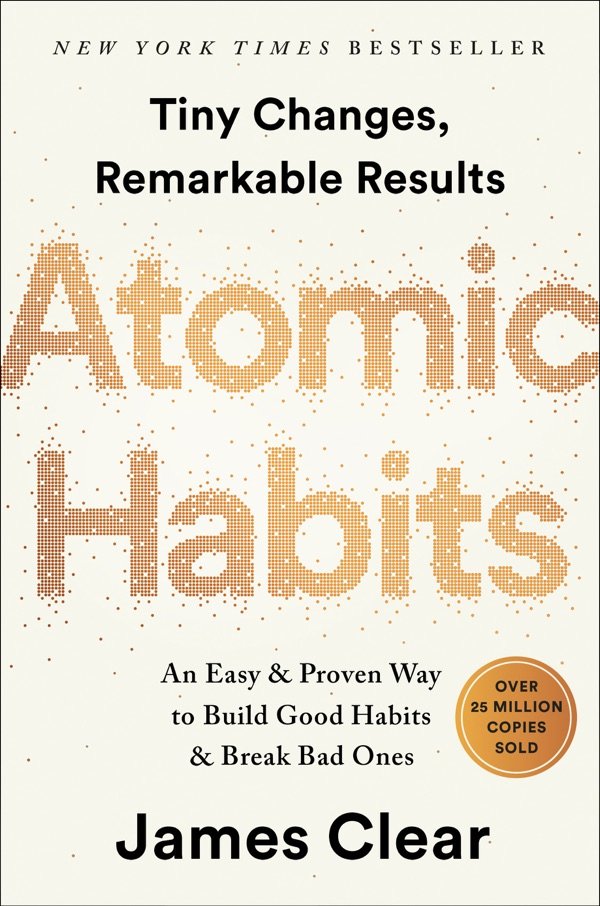
Atomic Habits: An Easy & Proven Way to Build Good Habits & Break Bad Ones
von James Clear
One of the best ways to build a new habit is to identify a current habit you already do each day and then stack your new behavior on top. This is called habit stacking. Habit stacking is a special form of an implementation intention. Rather than pairing your new habit with a particular time and location, you pair it with a current habit. The most effective way to change your habits is to focus not on what you want to achieve, but on who you wish to become. Your identity emerges out of your habits. Every action is a vote for the type of person you wish to become. Becoming the best version of yourself requires you to continuously edit your beliefs, and to upgrade and expand your identity. The real reason habits matter is not because they can get you better results (although they can do that), but because they can change your beliefs about yourself.
One of the best ways to build a new habit is to identify a current habit you already do each day and then stack your new behavior on top. This is called habit stacking. Habit stacking is a special form of an implementation intention. Rather than pairing your new habit with a particular time and location, you pair it with a current habit.
Diderot’s behavior is not uncommon. In fact, the tendency for one purchase to lead to another one has a name: the Diderot Effect. The Diderot Effect states that obtaining a new possession often creates a spiral of consumption that leads to additional purchases.
The purpose of setting goals is to win the game. The purpose of building systems is to continue playing the game. True long-term thinking is goal-less thinking. It’s not about any single accomplishment. It is about the cycle of endless refinement and continuous improvement. Ultimately, it is your commitment to the process that will determine your progress.
The purpose of setting goals is to win the game. The purpose of building systems is to continue playing the game. True long-term thinking is goal-less thinking. It’s not about any single accomplishment. It is about the cycle of endless refinement and continuous improvement. Ultimately, it is your commitment to the process that will determine your progress.
Whenever you face a problem repeatedly, your brain begins to automate the process of solving it. Your habits are just a series of automatic solutions that solve the problems and stresses you face regularly. As behavioral scientist Jason Hreha writes, “Habits are, simply, reliable solutions to recurring problems in our environment.”
"One of the best ways to build a new habit is to identify a current habit you already do each day and then stack your new behavior on top. This is called habit stacking. Habit stacking is a special form of an implementation intention. Rather than pairing your new habit with a particular time and location, you pair it with a current habit."
"The most effective way to change your habits is to focus not on what you want to achieve, but on who you wish to become. Your identity emerges out of your habits. Every action is a vote for the type of person you wish to become. Becoming the best version of yourself requires you to continuously edit your beliefs, and to upgrade and expand your identity. The real reason habits matter is not because they can get you better results (although they can do that), but because they can change your beliefs about yourself."
"Every Olympian wants to win a gold medal. Every candidate wants to get the job. And if successful and unsuccessful people share the same goals, then the goal cannot be what differentiates the winners from the losers. It wasn’t the goal of winning the Tour de France that propelled the British cyclists to the top of the sport. Presumably, they had wanted to win the race every year before—just like every other professional team. The goal had always been there. It was only when they implemented a system of continuous small improvements that they achieved a different outcome."
"Diderot’s behavior is not uncommon. In fact, the tendency for one purchase to lead to another one has a name: the Diderot Effect. The Diderot Effect states that obtaining a new possession often creates a spiral of consumption that leads to additional purchases."
"This is one of the core reasons why it is so hard to build habits that last. People make a few small changes, fail to see a tangible result, and decide to stop. You think, “I’ve been running every day for a month, so why can’t I see any change in my body?” Once this kind of thinking takes over, it’s easy to let good habits fall by the wayside. But in order to make a meaningful difference, habits need to persist long enough to break through this plateau—what I call the Plateau of Latent Potential."
"The backbone of this book is my four-step model of habits—cue, craving, response, and reward—and the four laws of behavior change that evolve out of these steps. Readers with a psychology background may recognize some of these terms from operant conditioning, which was first proposed as “stimulus, response, reward” by B. F. Skinner in the 1930s and has been popularized more recently as “cue, routine, reward” in The Power of Habit by Charles Duhigg."
"These are big questions, and many people aren’t sure where to begin—but they do know what kind of results they want: to get six-pack abs or to feel less anxious or to double their salary. That’s fine. Start there and work backward from the results you want to the type of person who could get those results. Ask yourself, “Who is the type of person that could get the outcome I want?” Who is the type of person that could lose forty pounds? Who is the type of person that could learn a new language? Who is the type of person that could run a successful start-up?"
- →One of the best ways to build a new habit is to identify a current habit you already do each day and then stack your new behavior on top. This is called habit stacking. Habit stacking is a special form of an implementation intention. Rather than pairing your new habit with a particular time and location, you pair it with a current habit.
- →Whenever you face a problem repeatedly, your brain begins to automate the process of solving it. Your habits are just a series of automatic solutions that solve the problems and stresses you face regularly. As behavioral scientist Jason Hreha writes, “Habits are, simply, reliable solutions to recurring problems in our environment.”
- →You do not rise to the level of your goals. You fall to the level of your systems.
Ähnliche Bücher gesucht?
Beschreibe deine Situation. Die Suche findet das passende Buch aus der gesamten Bibliothek.