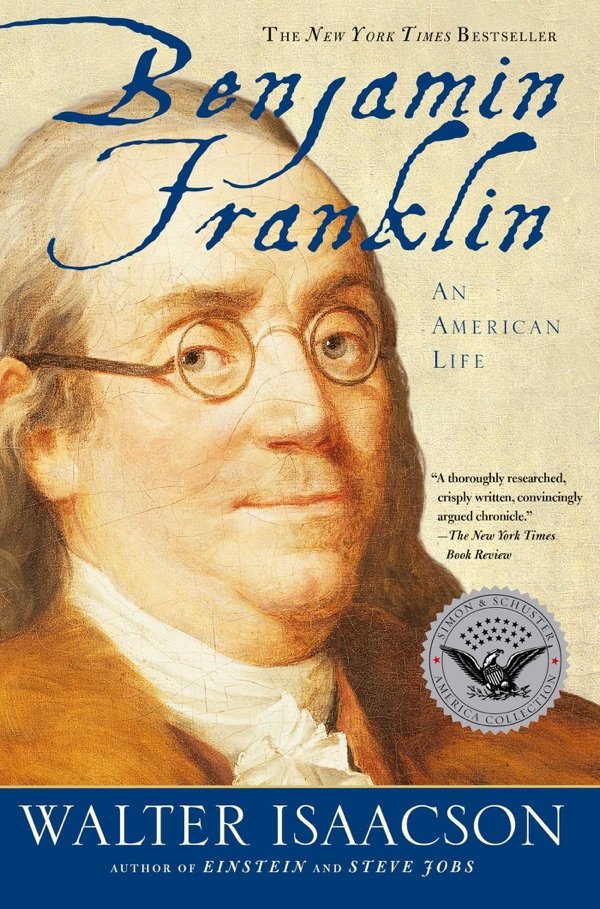
Benjamin Franklin: An American Life
von Walter Isaacson
And thus the Puritan migration established the foundation for some characteristics of Benjamin Franklin, and of America itself: a belief that spiritual salvation and secular success need not be at odds, that industriousness is next to godliness, and that free thought and free enterprise are integrally related. “Printers are educated in the belief that when men differ in opinion, both sides ought equally to have the advantage of being heard by the public; and that when Truth and Error have fair play, the former is always an overmatch for the latter.”
And thus the Puritan migration established the foundation for some characteristics of Benjamin Franklin, and of America itself: a belief that spiritual salvation and secular success need not be at odds, that industriousness is next to godliness, and that free thought and free enterprise are integrally related.
“Printers are educated in the belief that when men differ in opinion, both sides ought equally to have the advantage of being heard by the public; and that when Truth and Error have fair play, the former is always an overmatch for the latter.”
A secret to being more revered than resented, he learned, was to display (at least when he could muster the discipline) a self-deprecating humor, unpretentious demeanor, and unaggressive style in conversation.
By asking what seemed to be innocent questions, Franklin would draw people into making concessions that would gradually prove whatever point he was trying to assert.
Knowledge, he realized, “was obtained rather by the use of the ear than of the tongue.” So in the Junto, he began to work on his use of silence and gentle dialogue.
"And thus the Puritan migration established the foundation for some characteristics of Benjamin Franklin, and of America itself: a belief that spiritual salvation and secular success need not be at odds, that industriousness is next to godliness, and that free thought and free enterprise are integrally related."
"“Printers are educated in the belief that when men differ in opinion, both sides ought equally to have the advantage of being heard by the public; and that when Truth and Error have fair play, the former is always an overmatch for the latter.”"
"A secret to being more revered than resented, he learned, was to display (at least when he could muster the discipline) a self-deprecating humor, unpretentious demeanor, and unaggressive style in conversation."
"By asking what seemed to be innocent questions, Franklin would draw people into making concessions that would gradually prove whatever point he was trying to assert."
"Knowledge, he realized, “was obtained rather by the use of the ear than of the tongue.” So in the Junto, he began to work on his use of silence and gentle dialogue."
"His morality was built on a sincere belief in leading a virtuous life, serving the country he loved, and hoping to achieve salvation through good works."
"“So convenient a thing it is to be a reasonable creature, since it enables one to find or make a reason for everything one has a mind to do.”"
- →“Printers are educated in the belief that when men differ in opinion, both sides ought equally to have the advantage of being heard by the public; and that when Truth and Error have fair play, the former is always an overmatch for the latter.”
- →Knowledge, he realized, “was obtained rather by the use of the ear than of the tongue.” So in the Junto, he began to work on his use of silence and gentle dialogue.
- →“So convenient a thing it is to be a reasonable creature, since it enables one to find or make a reason for everything one has a mind to do.”
- →“He that has once done you a kindness will be more ready to do you another, than he whom you yourself have obliged.”
Ähnliche Bücher gesucht?
Beschreibe deine Situation. Die Suche findet das passende Buch aus der gesamten Bibliothek.