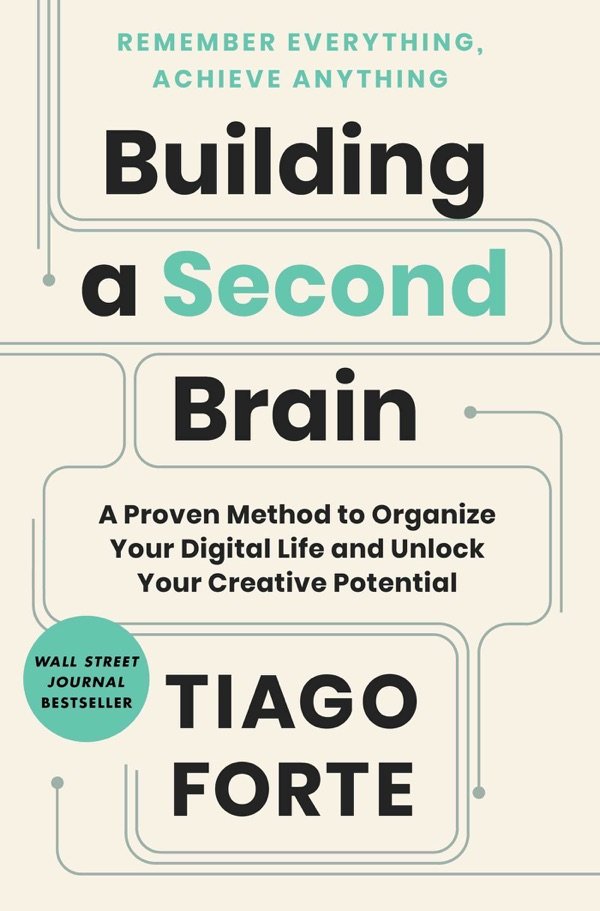
Building a Second Brain: A Proven Method to Organize Your Digital Life and Unlock Your Creative Potential
von Tiago Forte
How do you create a Hemingway Bridge? Instead of burning through every last ounce of energy at the end of a work session, reserve the last few minutes to write down some of the following kinds of things in your digital notes: Write down ideas for next steps: At the end of a work session, write down what you think the next steps could be for the next one. Write down the current status: This could include your current biggest challenge, most important open question, or future roadblocks you expect. Write down any details you have in mind that are likely to be forgotten once you step away: Such as details about the characters in your story, the pitfalls of the event you’re planning, or the subtle considerations of the product you’re designing. Write out your intention for the next work session: Set an intention for what you plan on tackling next, the problem you intend to solve, or a certain milestone you want to reach. How do I live less in the past, and more in the present? How do I build an investment strategy that is aligned with my mid-term and long-term goals and commitments? What does it look like to move from mindless consumption to mindful creation? How can I go to bed early instead of watching shows after the kids go to bed? How can my industry become more ecologically sustainable while remaining profitable? How can I work through the fear I have of taking on more responsibility? How can my school provide more resources for students with special needs? How do I start reading all the books I already have instead of buying more? How can I speed up and relax at the same time? How can we make the healthcare system more responsive to people’s needs? What can I do to make eating healthy easier? How can I make decisions with more confidence?
A project-centric way of working comes naturally in the creative and performing arts. Artists have paintings, dancers have dances, musicians have songs, and poets have poems. These are clearly identifiable, discrete chunks of work. This project-centric approach is increasingly finding its way into all knowledge work, a trend named the “Hollywood model” after the way films are made.
With the PARA system, every piece of information you want to save can be placed into one of just four categories: Projects: Short-term efforts in your work or life that you’re working on now. Areas: Long-term responsibilities you want to manage over time. Resources: Topics or interests that may be useful in the future. Archives: Inactive items from the other three categories.
You have to keep a dozen of your favorite problems constantly present in your mind, although by and large they will lay in a dormant state. Every time you hear or read a new trick or a new result, test it against each of your twelve problems to see whether it helps. Every once in a while there will be a hit, and people will say, “How did he do it? He must be a genius!”
I learned that creating new things is what really matters. I’d see a fire light up in people’s eyes when they reached the finish line and published that slideshow or exported that video or printed that résumé. The newfound confidence they had in themselves was unmistakable as they walked out of the store knowing they had everything they needed to move forward.
My mentor advised me to “move quickly and touch lightly” instead. To look for the path of least resistance and make progress in short steps. I want to give the same advice to you: don’t make organizing your Second Brain into yet another heavy obligation. Ask yourself: “What is the smallest, easiest step I can take that moves me in the right direction?”
"How do you create a Hemingway Bridge? Instead of burning through every last ounce of energy at the end of a work session, reserve the last few minutes to write down some of the following kinds of things in your digital notes: Write down ideas for next steps: At the end of a work session, write down what you think the next steps could be for the next one. Write down the current status: This could include your current biggest challenge, most important open question, or future roadblocks you expect. Write down any details you have in mind that are likely to be forgotten once you step away: Such as details about the characters in your story, the pitfalls of the event you’re planning, or the subtle considerations of the product you’re designing. Write out your intention for the next work session: Set an intention for what you plan on tackling next, the problem you intend to solve, or a certain milestone you want to reach."
"How do I live less in the past, and more in the present? How do I build an investment strategy that is aligned with my mid-term and long-term goals and commitments? What does it look like to move from mindless consumption to mindful creation? How can I go to bed early instead of watching shows after the kids go to bed? How can my industry become more ecologically sustainable while remaining profitable? How can I work through the fear I have of taking on more responsibility? How can my school provide more resources for students with special needs? How do I start reading all the books I already have instead of buying more? How can I speed up and relax at the same time? How can we make the healthcare system more responsive to people’s needs? What can I do to make eating healthy easier? How can I make decisions with more confidence?"
"There are five kinds of Intermediate Packets you can create and reuse in your work: Distilled notes: Books or articles you’ve read and distilled so it’s easy to get the gist of what they contain (using the Progressive Summarization technique you learned in the previous chapter, for example). Outtakes: The material or ideas that didn’t make it into a past project but could be used in future ones. Work-in-process: The documents, graphics, agendas, or plans you produced during past projects. Final deliverables: Concrete pieces of work you’ve delivered as part of past projects, which could become components of something new. Documents created by others: Knowledge assets created by people on your team, contractors or consultants, or even clients or customers, that you can reference and incorporate into your work."
"Noticing when an idea you’re reading about resonates with you and taking those extra few seconds to highlight it. Noticing that a note could use a better title—and changing it so it’s easier for your future self to find it. Noticing you could move or link a note to another project or area where it will be more useful. Noticing opportunities to combine two or more Intermediate Packets into a new, larger work so you don’t have to start it from scratch. Noticing a chance to merge similar content from different notes into the same note so it’s not spread around too many places. Noticing when an IP that you already have could help someone else solve a problem, and sharing it with them, even if it’s not perfect."
"Over time, your ability to quickly tap these creative assets and combine them into something new will make all the difference in your career trajectory, business growth, and even quality of life. In the short term, it might not matter. You might be able to scramble and put together a particular document right when you need it, but there will be a slowly accumulating, invisible cost. The cost of not being quite sure whether you have what you need. The stress of wondering whether you’ve already completed a task before. There is a cost to your sleep, your peace of mind, and your time with family when the full burden of constantly coming up with good ideas rests solely on your fickle biological brain."
"Unlike modern readers, who follow the flow of a narrative from beginning to end, early modern Englishmen read in fits and starts and jumped from book to book. They broke texts into fragments and assembled them into new patterns by transcribing them in different sections of their notebooks. Then they reread the copies and rearranged the patterns while adding more excerpts. Reading and writing were therefore inseparable activities. They belonged to a continuous effort to make sense of things, for the world was full of signs: you could read your way through it; and by keeping an account of your readings, you made a book of your own, one stamped with your personality.*"
"In an interview about how she wrote the smash hit “Blank Space,”3 Swift says, “I’ll be going about my daily life and I’ll think, ‘Wow, so we only have two real options in relationships—it’s going to be forever or it’s going to go down in flames,’ so I’ll jot that down in my notes . . . I’ll come up with a line that I think is clever like ‘Darling I’m a nightmare dressed like a daydream’ and I just pick them and put them where they fit and construct the bridge out of more lines that come up within the last couple of years . . . ‘Blank Space’ was the culmination of all my best ones one after the other.”"
- →Waiting until you have everything ready before getting started is like sitting in your car and waiting to leave your driveway until all the traffic lights across town are green at the same time. You can’t wait until everything is perfect. There will always be something missing, or something else you think you need.
- →The key thing to keep in mind is that these categories are anything but final. PARA is a dynamic, constantly changing system, not a static one. Your Second Brain evolves as constantly as your projects and goals change, which means you never have to worry about getting it perfect, or having it finished.
- →They had repeatedly postponed their creative ambitions to some far-off, mythical time when somehow everything would be perfectly in order. Once we set that aside and just focused on what they actually wanted to do right now, they suddenly gained a tremendous sense of clarity and motivation.
- →This is a challenging idea for a lot of people to wrap their head around. We are used to organizational systems that are static and fixed. We expect to find a strict set of rules that tells us exactly where each item goes, like the precise call numbers for books in a library.
Ähnliche Bücher gesucht?
Beschreibe deine Situation. Die Suche findet das passende Buch aus der gesamten Bibliothek.