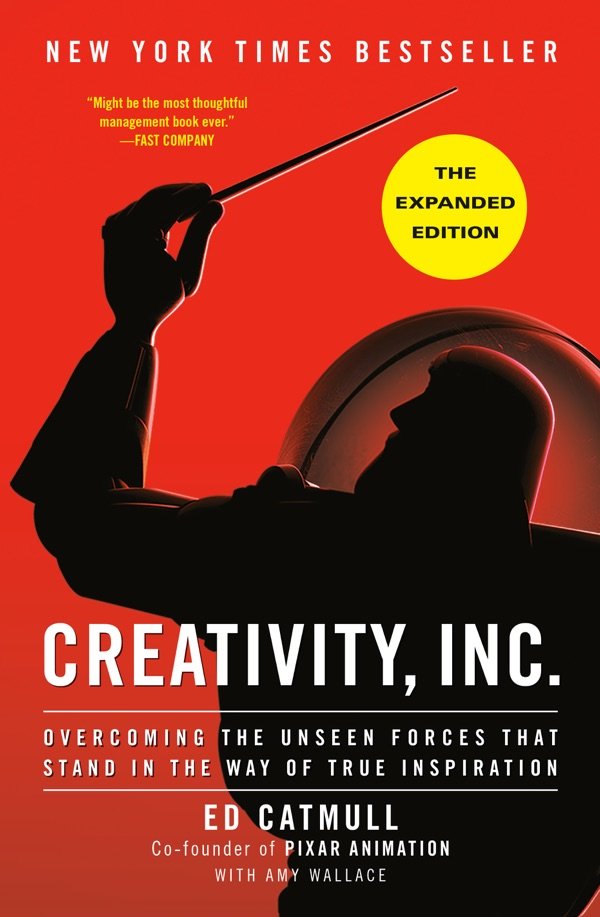
Creativity, Inc.: Overcoming the Unseen Forces That Stand in the Way of True Inspiration
von Ed Catmull
I often say that managers of creative enterprises must hold lightly to goals and firmly to intentions. What does that mean? It means that we must be open to having our goals change as we learn new information or are surprised by things we thought we knew but didn’t. As long as our intentions—our values—remain constant, our goals can shift as needed. It is one of life’s cruel ironies that when it comes to feeding the Beast, success only creates more pressure to hurry up and succeed again. Which is why at too many companies, the schedule (that is, the need for product) drives the output, not the strength of the ideas at the front end. I want to be careful not to imply that it is the individual people who comprise the Beast who are the problem—they are doing the best they can to accomplish what they’ve been charged with doing. Despite good intentions, the result is troubling: Feeding the Beast becomes the central focus.
I often say that managers of creative enterprises must hold lightly to goals and firmly to intentions. What does that mean? It means that we must be open to having our goals change as we learn new information or are surprised by things we thought we knew but didn’t. As long as our intentions—our values—remain constant, our goals can shift as needed.
Ideas come from people. Therefore, people are more important than ideas.
If you give a good idea to a mediocre team, they will screw it up. If you give a mediocre idea to a brilliant team, they will either fix it or throw it away and come up with something better.
You are being driven by the desire to avoid it. And, for leaders especially, this strategy-trying to avoid failure by outthinking itdooms you to fail. As Andrew puts it, "Moving things forward allows the team you are leading to feel like, 'Oh, I'm on a boat that is actually going towards land.' As opposed to having a leader who says, 'I'm still not sure.
The definition of superb animation is that each character on the screen makes you believe it is a thinking being. Whether it's a T-Rex or a slinky dog or a desk lamp, if viewers sense not just movement but intention—or, put another way, emotion—then the animator has done his or her job. It's not just lines on paper anymore; it's a living, feeling entity
"I often say that managers of creative enterprises must hold lightly to goals and firmly to intentions. What does that mean? It means that we must be open to having our goals change as we learn new information or are surprised by things we thought we knew but didn’t. As long as our intentions—our values—remain constant, our goals can shift as needed."
"It is one of life’s cruel ironies that when it comes to feeding the Beast, success only creates more pressure to hurry up and succeed again. Which is why at too many companies, the schedule (that is, the need for product) drives the output, not the strength of the ideas at the front end. I want to be careful not to imply that it is the individual people who comprise the Beast who are the problem—they are doing the best they can to accomplish what they’ve been charged with doing. Despite good intentions, the result is troubling: Feeding the Beast becomes the central focus."
"“In many ways, the work of a critic is easy,” Ego says. “We risk very little yet enjoy a position over those who offer up their work and their selves to our judgment. We thrive on negative criticism, which is fun to write and to read. But the bitter truth we critics must face is that in the grand scheme of things, the average piece of junk is probably more meaningful than our criticism designating it so. But there are times when a critic truly risks something, and that is in the discovery and defense of the new. The world is often unkind to new talent, new creations. The new needs friends.”"
"Ideas come from people. Therefore, people are more important than ideas."
"If you give a good idea to a mediocre team, they will screw it up. If you give a mediocre idea to a brilliant team, they will either fix it or throw it away and come up with something better."
"There is an alternative approach to being wrong as fast as you can. It is the notion that if you carefully think everything through, e meticulous and plan well and consider all possible outcomes, you are more likely to create a lasting product. But I should caution that if you seek to plot out all your moves before you make them if you put your faith in slow, deliberative planning in the hopes it will spare you failure down the line-well, you're deluding yourself. For one thing, it's easier to plan derivative work-things that copy or repeat something already out there. So if your primary goal is to have a fully worked out, set-in-stone plan, you are only upping your chances of being unoriginal. Moreover, you cannot plan your way out of problems"
"When we trust the process, we remember that we are resilient, that we've experienced discouragement before, only to come out the other side. When we trust the process-or perhaps more accurately, when we trust the people who use the process-we are optimistic but also realistic. The trust comes from knowing that we are safe, that our colleagues will not judge us for failures but will encourage us to keep pushing the boundaries. But to me, the key is not to let this trust, our faith, lull us into the abdication of personal responsibility. When that happens, we fall into dull repetition, producing empty versions of what was made before."
- →What makes Pixar special is that we acknowledge we will always have problems, many of them hidden from our view; that we work hard to uncover these problems, even if doing so means making ourselves uncomfortable; and that, when we come across a problem, we marshal all of our energies to solve it.
- →What makes Pixar special is that we acknowledge we will always have problems, many of them hidden from our view; that we work hard to uncover these problems, even if doing so means making ourselves uncomfortable; and that, when we come across a problem, we marshal all of our energies to solve it.
- →What interested me was not that companies rose and fell or that the landscape continually shifted as technology changed but that the leaders of these companies seemed so focused on the competition that they never developed any deep introspection about other destructive forces that were at work.
- →Creativity has to start somewhere, and we are true believers in the power of bracing, candid feedback and the iterative process reworking, reworking, and reworking again, until a flawed story finds its throughline or a hollow character finds its soul.
Ähnliche Bücher gesucht?
Beschreibe deine Situation. Die Suche findet das passende Buch aus der gesamten Bibliothek.