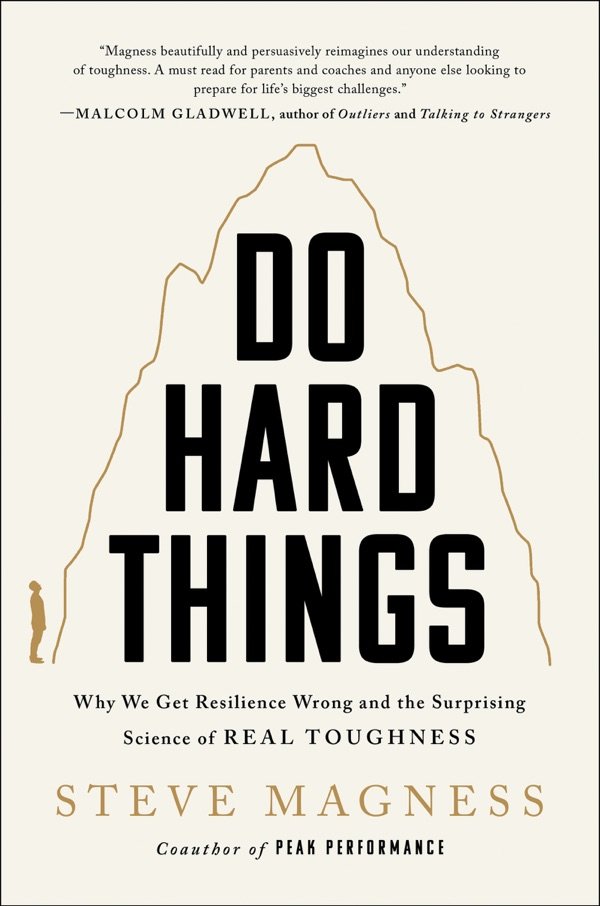
Do Hard Things: Why We Get Resilience Wrong and the Surprising Science of Real Toughness
von Steve Magness
Feelings are messengers that nudge. They are our body saying, “Hmm . . . something is different,” before sending us on a quest to figure out why we feel a certain way. Emotions, on the other hand, are more complex. They require context and meaning. To go from simple displeasure to sadness, we need to know what sadness entails. We combine a raw sensation (pleasure) with what else is going on in our internal and external world, add in a dash of experience, and all of a sudden, we feel our version of the emotion love. If feelings are meant to inform and nudge, emotions are the alarm bells, screaming at you that something changed and that you need to do something about it. Emotions move us from nudge to shove. We take fewer risks, playing to not lose instead of playing to win. On the other hand, if we see the stressor as an opportunity for growth or gain, as something that is difficult but that we can handle, we’re more likely to experience a challenge response. Instead of relying mostly on cortisol, our body releases more testosterone and adrenaline. We shift toward figuring out how to win the game, how to accomplish our goal. It’s not that challenge or threat responses are good or bad; they each have a specific purpose.
Toughness is about embracing the reality of where we are and what we have to do. Not deluding ourselves, filling ourselves with a false confidence, or living in denial. All of that simply sends us sprinting off the line, only to slow to a walk once reality hits. Being tough begins long before we enter the arena or walk on stage. It starts with our expectations.
In discussing with the athletes afterward, it was clear the better runners needed freedom. They wanted to explore their limits and be in charge of how they did. For the not-quite-as-fast runners, reducing the task to either persist or quit simplified their goal. They could maintain focus on one thing, to just keep going, which helped their performance.
Inner drive brings clarity, allowing you to listen to your body so that you can make the right decision during difficult moments. Whether your goal is to improve your persistence or develop the ability to reengage once a goal seems to be lost, motivation coming from within appears to be the special sauce. Psychologists call it autonomous motivation.
Instead, real toughness is experiencing discomfort or distress, leaning in, paying attention, and creating space to take thoughtful action. It’s maintaining a clear head to be able to make the appropriate decision. Toughness is navigating discomfort to make the best decision you can.
Social psychologist Heidi Wayment has pioneered the idea of a quiet ego. As she told Scientific American, with a quiet ego, “the volume of the ego is turned down so that it might listen to others as well as the self in an effort to approach life more humanely and compassionately.”
"Feelings are messengers that nudge. They are our body saying, “Hmm . . . something is different,” before sending us on a quest to figure out why we feel a certain way. Emotions, on the other hand, are more complex. They require context and meaning. To go from simple displeasure to sadness, we need to know what sadness entails. We combine a raw sensation (pleasure) with what else is going on in our internal and external world, add in a dash of experience, and all of a sudden, we feel our version of the emotion love. If feelings are meant to inform and nudge, emotions are the alarm bells, screaming at you that something changed and that you need to do something about it. Emotions move us from nudge to shove."
"We take fewer risks, playing to not lose instead of playing to win. On the other hand, if we see the stressor as an opportunity for growth or gain, as something that is difficult but that we can handle, we’re more likely to experience a challenge response. Instead of relying mostly on cortisol, our body releases more testosterone and adrenaline. We shift toward figuring out how to win the game, how to accomplish our goal. It’s not that challenge or threat responses are good or bad; they each have a specific purpose."
"Like the fist-bump research, the magic isn’t in the activity itself. The lesson isn’t to have team dinners but to create a place for bonding and trust to develop. Popovich utilizes his power of conversation and passion for food and wine to create an environment where people want to be. He invited them into a world he truly cares about and lets his passion infect others. The time and care spent creating the perfect dinner makes people want to attend."
"“The desire for control is not something we acquire through learning, but rather, is innate, and thus likely biologically motivated. We are born to choose.” We have a basic underlying need to have some semblance of control over whatever we’re tackling. Constraining and controlling workplaces take that away, nudging us toward quitting at the first sign of discomfort. Autonomy is the switch that allows us to persist."
"Toughness is about embracing the reality of where we are and what we have to do. Not deluding ourselves, filling ourselves with a false confidence, or living in denial. All of that simply sends us sprinting off the line, only to slow to a walk once reality hits. Being tough begins long before we enter the arena or walk on stage. It starts with our expectations."
"In discussing with the athletes afterward, it was clear the better runners needed freedom. They wanted to explore their limits and be in charge of how they did. For the not-quite-as-fast runners, reducing the task to either persist or quit simplified their goal. They could maintain focus on one thing, to just keep going, which helped their performance."
"Inner drive brings clarity, allowing you to listen to your body so that you can make the right decision during difficult moments. Whether your goal is to improve your persistence or develop the ability to reengage once a goal seems to be lost, motivation coming from within appears to be the special sauce. Psychologists call it autonomous motivation."
- →Our appraisal of a situation as a threat or as a challenge depends on the perceived demands of that stressor versus our perceived abilities to handle them. Do we have the resources to handle the demands?
- →Recent research found that those who tend to shout the loudest—both in person and online—do so because they lack inner confidence.
Ähnliche Bücher gesucht?
Beschreibe deine Situation. Die Suche findet das passende Buch aus der gesamten Bibliothek.