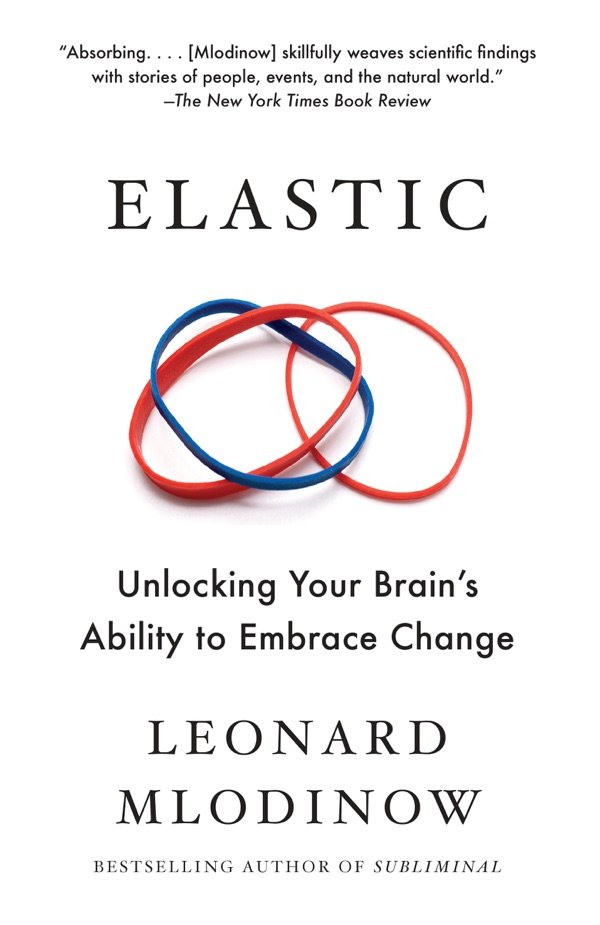
Elastic: Flexible Thinking in a Time of Change
von Leonard Mlodinow
Today we consume, on average, a staggering 100,000 words of new information each day from various media—the equivalent of a three-hundred-page book. That’s compared with about 28,000 a few decades ago. Often, as in these riddles, that is because no solution exists within the framework in which people have thought about them—but a solution could be found if one adopted a new point of view.
Today we consume, on average, a staggering 100,000 words of new information each day from various media—the equivalent of a three-hundred-page book. That’s compared with about 28,000 a few decades ago.
Often, as in these riddles, that is because no solution exists within the framework in which people have thought about them—but a solution could be found if one adopted a new point of view.
Luckily, there is a remedy for choice overload. One can employ a decision-making strategy in which one accepts the first satisfactory option, rather than continuing to look for a superior one. Psychologists call those who do the former “satisficers,” as opposed to “maximizers,” who always try to choose the best.
So if you find that you can sit down, focus, and grind through your spreadsheets, professional reading, and other analytical work with maximum efficiency in either the morning or the evening, there is a good physiological explanation. But the French study suggests a new wrinkle to that: Your elastic thinking ability may peak at the other end of the day, when your analytical powers are weakest.
Research suggests that, when faced with too many choices or too many decisions to make, we experience a “choice overload,” analogous to the “information overload” so famous in our current age. Both types of overload stimulate the primitive parts of your brain that respond to fear in life-and-death situations, depleting your mental resources, causing stress, and undermining your self-control.
"Today we consume, on average, a staggering 100,000 words of new information each day from various media—the equivalent of a three-hundred-page book. That’s compared with about 28,000 a few decades ago."
"Often, as in these riddles, that is because no solution exists within the framework in which people have thought about them—but a solution could be found if one adopted a new point of view."
"Luckily, there is a remedy for choice overload. One can employ a decision-making strategy in which one accepts the first satisfactory option, rather than continuing to look for a superior one. Psychologists call those who do the former “satisficers,” as opposed to “maximizers,” who always try to choose the best."
"We are adept at confronting novelty and change because, when faced with an unfamiliar obstacle to achieving our goals, our emotion-based reward system guides us toward elastic thinking, stimulating us to generate alternative ideas and invent a way to choose from among them. When that system doesn’t function, we cannot make choices. The lesson of EVR is that emotions, especially pleasure, do not just make our lives rich—they are an integral ingredient in our ability to face the challenges of our environment. Perhaps the elusive key to success in artificial intelligence is to learn to build a computer that solves problems because it enjoys solving them."
"There are certain talents that can help us, qualities of thought that have always been useful but are now becoming essential. For example: the capacity to let go of comfortable ideas and become accustomed to ambiguity and contradiction; the capability to rise above conventional mind-sets and to reframe the questions we ask; the ability to abandon our ingrained assumptions and open ourselves to new paradigms; the propensity to rely on imagination as much as on logic and to generate and integrate a wide variety of ideas; and the willingness to experiment and be tolerant of failure."
"Our culture can provide an approach to issues that will help us see solutions, but it can also hinder us. A strong cultural identity, if it produces a deeply ingrained approach to problems, can make it more difficult to change that approach, even if it is not working. On the other hand, exposing yourself to other cultures is beneficial, because those who grew up in or work within a different culture will often have different attitudes toward life, and studies show that simply interacting with such people can open our minds and increase our elasticity of thought."
"The game’s massive success might not have been predictable, but neither was it accidental. In creating the app, Niantic made a series of innovative and forward-thinking decisions concerning the use of technology, such as piggybacking on the GPS and camera capabilities of a cell phone and leveraging cloud computing to power the app, which provided a built-in infrastructure and a capacity to scale. The game also took advantage, like nothing before it, of app-store economics, a business model that hadn’t even been invented when World of Warcraft launched."
- →Often, as in these riddles, that is because no solution exists within the framework in which people have thought about them—but a solution could be found if one adopted a new point of view.
- →Luckily, there is a remedy for choice overload. One can employ a decision-making strategy in which one accepts the first satisfactory option, rather than continuing to look for a superior one. Psychologists call those who do the former “satisficers,” as opposed to “maximizers,” who always try to choose the best.
- →Our species today ought to possess a gene or a set of genes that drives us to be discontented with the status quo, to seek the new and unfamiliar. Scientists found just such a gene in 1996. It is called DRD4, for “dopamine receptor gene D4,” because it affects the way the brain responds to dopamine.
- →For those who are interested, one can practice taking control. Just Google “remote associates test” and take some of the tests you’ll find offered online. You can decide, in each instance, whether to focus on an analytical or an elastic approach, and observe the difference in your thinking.
Ähnliche Bücher gesucht?
Beschreibe deine Situation. Die Suche findet das passende Buch aus der gesamten Bibliothek.