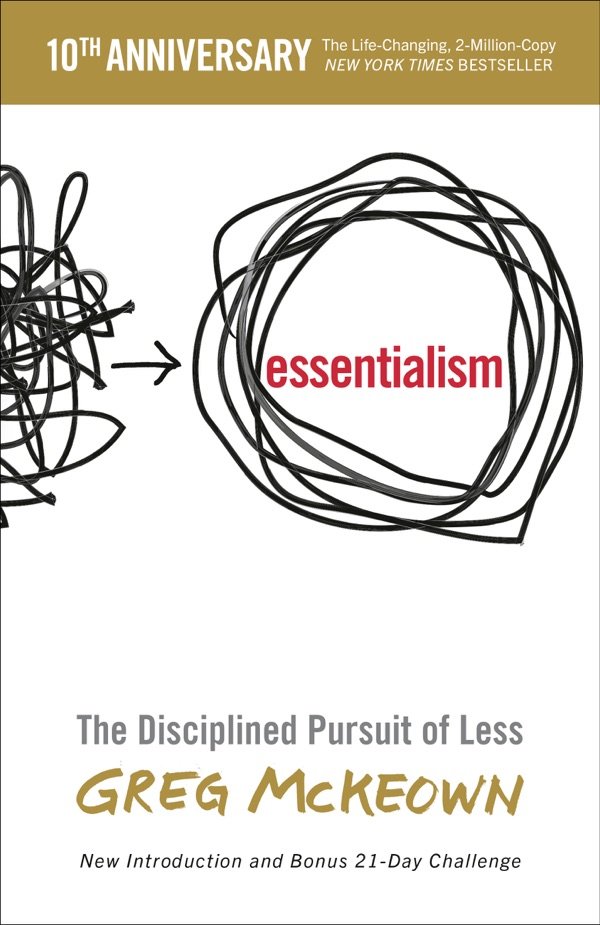
Essentialism: The Disciplined Pursuit of Less
von Greg McKeown
But when we try to do it all and have it all, we find ourselves making trade-offs at the margins that we would never take on as our intentional strategy. When we don’t purposefully and deliberately choose where to focus our energies and time, other people—our bosses, our colleagues, our clients, and even our families—will choose for us, and before long we’ll have lost sight of everything that is meaningful and important. We can either make our choices deliberately or allow other people’s agendas to control our lives. MAKE YOUR PEACE WITH THE FACT THAT SAYING “NO” OFTEN REQUIRES TRADING POPULARITY FOR RESPECT When you say no, there is usually a short-term impact on the relationship. After all, when someone asks for something and doesn’t get it, his or her immediate reaction may be annoyance or disappointment or even anger. This downside is clear. The potential upside, however, is less obvious: when the initial annoyance or disappointment or anger wears off, the respect kicks in. When we push back effectively, it shows people that our time is highly valuable.
Working hard is important. But more effort does not necessarily yield more results. “Less but better” does.
Essentialism is not about how to get more things done; it’s about how to get the right things done. It doesn’t mean just doing less for the sake of less either. It is about making the wisest possible investment of your time and energy in order to operate at our highest point of contribution by doing only what is essential.
To embrace the essence of Essentialism requires we replace these false assumptions with three core truths: “I choose to,” “Only a few things really matter,” and “I can do anything but not everything.”
When there is a serious lack of clarity about what the team stands for and what their goals and roles are, people experience confusion, stress, and frustration. When there is a high level of clarity, on the other hand, people thrive.
Essentialists spend as much time as possible exploring, listening, debating, questioning, and thinking. But their exploration is not an end in itself. The purpose of the exploration is to discern the vital few from the trivial many.
"But when we try to do it all and have it all, we find ourselves making trade-offs at the margins that we would never take on as our intentional strategy. When we don’t purposefully and deliberately choose where to focus our energies and time, other people—our bosses, our colleagues, our clients, and even our families—will choose for us, and before long we’ll have lost sight of everything that is meaningful and important. We can either make our choices deliberately or allow other people’s agendas to control our lives."
"MAKE YOUR PEACE WITH THE FACT THAT SAYING “NO” OFTEN REQUIRES TRADING POPULARITY FOR RESPECT When you say no, there is usually a short-term impact on the relationship. After all, when someone asks for something and doesn’t get it, his or her immediate reaction may be annoyance or disappointment or even anger. This downside is clear. The potential upside, however, is less obvious: when the initial annoyance or disappointment or anger wears off, the respect kicks in. When we push back effectively, it shows people that our time is highly valuable."
"Working hard is important. But more effort does not necessarily yield more results. “Less but better” does."
"Essentialism is not about how to get more things done; it’s about how to get the right things done. It doesn’t mean just doing less for the sake of less either. It is about making the wisest possible investment of your time and energy in order to operate at our highest point of contribution by doing only what is essential."
"To embrace the essence of Essentialism requires we replace these false assumptions with three core truths: “I choose to,” “Only a few things really matter,” and “I can do anything but not everything.”"
"In The Tao of Warren Buffett, Mary Buffett and David Clark explain: “Warren decided early in his career it would be impossible for him to make hundreds of right investment decisions, so he decided that he would invest only in the businesses that he was absolutely sure of, and then bet heavily on them. He owes 90% of his wealth to just ten investments. Sometimes what you don’t do is just as important as what you do.”6 In short, he makes big bets on the essential few investment opportunities and says no to the many merely good ones."
"The way of the Essentialist means living by design, not by default. Instead of making choices reactively, the Essentialist deliberately distinguishes the vital few from the trivial many, eliminates the nonessentials, and then removes obstacles so the essential things have clear, smooth passage. In other words, Essentialism is a disciplined, systematic approach for determining where our highest point of contribution lies, then making execution of those things almost effortless."
- →To embrace the essence of Essentialism requires we replace these false assumptions with three core truths: “I choose to,” “Only a few things really matter,” and “I can do anything but not everything.”
- →Essentialists see trade-offs as an inherent part of life, not as an inherently negative part of life. Instead of asking, “What do I have to give up?” they ask, “What do I want to go big on?”
Ähnliche Bücher gesucht?
Beschreibe deine Situation. Die Suche findet das passende Buch aus der gesamten Bibliothek.