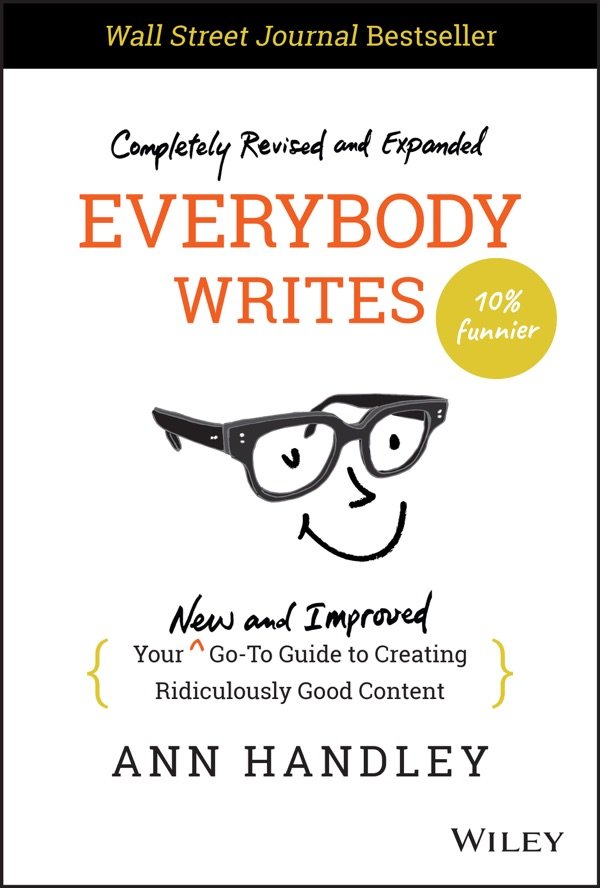
Everybody Writes: Your Go-To Guide to Creating Ridiculously Good Content
von Ann Handley
Words matter. Your words (what you say) and style (how you say it) are your most cherished (and, yet, undervalued) assets. Finding the best fit for your message. Do we need more or fewer words? Would a chart or graphic or visual convey an idea more simply? Would a video convey what we are trying to say more directly? Designing with your words, rather than fitting words into a design. This isn't a book on design, of course. Nonetheless, the visual treatment of words on a page (digital or actual) can greatly enhance their effectiveness. So here are two things to keep in mind: White space is a prerequisite, not a luxury.
Words matter. Your words (what you say) and style (how you say it) are your most cherished (and, yet, undervalued) assets.
In our world, quality content means content that is packed with clear utility and is brimming with inspiration, and it has relentless empathy for the audience:
Here are some phrases to avoid at the start of a sentence: According to… There is a… It is [important, critical, advised, suggested, and so on]… In my opinion… The purpose of this [email, post, article] is… In 2014 [or any year]… I think [believe] that… You can tack them onto the end, or insert them somewhere in the middle—if you must use them at all.
Show, don't tell is a Content Rules rule, and it's also moonlighting here as a writing rule. Good content—and good writing—doesn't preach or hard-sell. Instead, it shows how your product or service lives in the world, explaining in human terms how it adds value to people's lives, eases troubles, shoulders burdens, and meets needs.
“Good writing (and therefore crafting good experiences) requires us to understand and have empathy for our audience, their situation, their needs and goals,” says Jonathon Colman of Facebook. “The best content experiences are pitched perfectly in the sweet spot, the nexus of all those human factors.”
"Words matter. Your words (what you say) and style (how you say it) are your most cherished (and, yet, undervalued) assets."
"Finding the best fit for your message. Do we need more or fewer words? Would a chart or graphic or visual convey an idea more simply? Would a video convey what we are trying to say more directly? Designing with your words, rather than fitting words into a design. This isn't a book on design, of course. Nonetheless, the visual treatment of words on a page (digital or actual) can greatly enhance their effectiveness. So here are two things to keep in mind: White space is a prerequisite, not a luxury."
"In our world, quality content means content that is packed with clear utility and is brimming with inspiration, and it has relentless empathy for the audience:"
"So embrace The Ugly First Draft as necessary. As painful and depressing as it might be to write badly—at least you're writing, you're getting the mess out of your head and onto the screen or paper. Then, when you get back to it, you can start shaping it into something more respectable. Recognize that brilliance—or anything close to it—comes on the rewrite. That implies that there is a rewrite, of course. And there should be. As writing teacher Don Murray said, “The draft needs fixing, but first it needs writing.”"
"Here are some phrases to avoid at the start of a sentence: According to… There is a… It is [important, critical, advised, suggested, and so on]… In my opinion… The purpose of this [email, post, article] is… In 2014 [or any year]… I think [believe] that… You can tack them onto the end, or insert them somewhere in the middle—if you must use them at all."
"Show, don't tell is a Content Rules rule, and it's also moonlighting here as a writing rule. Good content—and good writing—doesn't preach or hard-sell. Instead, it shows how your product or service lives in the world, explaining in human terms how it adds value to people's lives, eases troubles, shoulders burdens, and meets needs."
"“Good writing (and therefore crafting good experiences) requires us to understand and have empathy for our audience, their situation, their needs and goals,” says Jonathon Colman of Facebook. “The best content experiences are pitched perfectly in the sweet spot, the nexus of all those human factors.”"
- →Show, don't tell is a Content Rules rule, and it's also moonlighting here as a writing rule. Good content—and good writing—doesn't preach or hard-sell. Instead, it shows how your product or service lives in the world, explaining in human terms how it adds value to people's lives, eases troubles, shoulders burdens, and meets needs.
- →“Start telling the stories that only you can tell, because there'll always be better writers than you and there'll always be smarter writers than you. There will always be people who are much better at doing this or doing that—but you are the only you,” author Neil Gaiman said in a 2011 podcast.
- →Reframe: put your reader into it. Reframe the idea to relate it to your readers. Why does it matter to them? What's in it for them? Why should they care? What's the clear lesson or message you want them to take away? What value do you offer them? What questions might they have?
- →Draw natural connections between paragraphs. Again, don't merely rely on high school transitions like however, thus, therefore, and so on. Instead, pick up an idea from the previous paragraph and connect it to an idea in the next paragraph.
Ähnliche Bücher gesucht?
Beschreibe deine Situation. Die Suche findet das passende Buch aus der gesamten Bibliothek.