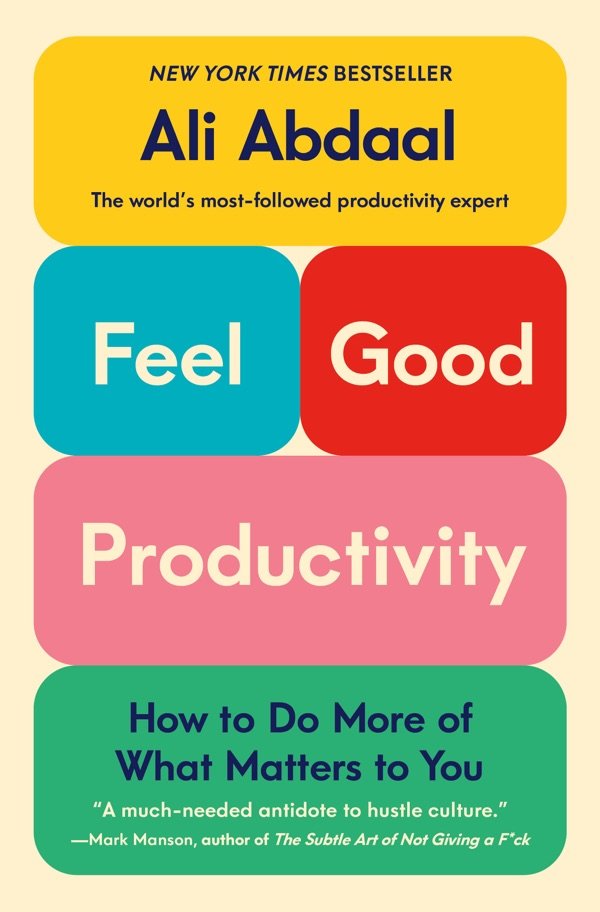
Feel-Good Productivity: How to Do More of What Matters to You
von Ali Abdaal
NICE goals. Near-term: Near-term goals ensure that we’re concentrating on the immediate steps we need to take along our journey. They help us avoid being overwhelmed by the bigger picture. I find that a daily or weekly objective is the most helpful time horizon. Input-based: Input-based goals emphasise the process, rather than some distant, abstract end-goal. Whereas an output-based goal would home in on the end result – ‘Lose 5kg by the end of the year’, ‘Hit the bestseller list with my book’ – an input-based goal would focus on what we can do in the here and now – ‘Go for a ten-minute walk everyday’, ‘Write 100 words each morning for my novel’. Controllable: We want to focus on goals that are within our control. ‘Spend eight hours a day on my novel’ probably isn’t something you can actually do, since many external factors would have to come together for such an input to be possible. Setting a more genuinely controllable goal (like allocating twenty minutes per day to the task) is far more realistic. Energising: We’ve already discussed plenty of principles and strategies for making our projects, tasks and chores more energising. Is there a way to integrate play, power and people into the goals you set yourself? there are a handful of processes that reinforce the loop between uncertainty, anxiety and paralysis. We overestimate what’s at stake. Someone who’s already anxious will think that the uncertain event is going to be worse than it already is. We become hypervigilant. Sensing that something negative might happen, our safety antennae prick up to the sign of any potential danger. We stop recognising safety cues. Because we’re hypervigilant to threats, we’re not able to calm down when there really is no danger. We become avoidant. Our brains encourage us to adopt behavioural and cognitive avoidance strategies, to get us out of there as soon as possible.
This approach is supported by a growing body of research. Psychologists increasingly believe that play holds the key to true productivity, partly because it provides a sense of psychological relief. As one recent study put it:4 ‘the psychological function of play is to restore the physically and mentally fatigued individual through participation in activity which is pleasurable and relaxing.’
the ‘spotlight effect’.8 We’re highly attuned to what others think of us. This makes sense – as social creatures, our amygdala is always on the hunt for threats to our status. But this means that we spend our lives believing a spotlight is always trained on us, and that everyone around is constantly looking at us, analysing our behaviours, and passing judgement on our worth as human beings.
psychology professor Joseph Ferrari,2 ‘to tell the chronic procrastinator to just do it would be like saying to a clinically depressed person, cheer up.’ Motivation and discipline are useful strategies, but they’re band-aids covering up deeper wounds. They might sometimes work to treat the symptoms, but they don’t change the underlying condition.
The researchers wanted to test whether these subtle – and crucially, cheap – tweaks in our environment (like the green inlay and the message in the shopping trolley) would change shoppers’ behaviour. And indeed they did. On the days with the green inlays, shoppers on average included over 50 per cent more vegetables than those without.
In particular, this involves focusing on what behavioural scientists call our default choices. This is the automatic outcome if you don’t make a choice actively. In the case of those Dutch shoppers, the green inlay dedicated to fresh produce made vegetables the default: it required no real thought to load up a cart with fresh produce.
"NICE goals. Near-term: Near-term goals ensure that we’re concentrating on the immediate steps we need to take along our journey. They help us avoid being overwhelmed by the bigger picture. I find that a daily or weekly objective is the most helpful time horizon. Input-based: Input-based goals emphasise the process, rather than some distant, abstract end-goal. Whereas an output-based goal would home in on the end result – ‘Lose 5kg by the end of the year’, ‘Hit the bestseller list with my book’ – an input-based goal would focus on what we can do in the here and now – ‘Go for a ten-minute walk everyday’, ‘Write 100 words each morning for my novel’. Controllable: We want to focus on goals that are within our control. ‘Spend eight hours a day on my novel’ probably isn’t something you can actually do, since many external factors would have to come together for such an input to be possible. Setting a more genuinely controllable goal (like allocating twenty minutes per day to the task) is far more realistic. Energising: We’ve already discussed plenty of principles and strategies for making our projects, tasks and chores more energising. Is there a way to integrate play, power and people into the goals you set yourself?"
"there are a handful of processes that reinforce the loop between uncertainty, anxiety and paralysis. We overestimate what’s at stake. Someone who’s already anxious will think that the uncertain event is going to be worse than it already is. We become hypervigilant. Sensing that something negative might happen, our safety antennae prick up to the sign of any potential danger. We stop recognising safety cues. Because we’re hypervigilant to threats, we’re not able to calm down when there really is no danger. We become avoidant. Our brains encourage us to adopt behavioural and cognitive avoidance strategies, to get us out of there as soon as possible."
"This technique is called ‘affective labelling’. Put simply, it’s the act of putting your feelings into words, which forces you to identify and get to know the sensations you’re experiencing. It works in two ways. First, it increases our self-awareness. By naming and acknowledging our fears, we cultivate a deeper self-awareness that helps us better understand our emotional patterns. Second, it reduces our rumination. Cyclical thoughts about our fears can make us even more convinced the fear is justified. When we label our emotions, we become better able to process and release them – and so escape the cyclical thoughts that make us put things off."
"Alternatively, you might decide that while you’re doing your weekly chores – washing the dishes, hanging up the laundry, or going to the grocery store – you’re not going to listen to anything on your headphones. It’s a counter-intuitive method for productivity enthusiasts, and one that I often have to force myself to partake in. And yet it works. It might feel unproductive. But sometimes, it’s just the time your brain needs to wander – and so solve problems with perspectives you didn’t realise you had."
"Misalignment burnout arises from the negative feelings that arise when our goals don’t match up to our sense of self. We feel worse – and so achieve less – because we’re not acting authentically. In these moments, our behaviour is driven by external forces – rather than by a deeper alignment between who we are and what we’re doing. This alignment is something that only intrinsic and identified motivation can offer. The solution? To work out what really matters to you – and align your behaviour with it."
"Fortunately, this is something we can learn. The first step is to feel and show your delight and joy for the other person’s good news. Try phrases like ‘That’s such wonderful news’ and ‘I couldn’t be happier for you!’ Next, recall to the sharer of good news how you’ve actively witnessed the process that led to the good news. Perhaps you’ve seen how hard they’ve worked to prepare for that job interview, the weeks they studied for the qualifying exam, how much they wanted that outcome."
"This approach is supported by a growing body of research. Psychologists increasingly believe that play holds the key to true productivity, partly because it provides a sense of psychological relief. As one recent study put it:4 ‘the psychological function of play is to restore the physically and mentally fatigued individual through participation in activity which is pleasurable and relaxing.’"
- →psychology professor Joseph Ferrari,2 ‘to tell the chronic procrastinator to just do it would be like saying to a clinically depressed person, cheer up.’ Motivation and discipline are useful strategies, but they’re band-aids covering up deeper wounds. They might sometimes work to treat the symptoms, but they don’t change the underlying condition.
- →The Reitoff principle is the idea that we should grant ourselves permission to write off a day and intentionally step away from achieving anything. For many of us, the challenge of rest lies in the act of stepping back from the things we think we should be doing. We’re conditioned to value self-control, grit and persistence. We equate
- →Procrastination isn’t something we can always control. Forgiving ourselves is something we can. You can focus on the small losses. Or you can celebrate the small wins. By accepting and forgiving our inevitable tendency to procrastinate – and celebrating the little victories instead – we can begin to conquer its hold over us.
- →This study hints at a powerful way to see our fears for what they really are. The goal here is not to stop your amygdala from working completely (which would dramatically increase the chances of you being hit by a truck). Instead, it’s to recognise when an amygdala hijack is happening.
Ähnliche Bücher gesucht?
Beschreibe deine Situation. Die Suche findet das passende Buch aus der gesamten Bibliothek.