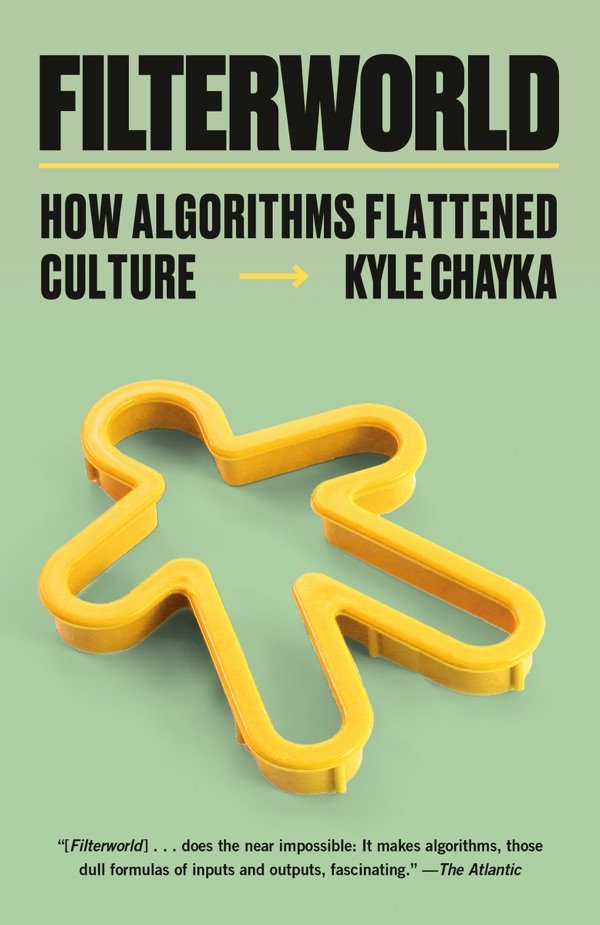
Filterworld: How Algorithms Flattened Culture
von Kyle Chayka
Algorithmic recommendations are the latest iteration of the Mechanical Turk: a series of human decisions that have been dressed up and automated as technological ones, at an inhuman scale and speed. Designed and maintained by the engineers of monopolistic tech companies, and running on data that we users continuously provide by logging in each day, the technology is both constructed by us and dominates us, manipulating our perceptions and attention. The algorithm always wins. The culture of Filterworld is the culture of presets, established patterns that get repeated again and again. The technology limits us to certain modes of consumption; you can’t stray outside of the lines. “Maniac fun,” as Yuri says, is gone—that is to say, a certain degree of originality, unprecedentedness, creativity, and surprise disappears when so much weighs on culture’s ability to spread through digital feeds.
Algorithmic recommendations shape the vast majority of our experiences in digital spaces by considering our previous actions and selecting the pieces of content that will most suit our patterns of behavior. They are supposed to interpret and then show us what we want to see.
“Knowledge itself is power,” Francis Bacon wrote in the sixteenth century, but in the Internet era, sorting knowledge might be even more powerful. Information is now easy to find in abundance; making sense of it, knowing which information is useful, is much harder.
If taste indeed must be deeply felt, requires time to engage with, and benefits from the surprise that comes from the unfamiliar, then it seems that technology could not possibly replicate it, because algorithmic feeds run counter to these fundamental qualities.
Each platform develops its own stylistic archetype, which is informed not just by aesthetic preferences but by biases of race, gender, and politics as well as by the fundamental business model of the corporation that owns it.
Filterworld culture is ultimately homogenous, marked by a pervasive sense of sameness even when its artifacts aren’t literally the same. It perpetuates itself to the point of boredom.
"Algorithmic recommendations are the latest iteration of the Mechanical Turk: a series of human decisions that have been dressed up and automated as technological ones, at an inhuman scale and speed. Designed and maintained by the engineers of monopolistic tech companies, and running on data that we users continuously provide by logging in each day, the technology is both constructed by us and dominates us, manipulating our perceptions and attention. The algorithm always wins."
"The culture of Filterworld is the culture of presets, established patterns that get repeated again and again. The technology limits us to certain modes of consumption; you can’t stray outside of the lines. “Maniac fun,” as Yuri says, is gone—that is to say, a certain degree of originality, unprecedentedness, creativity, and surprise disappears when so much weighs on culture’s ability to spread through digital feeds."
"On the other side of our algorithmic anxiety is a state of numbness. The dopamine rushes become inadequate, and the noise and speed of the feeds overwhelming. Our natural reaction is to seek out culture that embraces nothingness, that blankets and soothes rather than challenges or surprises, as powerful artwork is meant to do. Our capacity to be moved, or even to be interested and curious, is depleted."
"Algorithmic recommendations shape the vast majority of our experiences in digital spaces by considering our previous actions and selecting the pieces of content that will most suit our patterns of behavior. They are supposed to interpret and then show us what we want to see."
"“Knowledge itself is power,” Francis Bacon wrote in the sixteenth century, but in the Internet era, sorting knowledge might be even more powerful. Information is now easy to find in abundance; making sense of it, knowing which information is useful, is much harder."
"If taste indeed must be deeply felt, requires time to engage with, and benefits from the surprise that comes from the unfamiliar, then it seems that technology could not possibly replicate it, because algorithmic feeds run counter to these fundamental qualities."
"Each platform develops its own stylistic archetype, which is informed not just by aesthetic preferences but by biases of race, gender, and politics as well as by the fundamental business model of the corporation that owns it."
- →“Knowledge itself is power,” Francis Bacon wrote in the sixteenth century, but in the Internet era, sorting knowledge might be even more powerful. Information is now easy to find in abundance; making sense of it, knowing which information is useful, is much harder.
- →If taste indeed must be deeply felt, requires time to engage with, and benefits from the surprise that comes from the unfamiliar, then it seems that technology could not possibly replicate it, because algorithmic feeds run counter to these fundamental qualities.
Ähnliche Bücher gesucht?
Beschreibe deine Situation. Die Suche findet das passende Buch aus der gesamten Bibliothek.