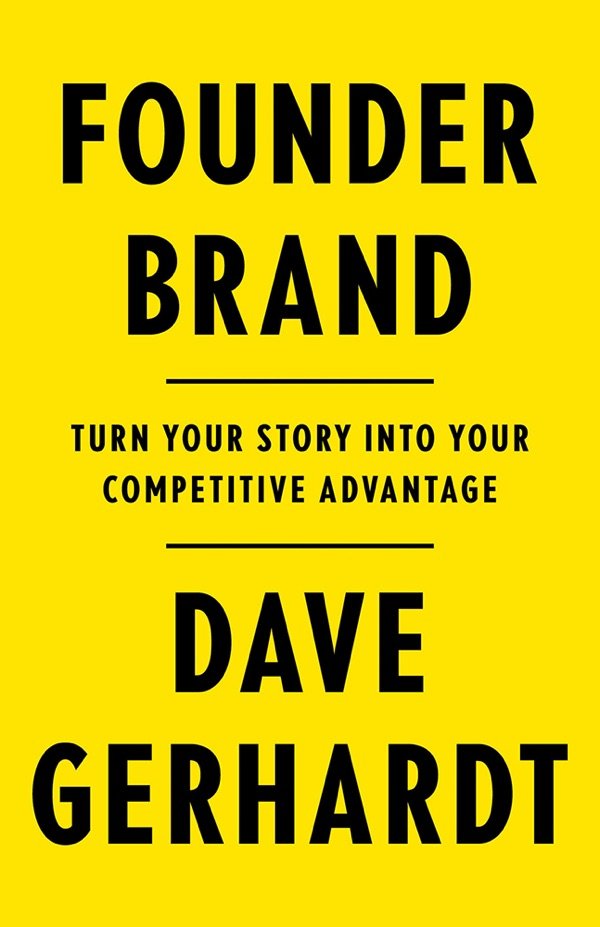
Founder Brand: Turn Your Story Into Your Competitive Advantage
von Dave Gerhardt
The steps to building your founder brand are simple: Develop your story as the founder, including the backstory of what problem you are solving and why. Determine your niche by specifically determining your target customer. This needs to be small and very well-defined. Identify your villain. What problem are you solving? Clarify your explainer. This will allow you to be able to capture attention and start a conversation with your target audience because they can understand exactly what you are selling. Develop your one-liner, the one sentence that becomes your catchphrase and is sprinkled everywhere until your audience knows it by heart. (1) get content from an event, (2) connect with industry influencers, and (3) tap into the event and “hijack” it for the benefit of your podcast. In 2019 after submitting to speak at SaaStr Annual and getting rejected, we did exactly this at Drift. The result was five podcast episodes with big-name guests in our industry (everyone said yes because they were already there on-site at the event, so the barrier to record was very low). We ended up turning those episodes into podcasts that reached 10,000 people via our blog and podcast feed—and I’m not sure speaking at the event would have done even close to that 5535756835
Make a list of potential mentors. Is there a professional organization where you can connect with others in your industry? Look through their membership listings to identify potential mentors and make a plan to reach out to them. Finally, make a list of several anti-role models. Learn about them and reflect on why you don’t want to emulate their process or them as people.
Most companies only tell the story of their products. Telling the story of the founder, or at least telling it along with the story of the product, makes a huge difference in whether the business succeeds. Time and again my research shows the difference between thriving and withering lies in whether the business used the advantage of the founder brand.
Find great and model great. Be curious online in your niche and find people worth following. Appearance matters. Make sure to set your profile picture and cover photo. Use Twitter’s Pinned Tweet and LinkedIn’s Featured section to your advantage. Each platform gives you a way to highlight a top piece of content on your profile a.k.a. your homepage.
Giveaways work so well because you get basically a two for one. Someone is going to share your show to get the thing you’re giving away like a book, T-shirt, or sticker. But then when they get their book, T-shirt, or sticker, they are most likely going to take a picture, tag you/your show, and post it on Twitter and other social networks.
First, find your voice. Remember that that goal is not to build a following overnight. This will take time. Treat the first weeks and months as “finding your voice” as opposed to worrying about how many followers you have. You need to learn what to say, how to say it, and what people are interested in. Be patient and publish regularly.
"The steps to building your founder brand are simple: Develop your story as the founder, including the backstory of what problem you are solving and why. Determine your niche by specifically determining your target customer. This needs to be small and very well-defined. Identify your villain. What problem are you solving? Clarify your explainer. This will allow you to be able to capture attention and start a conversation with your target audience because they can understand exactly what you are selling. Develop your one-liner, the one sentence that becomes your catchphrase and is sprinkled everywhere until your audience knows it by heart."
"(1) get content from an event, (2) connect with industry influencers, and (3) tap into the event and “hijack” it for the benefit of your podcast. In 2019 after submitting to speak at SaaStr Annual and getting rejected, we did exactly this at Drift. The result was five podcast episodes with big-name guests in our industry (everyone said yes because they were already there on-site at the event, so the barrier to record was very low). We ended up turning those episodes into podcasts that reached 10,000 people via our blog and podcast feed—and I’m not sure speaking at the event would have done even close to that 5535756835"
"By finding your niche, you can still be very successful with your brand. Can you be the first woman-owned fitness brand in Burlington, Vermont, that caters to working moms who want to bring their children to the gym for art/music classes while they work out? Could you also be the first brand to offer to-go meals you could order and take home when you are done working out? Yes, that would be a niche. The niche would be working moms who want an enrichment activity for their children and a healthy meal to take home after working out. That level of specificity is a niche."
"Content: Because the founder is an expert, they often have the most “internal knowledge” about the industry, the market, the competition, the landscape, the best practices, and the trends. David Cancel’s knowledge of the needs in product marketing comes to mind. His unique experience after twenty years in the sales and marketing industry gave the Drift team an incredible advantage because the founders had deep experience in this industry. We used that to our advantage to create content that would resonate with our audience. I didn’t have all the marketing experience…"
"Relationships: Founders have the relationships with investors, advisors, partners, industry analysts, and influencers. All of that can be used to your advantage in marketing because it gives you an incredible perspective on what is happening in your industry. The way to become a leader in your industry is not to promote your product 24/7 but to add value to others (ideally your potential customers). Founders are in so many interesting conversations each week, and all of that can build a brand by doing your work in public. Share…"
"Leadership: Every great movement has a leader. Clearly announcing who the leader is and what the leader does gives credibility to your brand. Steve Jobs was the leader of the “Think Different” movement for Apple, but even on a smaller scale, people want a leader. If you are a startup in the financial world, the opportunity is not just to offer a product, but to teach people a new way of thinking about finance for the future. And the best way to get that story to stick is to have it be told by a person, not a…"
"Shopify Founder Tobi Lütke: In 2004, Lütke, along with his partners, Daniel Weinand and Scott Lake, launched Snowdevil, an online snowboard shop. Lütke built a new e-commerce platform for the site, using Ruby on Rails because they couldn’t find an existing tool that made it easy for them to build their own online store. Soon after, the Snowdevil founders shifted their focus from snowboards to e-commerce and launched Shopify in 2006. Shopify was built to solve this initial problem.2 Zoom"
- →Find great and model great. Be curious online in your niche and find people worth following. Appearance matters. Make sure to set your profile picture and cover photo. Use Twitter’s Pinned Tweet and LinkedIn’s Featured section to your advantage. Each platform gives you a way to highlight a top piece of content on your profile a.k.a. your homepage.
- →Giveaways work so well because you get basically a two for one. Someone is going to share your show to get the thing you’re giving away like a book, T-shirt, or sticker. But then when they get their book, T-shirt, or sticker, they are most likely going to take a picture, tag you/your show, and post it on Twitter and other social networks.
- →First, find your voice. Remember that that goal is not to build a following overnight. This will take time. Treat the first weeks and months as “finding your voice” as opposed to worrying about how many followers you have. You need to learn what to say, how to say it, and what people are interested in. Be patient and publish regularly.
- →The goal of the first line of your copy should always be to get someone to read your second line of copy. The goal of the second line of copy should be to get them to read the third. All the way until they have finished reading. This is a technique I rely on to write compelling copy, and you can use it to create your explainer too.
Ähnliche Bücher gesucht?
Beschreibe deine Situation. Die Suche findet das passende Buch aus der gesamten Bibliothek.