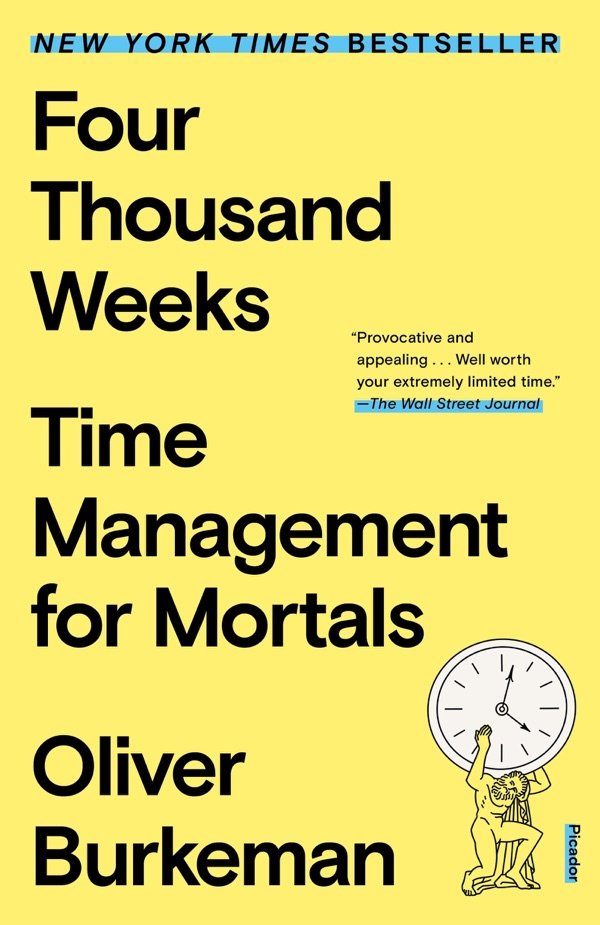
Four Thousand Weeks: Time Management for Mortals
von Oliver Burkeman
The fundamental problem is that this attitude toward time sets up a rigged game in which it’s impossible ever to feel as though you’re doing well enough. Instead of simply living our lives as they unfold in time—instead of just being time, you might say—it becomes difficult not to value each moment primarily according to its usefulness for some future goal, or for some future oasis of relaxation you hope to reach once your tasks are finally “out of the way.” The most effective way to sap distraction of its power is just to stop expecting things to be otherwise—to accept that this unpleasantness is simply what it feels like for finite humans to commit ourselves to the kinds of demanding and valuable tasks that force us to confront our limited control over how our lives unfold.
The most effective way to sap distraction of its power is just to stop expecting things to be otherwise—to accept that this unpleasantness is simply what it feels like for finite humans to commit ourselves to the kinds of demanding and valuable tasks that force us to confront our limited control over how our lives unfold.
The real problem isn’t our limited time. The real problem—or so I hope to convince you—is that we’ve unwittingly inherited, and feel pressured to live by, a troublesome set of ideas about how to use our limited time, all of which are pretty much guaranteed to make things worse.
There is an alternative: the unfashionable but powerful notion of letting time use you, approaching life not as an opportunity to implement your predetermined plans for success but as a matter of responding to the needs of your place and your moment in history.
Historians call this way of living “task orientation,” because the rhythms of life emerge organically from the tasks themselves, rather than from being lined up against an abstract timeline, the approach that has become second nature for us today.
The world is bursting with wonder, and yet it’s the rare productivity guru who seems to have considered the possibility that the ultimate point of all our frenetic doing might be to experience more of that wonder.
"The fundamental problem is that this attitude toward time sets up a rigged game in which it’s impossible ever to feel as though you’re doing well enough. Instead of simply living our lives as they unfold in time—instead of just being time, you might say—it becomes difficult not to value each moment primarily according to its usefulness for some future goal, or for some future oasis of relaxation you hope to reach once your tasks are finally “out of the way.”"
"The most effective way to sap distraction of its power is just to stop expecting things to be otherwise—to accept that this unpleasantness is simply what it feels like for finite humans to commit ourselves to the kinds of demanding and valuable tasks that force us to confront our limited control over how our lives unfold."
"The real problem isn’t our limited time. The real problem—or so I hope to convince you—is that we’ve unwittingly inherited, and feel pressured to live by, a troublesome set of ideas about how to use our limited time, all of which are pretty much guaranteed to make things worse."
"There is an alternative: the unfashionable but powerful notion of letting time use you, approaching life not as an opportunity to implement your predetermined plans for success but as a matter of responding to the needs of your place and your moment in history."
"Historians call this way of living “task orientation,” because the rhythms of life emerge organically from the tasks themselves, rather than from being lined up against an abstract timeline, the approach that has become second nature for us today."
"The world is bursting with wonder, and yet it’s the rare productivity guru who seems to have considered the possibility that the ultimate point of all our frenetic doing might be to experience more of that wonder."
"The technologies we use to try to “get on top of everything” always fail us, in the end, because they increase the size of the “everything” of which we’re trying to get on top."
- →The most effective way to sap distraction of its power is just to stop expecting things to be otherwise—to accept that this unpleasantness is simply what it feels like for finite humans to commit ourselves to the kinds of demanding and valuable tasks that force us to confront our limited control over how our lives unfold.
- →The real problem isn’t our limited time. The real problem—or so I hope to convince you—is that we’ve unwittingly inherited, and feel pressured to live by, a troublesome set of ideas about how to use our limited time, all of which are pretty much guaranteed to make things worse.
- →There is an alternative: the unfashionable but powerful notion of letting time use you, approaching life not as an opportunity to implement your predetermined plans for success but as a matter of responding to the needs of your place and your moment in history.
- →Historians call this way of living “task orientation,” because the rhythms of life emerge organically from the tasks themselves, rather than from being lined up against an abstract timeline, the approach that has become second nature for us today.
Ähnliche Bücher gesucht?
Beschreibe deine Situation. Die Suche findet das passende Buch aus der gesamten Bibliothek.