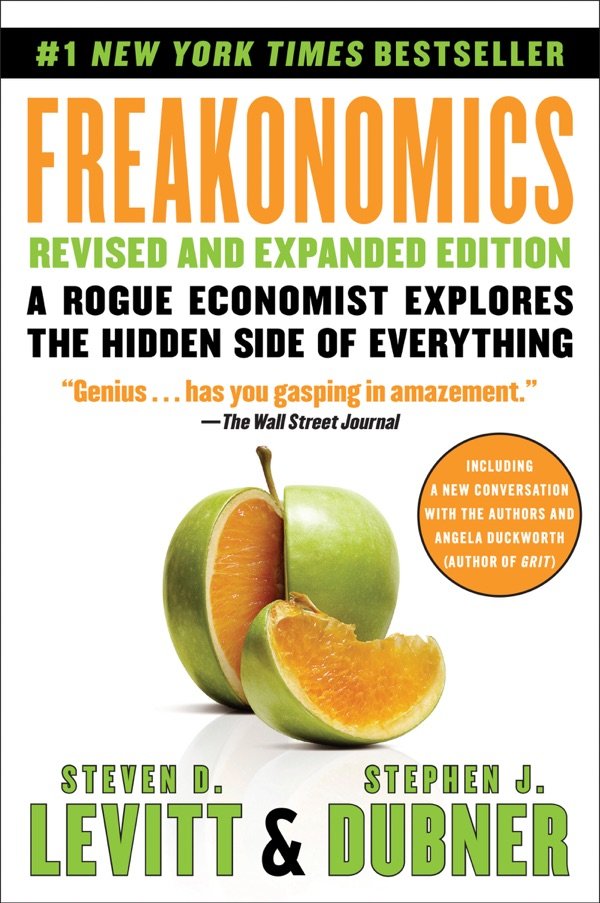
Freakonomics: A Rogue Economist Explores the Hidden Side of Everything
von Steven D. Levitt
The broken window theory argues that minor nuisances, if left unchecked, turn into major nuisances: that is, if someone breaks a window and sees it isn’t fixed immediately, he gets the signal that it’s all right to break the rest of the windows and maybe set the building afire too. Sacerdote found that parents who adopt children are typically smarter, better educated, and more highly paid than the baby’s biological parents. But the adoptive parents’ advantages had little bearing on the child’s school performance.
The broken window theory argues that minor nuisances, if left unchecked, turn into major nuisances: that is, if someone breaks a window and sees it isn’t fixed immediately, he gets the signal that it’s all right to break the rest of the windows and maybe set the building afire too.
Sacerdote found that parents who adopt children are typically smarter, better educated, and more highly paid than the baby’s biological parents. But the adoptive parents’ advantages had little bearing on the child’s school performance.
Morality, it could be argued, represents the way that people would like the world to work—whereas economics represents how it actually does work.
Economics is, at root, the study of incentives: how people get what they want, or need, especially when other people want or need the same thing.
“The basic reality,” Sandman told The New York Times, “is that the risks that scare people and the risks that kill people are very different.”
"The broken window theory argues that minor nuisances, if left unchecked, turn into major nuisances: that is, if someone breaks a window and sees it isn’t fixed immediately, he gets the signal that it’s all right to break the rest of the windows and maybe set the building afire too."
"Sacerdote found that parents who adopt children are typically smarter, better educated, and more highly paid than the baby’s biological parents. But the adoptive parents’ advantages had little bearing on the child’s school performance."
"Morality, it could be argued, represents the way that people would like the world to work—whereas economics represents how it actually does work."
"Economics is, at root, the study of incentives: how people get what they want, or need, especially when other people want or need the same thing."
"“The basic reality,” Sandman told The New York Times, “is that the risks that scare people and the risks that kill people are very different.”"
"Information is so powerful that the assumption of information, even if the information does not actually exist, can have a sobering effect."
"An incentive is simply a means of urging people to do more of a good thing and less of a bad thing."
- →An incentive is simply a means of urging people to do more of a good thing and less of a bad thing.
Ähnliche Bücher gesucht?
Beschreibe deine Situation. Die Suche findet das passende Buch aus der gesamten Bibliothek.