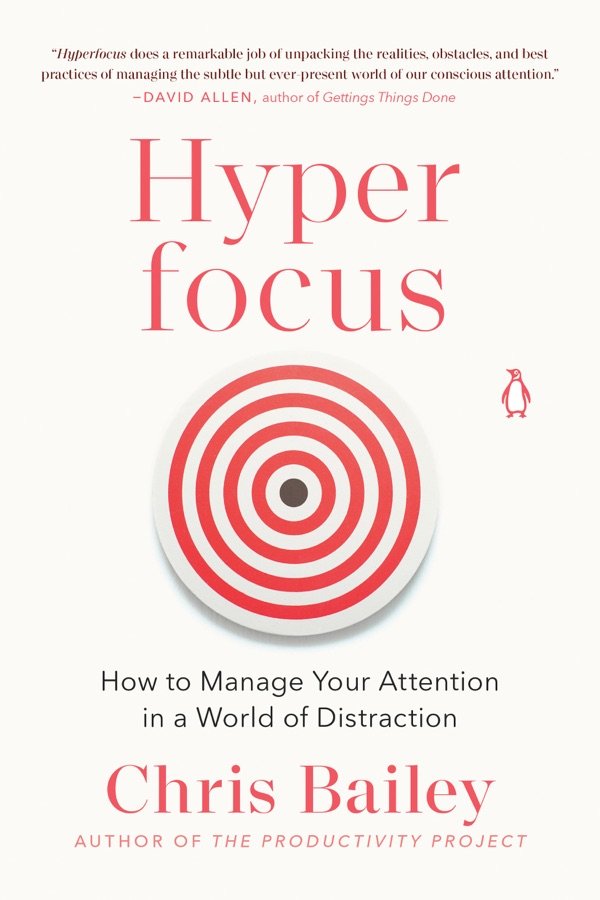
Hyperfocus: How to Work Less to Achieve More
von Chris Bailey
When you hyperfocus on a task, you expand one task, project, or other object of attention . so it fills your attentional space completely. You enter this mode by managing your attention deliberately and purposefully: by choosing one important object of attention, eliminating distractions that will inevitably arise as you work, and then focusing on just that one task. Modifying your environment is one of the top ways to cultivate your focus. The most focus-conducive environments are those in which you’re interrupted and distracted the least. If possible, move yourself to one of these places—whether it’s a café down the street, the library, or a quieter room in the house.
When you hyperfocus on a task, you expand one task, project, or other object of attention . so it fills your attentional space completely. You enter this mode by managing your attention deliberately and purposefully: by choosing one important object of attention, eliminating distractions that will inevitably arise as you work, and then focusing on just that one task.
Modifying your environment is one of the top ways to cultivate your focus. The most focus-conducive environments are those in which you’re interrupted and distracted the least. If possible, move yourself to one of these places—whether it’s a café down the street, the library, or a quieter room in the house.
In order to put its advice into practice, you’ll need to do several things: set intentions more often, modify your environment to be less distracting, overcome the mental resistance you have to certain tasks, eliminate distractions before they derail you, and clear the distractions inside your own head.
When doing such habitual tasks, it’s best to not focus completely on what you’re doing. Save hyperfocus for your most complex tasks—things that will actually benefit from your complete attention, such as writing a report, mapping your team’s budget, or having a meaningful conversation with a loved one.
Autopilot mode guides us through actions like these. As many as 40 percent of our actions are habits, which shouldn’t require conscious deliberation. Unless you’re a monk and have the luxury of being able to meditate all day, it’s impossible to live intentionally 100 percent of the time.
"When you hyperfocus on a task, you expand one task, project, or other object of attention . so it fills your attentional space completely. You enter this mode by managing your attention deliberately and purposefully: by choosing one important object of attention, eliminating distractions that will inevitably arise as you work, and then focusing on just that one task."
"Modifying your environment is one of the top ways to cultivate your focus. The most focus-conducive environments are those in which you’re interrupted and distracted the least. If possible, move yourself to one of these places—whether it’s a café down the street, the library, or a quieter room in the house."
"In order to put its advice into practice, you’ll need to do several things: set intentions more often, modify your environment to be less distracting, overcome the mental resistance you have to certain tasks, eliminate distractions before they derail you, and clear the distractions inside your own head."
"When doing such habitual tasks, it’s best to not focus completely on what you’re doing. Save hyperfocus for your most complex tasks—things that will actually benefit from your complete attention, such as writing a report, mapping your team’s budget, or having a meaningful conversation with a loved one."
"Autopilot mode guides us through actions like these. As many as 40 percent of our actions are habits, which shouldn’t require conscious deliberation. Unless you’re a monk and have the luxury of being able to meditate all day, it’s impossible to live intentionally 100 percent of the time."
"Letting our attention overflow makes our actions less meaningful, because we don’t remember how we spent our time in the first place. This affects our productivity in the long run: we make more mistakes because we don’t properly encode the lessons we learned the first time we messed up."
"If you’re working on a pressure- or deadline-free project, consider taking a break before starting something else so more of that attentional residue can dissipate. As far as your productivity is concerned, the best time to take a break is after you’ve finished a big task."
- →In order to put its advice into practice, you’ll need to do several things: set intentions more often, modify your environment to be less distracting, overcome the mental resistance you have to certain tasks, eliminate distractions before they derail you, and clear the distractions inside your own head.
- →When doing such habitual tasks, it’s best to not focus completely on what you’re doing. Save hyperfocus for your most complex tasks—things that will actually benefit from your complete attention, such as writing a report, mapping your team’s budget, or having a meaningful conversation with a loved one.
- →Letting our attention overflow makes our actions less meaningful, because we don’t remember how we spent our time in the first place. This affects our productivity in the long run: we make more mistakes because we don’t properly encode the lessons we learned the first time we messed up.
- →While trying to do more tasks simultaneously, we prevent ourselves from finishing any one task of significance. And I began to discover that by focusing deeply on just one important thing at a time—hyperfocusing—we become the most productive version of ourselves.
Ähnliche Bücher gesucht?
Beschreibe deine Situation. Die Suche findet das passende Buch aus der gesamten Bibliothek.