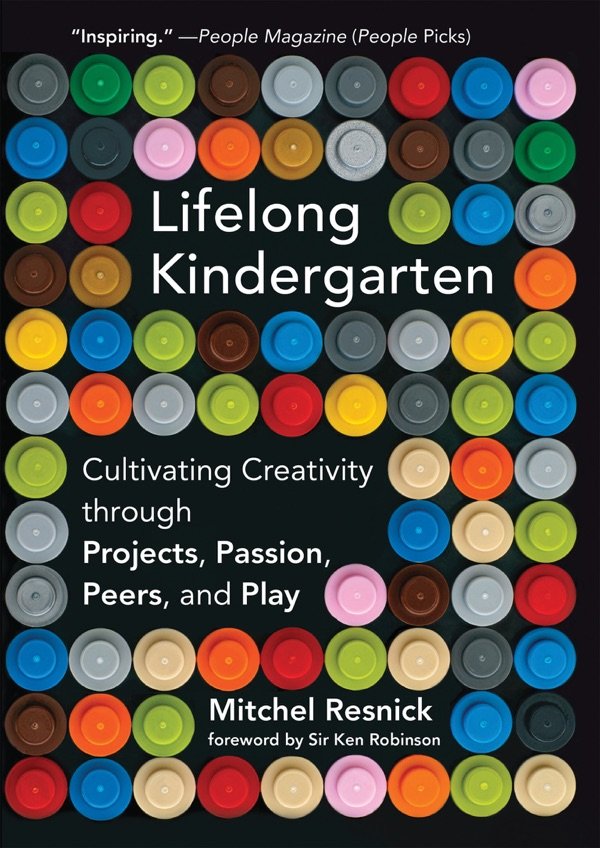
Lifelong Kindergarten: Cultivating Creativity through Projects, Passion, Peers, and Play (Mit Press)
von Mitchel Resnick
Risk-takers. Makers of things. These are the X students, the creative thinkers. They’ve been the driving force for economic, technological, political, and cultural change throughout history. Today, everyone needs to be a risk-taker, a doer, a maker of things—not necessarily to bend the arc of history, but to bend the arcs of their own lives. Seymour Papert used the term hard fun to describe this type of learning. Too often, teachers and educational publishers try to make lessons easier, believing that children want things to be easy. But that’s not the case. Most children are willing to work hard—eager to work hard—so long as they’re excited about the things they’re working on.
Risk-takers. Makers of things. These are the X students, the creative thinkers. They’ve been the driving force for economic, technological, political, and cultural change throughout history. Today, everyone needs to be a risk-taker, a doer, a maker of things—not necessarily to bend the arc of history, but to bend the arcs of their own lives.
Seymour Papert used the term hard fun to describe this type of learning. Too often, teachers and educational publishers try to make lessons easier, believing that children want things to be easy. But that’s not the case. Most children are willing to work hard—eager to work hard—so long as they’re excited about the things they’re working on.
Creativity is a step beyond imagination: it is putting your imagination to work. Creativity is a practical as well as a conceptual process: how and what we create has much to do with the tools and materials we have available, and what we make of and with them.
Creative thinking has always been, and will always be, a central part of what makes life worth living. Life as a creative thinker can bring not only economic rewards, but also joy, fulfillment, purpose, and meaning. Children deserve nothing less.
Most schools in most countries place a higher priority on teaching students to follow instructions and rules (becoming A students) than on helping students develop their own ideas, goals, and strategies (becoming X students).
"Risk-takers. Makers of things. These are the X students, the creative thinkers. They’ve been the driving force for economic, technological, political, and cultural change throughout history. Today, everyone needs to be a risk-taker, a doer, a maker of things—not necessarily to bend the arc of history, but to bend the arcs of their own lives."
"Seymour Papert used the term hard fun to describe this type of learning. Too often, teachers and educational publishers try to make lessons easier, believing that children want things to be easy. But that’s not the case. Most children are willing to work hard—eager to work hard—so long as they’re excited about the things they’re working on."
"Creativity is a step beyond imagination: it is putting your imagination to work. Creativity is a practical as well as a conceptual process: how and what we create has much to do with the tools and materials we have available, and what we make of and with them."
"Creative thinking has always been, and will always be, a central part of what makes life worth living. Life as a creative thinker can bring not only economic rewards, but also joy, fulfillment, purpose, and meaning. Children deserve nothing less."
"Most schools in most countries place a higher priority on teaching students to follow instructions and rules (becoming A students) than on helping students develop their own ideas, goals, and strategies (becoming X students)."
"According to Piaget’s constructivist theory of learning, children are active builders of knowledge, not passive recipients. Children don’t get ideas, they make ideas."
"Creativity grows out of a certain type of hard work, combining curious exploration with playful experimentation and systematic investigation."
- →Seymour Papert used the term hard fun to describe this type of learning. Too often, teachers and educational publishers try to make lessons easier, believing that children want things to be easy. But that’s not the case. Most children are willing to work hard—eager to work hard—so long as they’re excited about the things they’re working on.
- →Creativity is a step beyond imagination: it is putting your imagination to work. Creativity is a practical as well as a conceptual process: how and what we create has much to do with the tools and materials we have available, and what we make of and with them.
- →Creative thinking has always been, and will always be, a central part of what makes life worth living. Life as a creative thinker can bring not only economic rewards, but also joy, fulfillment, purpose, and meaning. Children deserve nothing less.
- →But tools do more than extend our bodies: they expand our minds. Technology facilitates ideas that might otherwise be inconceivable.
Ähnliche Bücher gesucht?
Beschreibe deine Situation. Die Suche findet das passende Buch aus der gesamten Bibliothek.