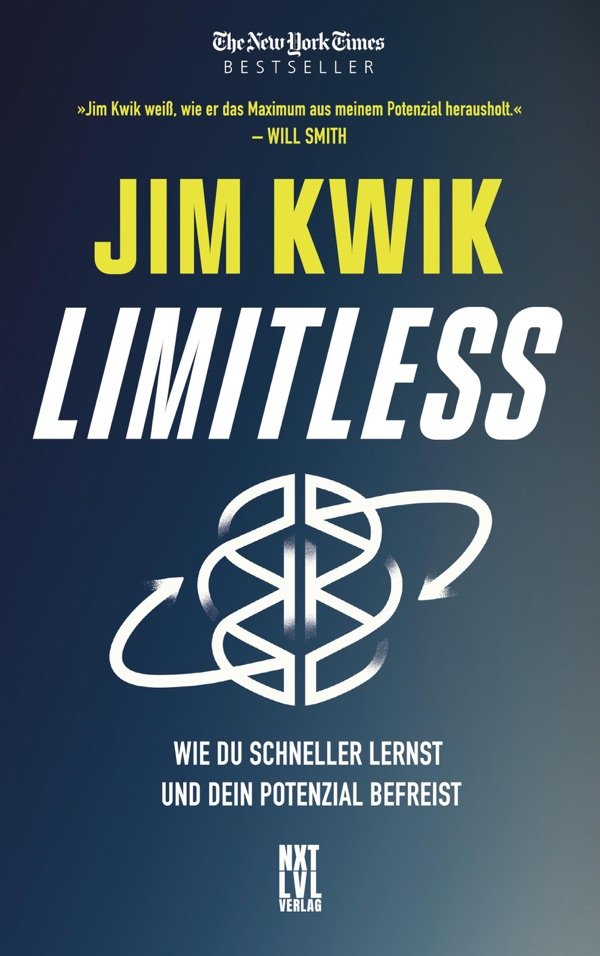
Limitless: Upgrade Your Brain, Learn Anything Faster, and Unlock Your Exceptional Life
von Jim Kwik
Our brains are the ultimate adaptation machines, capable of seemingly endless levels of evolution. And yet we often forget to give it the exercise it needs. Just as there is a physical price to always relying on the technology of the elevator instead of taking the stairs, so is there a price for lazy mental muscles. Use it or lose it. Fredrickson refers to this as the “broaden and build” theory because positive emotions broaden your sense of possibilities and open your mind, which in turn allows you to build new skills and resources that can provide value in other areas of your life.
Our brains are the ultimate adaptation machines, capable of seemingly endless levels of evolution. And yet we often forget to give it the exercise it needs. Just as there is a physical price to always relying on the technology of the elevator instead of taking the stairs, so is there a price for lazy mental muscles. Use it or lose it.
Fredrickson refers to this as the “broaden and build” theory because positive emotions broaden your sense of possibilities and open your mind, which in turn allows you to build new skills and resources that can provide value in other areas of your life.
Put another way, knowledge is important, but it is “the performing of some action” that is required to make it powerful.
Studies show that there is a direct relationship between your ability to read and your success in life. Skilled readers enjoy better jobs, higher incomes, and greater opportunities for success in all realms of life. Think about this: If you have average reading skills, then you have the same understanding that most people have. That doesn’t give you much of a competitive advantage, does it?
Step 3: Read about It As you already know, I am an extremely strong advocate for reading as much as you possibly can. Reading liberates your brain more than virtually any other activity. Reading is especially important when it comes to exponential thinking. You can’t make huge cognitive leaps if you don’t have a well-rounded view of a subject. So,
"Our brains are the ultimate adaptation machines, capable of seemingly endless levels of evolution. And yet we often forget to give it the exercise it needs. Just as there is a physical price to always relying on the technology of the elevator instead of taking the stairs, so is there a price for lazy mental muscles. Use it or lose it."
"Fredrickson refers to this as the “broaden and build” theory because positive emotions broaden your sense of possibilities and open your mind, which in turn allows you to build new skills and resources that can provide value in other areas of your life."
"Put another way, knowledge is important, but it is “the performing of some action” that is required to make it powerful."
"I’ve spoken to many experts over the years, and the conversation often comes back to the same thing: as long as you believe that your inner critic is the voice of the true you, the wisest you, it’s always going to guide you. Many of us even use phrases like, “I know myself, and . . .” before announcing a limiting belief. But if you can create a separate persona for your inner critic—one that is different from the true you—you’ll be considerably more successful at quieting it. This can be enormously helpful and you can have fun with it at the same time. Give your inner critic a preposterous name and outrageous physical attributes. Make it cartoonish and unworthy of even a B-grade movie."
"“The present research suggests that even when laptops are used solely to take notes, they may still be impairing learning because their use results in shallower processing,” write Pam A. Mueller and Daniel M. Oppenheimer in their study on this topic. “We found that students who took notes on laptops performed worse on conceptual questions than students who took notes longhand. We show that whereas taking more notes can be beneficial, laptop note takers’ tendency to transcribe lectures verbatim rather than processing information and reframing it in their own words is detrimental to learning.”"
"“Spaced repetition is simple but highly effective because it deliberately hacks the way your brain works,” agrees James Gupta, CEO of the online learning platform Synap. “It forces learning to be effortful and, like muscles, the brain responds to that stimulus by strengthening the connections between nerve cells. By spacing the intervals out, you’re further exercising these connections each time. It produces long-term, durable retention of knowledge and, in my experience, once people start using it, they swear by it.”5"
"Just as memory is foundational to nearly all brain function, reading is foundational to nearly all learning. If anyone tells you that they don’t read, they’re essentially saying, “I’ve stopped trying to learn.” Yes, you can learn something from watching videos, listening to podcasts, or going to the movies. Even the silliest network sitcom is likely to teach you something. But it is nearly impossible to make learning a dynamic and renewable part of your life without a dedicated approach to reading."
- →Our brains are the ultimate adaptation machines, capable of seemingly endless levels of evolution. And yet we often forget to give it the exercise it needs. Just as there is a physical price to always relying on the technology of the elevator instead of taking the stairs, so is there a price for lazy mental muscles. Use it or lose it.
- →Fredrickson refers to this as the “broaden and build” theory because positive emotions broaden your sense of possibilities and open your mind, which in turn allows you to build new skills and resources that can provide value in other areas of your life.
- →Write down a list of your most common “I am” statements. How do you feel about the ways in which these statements define you? Create a list of the things you value the most. Now prioritize that list and think about how this aligns with your definition of yourself. Get into the habit of asking the question “why” before you do anything.
- →So, listen carefully every time you find yourself using phrases like “I can’t,” “I’m not,” or “I don’t.” You’re sending messages to yourself that are affecting how you think about your life in general, even if what you’re beating yourself up over is something specific and seemingly not important to how you define yourself.
Ähnliche Bücher gesucht?
Beschreibe deine Situation. Die Suche findet das passende Buch aus der gesamten Bibliothek.