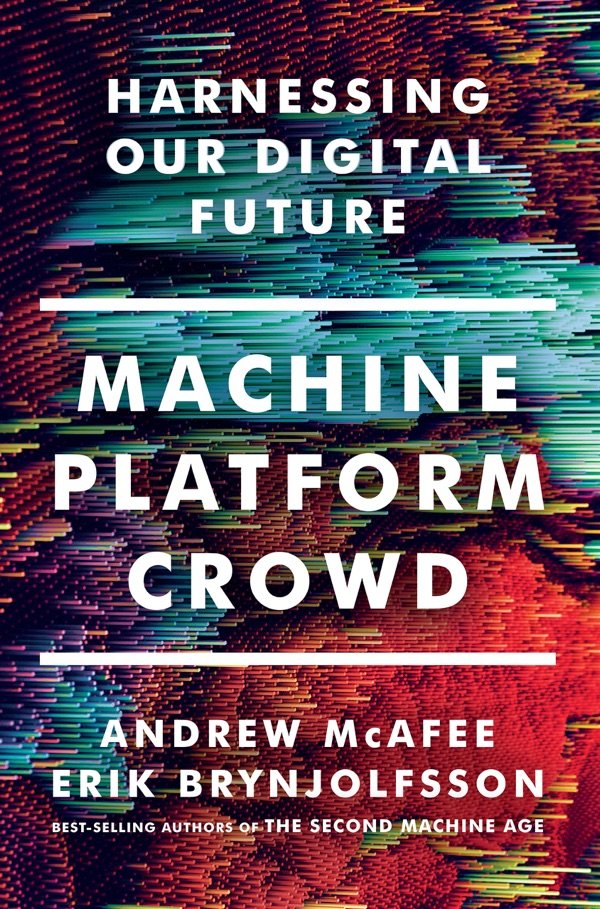
Machine, Platform, Crowd: Harnessing Our Digital Future
von Andrew McAfee
“Most of the checking, reconciling, waiting, monitoring, tracking—the unproductive work . . .—is eliminated by reengineering. . . . People working in a reengineered process are, of necessity, empowered. As process team workers they are both permitted and required to think, interact, use judgment, and make decisions.” In 2006, Avinash Kaushik and Ronny Kohavi, two data analysis professionals who were then working at Intuit and Microsoft, respectively, came up with the acronym HiPPO to summarize the dominant decision-making style at most companies. It stands for “highest-paid person’s opinion.” We love this shorthand and use it a lot, because it vividly illustrates the standard partnership. Even when the decisions are not made by the highest-paid people, they’re often—too often—based on opinions, judgments, intuition, gut, and System 1. The evidence is clear that this approach frequently doesn’t work well, and that HiPPOs too often destroy value.
“Most of the checking, reconciling, waiting, monitoring, tracking—the unproductive work . . .—is eliminated by reengineering. . . . People working in a reengineered process are, of necessity, empowered. As process team workers they are both permitted and required to think, interact, use judgment, and make decisions.”
As technology advances, high-level social skills could become even more valuable than advanced quantitative ones. And the ability to combine social with quantitative skills will often have the highest payoff of all.
In other cases, subjective human judgments should still be used, but in an inversion of the standard partnership: the judgments should be quantified and included in quantitative analyses. Decision-making processes should not be set up so that decision makers feel good about themselves. They should be set up to produce the best decisions, based on the right goals and clear metrics.
the medical office of the future might employ an artificial intelligence, a person, and a dog. The AI’s job will be to diagnose the patient, the person’s job will be to understand and communicate the diagnosis, and to coach the patient through treatment, and the dog’s job will be to bite the person if the person tries to second-guess the artificial intelligence.
The system uses this set of matched pairs to build up the associations within its neural network that enable it to transcribe new instances of recorded speech. Because both supervised and unsupervised machine learning approaches use the algorithms described by Hinton and his colleagues in their 2006 paper, they’re now commonly called “deep learning” systems.
"“Most of the checking, reconciling, waiting, monitoring, tracking—the unproductive work . . .—is eliminated by reengineering. . . . People working in a reengineered process are, of necessity, empowered. As process team workers they are both permitted and required to think, interact, use judgment, and make decisions.”"
"In 2006, Avinash Kaushik and Ronny Kohavi, two data analysis professionals who were then working at Intuit and Microsoft, respectively, came up with the acronym HiPPO to summarize the dominant decision-making style at most companies. It stands for “highest-paid person’s opinion.” We love this shorthand and use it a lot, because it vividly illustrates the standard partnership. Even when the decisions are not made by the highest-paid people, they’re often—too often—based on opinions, judgments, intuition, gut, and System 1. The evidence is clear that this approach frequently doesn’t work well, and that HiPPOs too often destroy value."
"Young children don’t need explicit lessons on rules in order to learn to speak well.‡ Most adults can’t learn without them. There’s some overlap in the two approaches, of course—many kids eventually take language classes, and adults pick up some things by ear—but they are starkly different. The brains of young children are specialized for language learning: they operate on statistical principles to discern the patterns in language§ (for example, When Mom talks about herself as the subject, she uses the word “I” and puts it at the start of the sentence. When she’s the object, she uses “me” and places it later). Because adults’ brains are different, they usually learn the rules explicitly when acquiring a new language."
"As technology advances, high-level social skills could become even more valuable than advanced quantitative ones. And the ability to combine social with quantitative skills will often have the highest payoff of all."
"By 2013, total US newspaper print ad revenue had declined by 70% over the previous decade, and online ads had contributed back only $3.4 billion of the $40 billion lost in annual sales. A saying emerged in the newspaper industry that “print dollars were being replaced by digital dimes.” From 2007 to 2011, 13,400 newspaper newsroom jobs were cut in the United States. Help-wanted classified ad revenue dropped by more than 90% in the decade after 2000, from $8.7 billion to $723 million. Newspaper companies including the Tucson Citizen (Arizona’s oldest continuously published daily newspaper) and the Rocky Mountain News went bankrupt. Others, like the McClatchy Company, lost more than 90% of their value. On August 5, 2013, the Washington Post made a surprise announcement that it had been acquired by Amazon founder Jeff Bezos for $250 million. Similar patterns held in magazine publishing, with total circulation and advertising revenue in precipitous decline. The parent companies of magazines as diverse as Penthouse (General Media) and the National Enquirer and Men’s Fitness (American Media) declared bankruptcy. Newsweek, which had been in print since 1933 and at one point had a circulation of 3.3 million, saw its total circulation dropped by more than 50% between 2007 and 2011 and ceased publishing a print edition altogether in 2012. The New Republic, a once influential political magazine (in the mid-1990s it had a reputation for being “required reading on Air Force One”) was bought by Facebook cofounder Chris Hughes in 2012 for an estimated $2 million.† Perhaps the clearest sign of deep shifts in the industry was Playboy’s announcement in October of 2015 that after sixty-two years, it would no longer feature nude photos. Founder Hugh Hefner, who in 2006 was named by the Atlantic as one of the most influential living Americans in large part because of photos of unclothed women, agreed with the move. One of the reasons for this change was that, like other publications, Playboy depended increasingly on traffic from social media, but sites like Facebook and Instagram did not allow nudity.‡ (In February of 2017, Cooper Hefner, the magazine’s chief creative officer and son of its founder, announced that partial female nudity would return to Playboy.) Worldwide sales of recorded music declined by 45%, from $27 billion to $15 billion, between 1999 and 2014. The year 2014 was also the first that the global music industry generated the same proportion of revenue from digital channels as from physical formats such as CDs. In 2002, five major labels controlled 75% of the world market for recorded music. The consolidation in the industry has left standing just three major content providers: Universal Music Group, Sony Music Entertainment, and Warner Music Group. These three now account for 85% of music distributed in the United States. Tower Records went bankrupt in 2006, and HMV “called in the administrators” (equivalently bad news for an English company)…"
"Of course, not all of these predictions are wrong. Tetlock found that some people, whom he calls “superforecasters,” really are able to consistently generate forecasts more accurately than chance would predict. They tend to take in information from many sources and, perhaps more important, show an ability to adopt multiple viewpoints when looking at a situation. Less accurate forecasters, meanwhile, tend to have one fixed perspective that they always use in their analyses (both ardent conservatives and diehard liberals, for example, tend to make lousy political predictions). Tetlock calls the former group (the more successful, multiperspective predictors) “foxes,” and the latter “hedgehogs”; he takes these labels from the ancient Greek poet Archilochus’s aphorism “A fox knows many things, but a hedgehog one important thing.”*** A piece of guidance, then, is to rely on foxes instead of hedgehogs wherever possible. Foxes can be spotted by the multidimensional, multiperspective reasoning and analyses they present. They can also be spotted by their track records. People with verifiable histories of accurate prediction are likely to be foxes."
"A much bigger blow to the notion of human superiority in judgment came from the finding that in 46% of the studies considered, the human experts actually performed significantly worse than the numbers and formulas alone. This means that people were clearly superior in only 6% of cases. And the authors concluded that in almost all of the studies where humans did better, “the clinicians received more data than the mechanical prediction.” As Paul Meehl, the legendary psychologist who began in the early 1950s to document and describe the poor track record of human expert judgment, summarized, There is no controversy in social science that shows such a large body of qualitatively diverse studies coming out so uniformly in the same direction as this one [the relative validity of statistical versus clinical prediction]. When you are pushing over 100 investigations, predicting everything from the outcome of football games to the diagnosis of liver disease and when you can hardly come up with a half dozen studies showing even a weak tendency in favor of the clinician, it is time to draw a practical conclusion."
- →“Most of the checking, reconciling, waiting, monitoring, tracking—the unproductive work . . .—is eliminated by reengineering. . . . People working in a reengineered process are, of necessity, empowered. As process team workers they are both permitted and required to think, interact, use judgment, and make decisions.”
- →“In doing commonsense reasoning, people . . . are drawing on . . . reasoning processes largely unavailable to introspection.” In other words, the cognitive work that we humans do to navigate so easily through so many thickets of rules is an ongoing demonstration of Polanyi’s Paradox, the strange phenomenon that we know more than we can tell.
- →The existence of superforecasters aside, our most fundamental advice about predictions is to rely on them less. Our world is increasingly complex, often chaotic, and always fast-flowing. This makes forecasting something between tremendously difficult and actually impossible, with a strong shift toward the latter as timescales get longer.
- →A study published in January 2017 by James Manyika and his colleagues at the McKinsey Global Institute estimated that “about half of all the activities people are paid to do in the world’s workforce could potentially be automated by adapting currently demonstrated technologies.”
Ähnliche Bücher gesucht?
Beschreibe deine Situation. Die Suche findet das passende Buch aus der gesamten Bibliothek.