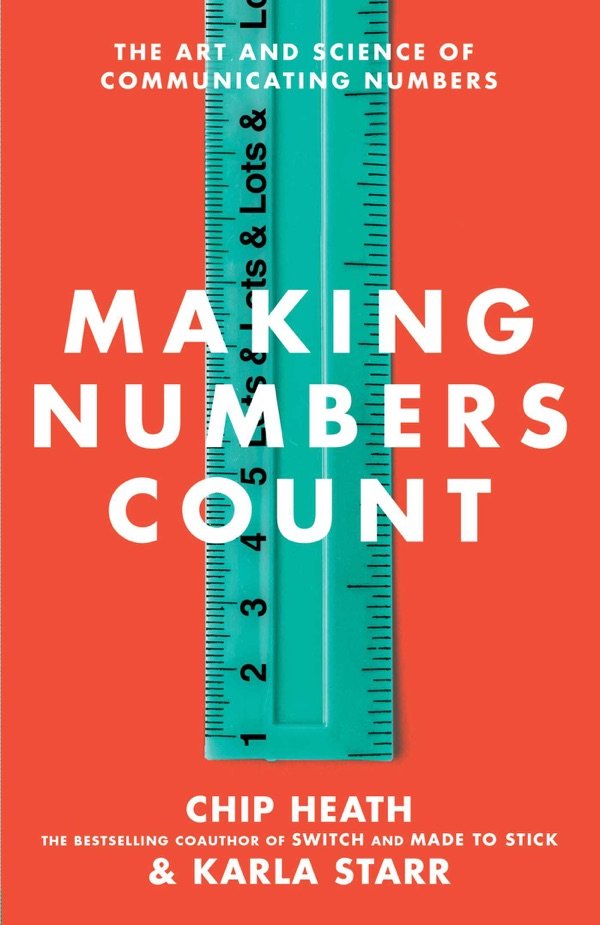
Making Numbers Count: The Art and Science of Communicating Numbers
von Chip Heath
Jeff Bezos is worth $198 billion. Let’s imagine if each step of a staircase represents $100,000 in the bank. Most people, including 1 in 2 Americans and 89% of the world, can’t even step onto the first step of the staircase because they have less. After 4 steps, we’ve lost over 75% of Americans. Fewer than 1 in 10 people will ever reach the 10th step: a million dollars. Now put on your most comfortable hiking shoes. You’d have to climb for almost 3 hours before reaching the net worth of a billionaire. After spending 9 hours a day climbing steps for 2 months, you’d have Ironman-level quads as you finally reach the wealth of Jeff Bezos. Activate the Senses The current operating system for programming industrial robots is from 1969. You want to convince people that that is ludicrously out of date… As people enter the meeting room, play music from 1969. During your discussion section, say: “We call those ‘classic’ rock and roll songs. Do you want your tech to be classic?” To the music soundtrack, add visuals: Show ads for cars from 1969, clock radios, a computer, rotary-dial telephones, television sets with big dials. Serve them a TV dinner with Baked Alaska for dessert. Remind them: “If you miss an episode of a TV show, you may never see it again.”
For numbers less than 1, you can use a method we call “counting in baskets” to make things start to show up as whole numbers. If you find that .2% of people have a certain trait, use a basket size of at least 500, maybe 1,000, to make them show up as real people. “1 out of 500” or “2 out of 1,000” makes these abstract percentages into real things.
In 2020, Apple was at one point valued at over $2 trillion. Imagine Apple as a country, with its shareholders as citizens and its citizens’ sole source of wealth their Apple stock. The total wealth of Apple would still be ahead of 150/171 countries, including Norway, South Africa, Thailand, and Saudi Arabia.
The higher numbers get, the less sensitive we get to them, a phenomenon psychologists have labeled “psychophysical numbing.” Moving on the number scale from 10 to 20 feels significant. But moving an equal distance from 340 to 350, even though it’s the same increase, we feel nothing… that’s “numbing.”
“If cows were a country,” they would be the third-highest producer of greenhouse emissions among all nations. They produce more emissions than Saudi Arabia or Australia or India, “and surpass every country in the European Union combined. They lag behind only China and America.” (Based on Steven Chu.)
Whatever the quantity you’re trying to highlight—from laptop size to nerve speed—it stands out more when contrasted against the unspoken assumptions your audience brings to the scenario. Whenever possible, crystallize these assumptions right before the reveal. What does your audience think they know?
"Jeff Bezos is worth $198 billion. Let’s imagine if each step of a staircase represents $100,000 in the bank. Most people, including 1 in 2 Americans and 89% of the world, can’t even step onto the first step of the staircase because they have less. After 4 steps, we’ve lost over 75% of Americans. Fewer than 1 in 10 people will ever reach the 10th step: a million dollars. Now put on your most comfortable hiking shoes. You’d have to climb for almost 3 hours before reaching the net worth of a billionaire. After spending 9 hours a day climbing steps for 2 months, you’d have Ironman-level quads as you finally reach the wealth of Jeff Bezos."
"Activate the Senses The current operating system for programming industrial robots is from 1969. You want to convince people that that is ludicrously out of date… As people enter the meeting room, play music from 1969. During your discussion section, say: “We call those ‘classic’ rock and roll songs. Do you want your tech to be classic?” To the music soundtrack, add visuals: Show ads for cars from 1969, clock radios, a computer, rotary-dial telephones, television sets with big dials. Serve them a TV dinner with Baked Alaska for dessert. Remind them: “If you miss an episode of a TV show, you may never see it again.”"
"If we wanted to imagine a different era, we might model the day of a hunter-gatherer or, for that matter, a lion, against our own—how much time is spent hunting, sleeping, fighting, playing? We could model an indie band’s revenue and see whether touring, endorsements, or record sales are keeping them afloat. Whatever the system, a scale model makes all the complex dynamics much more approachable, and lets us bring the numbers into one place where they all make sense. Here, we can get the conversation started. Here, we can make the numbers count."
"Amazon founder Jeff Bezos increased his fortune by $75 billion in 2020. Think about $25,000: how many weeks do you have to work to make that much? How dramatically would your life change if someone gave you $25,000? Would you finally be debt-free? If you had to give away $25,000, how many people’s lives could you save by paying for their food, rent, or medical bills? That’s what Jeff Bezos made in the time it took you to read this (11 seconds)."
"We’ve seen sixth graders (11-year-olds) get excited about knowing the difference between a million seconds and a billion seconds. A million seconds is 12 days from now, the next pizza day in the cafeteria. A billion seconds is 32 years, unfathomably far off in the future (the 11-year-old will be 43!), past high school and college and first jobs and over the horizon into the boring years of chauffeuring kids and heart attacks."
"For numbers less than 1, you can use a method we call “counting in baskets” to make things start to show up as whole numbers. If you find that .2% of people have a certain trait, use a basket size of at least 500, maybe 1,000, to make them show up as real people. “1 out of 500” or “2 out of 1,000” makes these abstract percentages into real things."
"In 2020, Apple was at one point valued at over $2 trillion. Imagine Apple as a country, with its shareholders as citizens and its citizens’ sole source of wealth their Apple stock. The total wealth of Apple would still be ahead of 150/171 countries, including Norway, South Africa, Thailand, and Saudi Arabia."
- →For numbers less than 1, you can use a method we call “counting in baskets” to make things start to show up as whole numbers. If you find that .2% of people have a certain trait, use a basket size of at least 500, maybe 1,000, to make them show up as real people. “1 out of 500” or “2 out of 1,000” makes these abstract percentages into real things.
- →“If cows were a country,” they would be the third-highest producer of greenhouse emissions among all nations. They produce more emissions than Saudi Arabia or Australia or India, “and surpass every country in the European Union combined. They lag behind only China and America.” (Based on Steven Chu.)
- →Whatever the quantity you’re trying to highlight—from laptop size to nerve speed—it stands out more when contrasted against the unspoken assumptions your audience brings to the scenario. Whenever possible, crystallize these assumptions right before the reveal. What does your audience think they know?
- →Often experts become so accustomed to their own wizardry that they no longer see how much work it takes for the rest of us to do what they do. Researchers call this “the Curse of Knowledge,” and it is the supervillain in any communication domain.
Ähnliche Bücher gesucht?
Beschreibe deine Situation. Die Suche findet das passende Buch aus der gesamten Bibliothek.