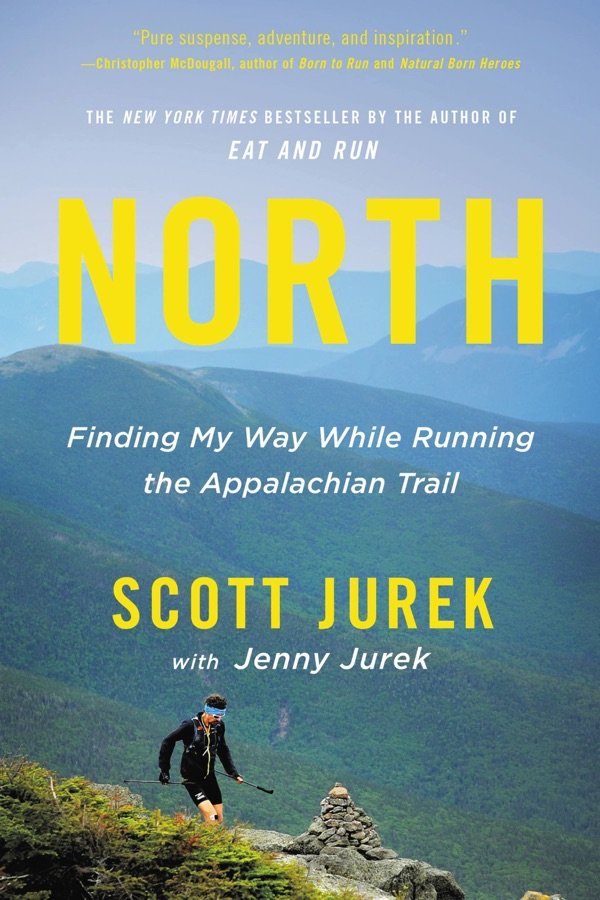
North: Finding My Way While Running the Appalachian Trail
von Scott Jurek
“It is not the critic who counts; not the man who points out how the strong man stumbles…. The credit belongs to the man who is actually in the arena, whose face is marred by dust and sweat and blood; who strives valiantly…who at the best knows in the end the triumph of high achievement, and who at the worst, if he fails, at least fails while daring greatly, so that his place shall never be with those cold and timid souls who neither know victory nor defeat.” Elective suffering is such a strange thing. At its essence, pushing his limits was a way for Jurker to learn more about himself and our relationship. Like Dean Potter once said, “I willingly expose myself to death-consequence situations in order to predictably enter heightened awareness.…And [it] often leads to a feeling of connectivity with everything.”
Elective suffering is such a strange thing. At its essence, pushing his limits was a way for Jurker to learn more about himself and our relationship. Like Dean Potter once said, “I willingly expose myself to death-consequence situations in order to predictably enter heightened awareness.…And [it] often leads to a feeling of connectivity with everything.”
We often think we can’t go any farther and feel like we have nothing left to give, yet there is a hidden potential and strength in all of us, begging us to find it. We arrive at it via different means—sometimes reward, sometimes fear. There was something to Horty’s motivational theory, and finding that desire was the most vexing problem.
The mind of a warrior (or anyone performing a difficult task) should be so attuned to the moment that thoughts and emotions do not impede proper action. A mind in this condition is thought to function so optimally that the right decisions come naturally and pain and fear disappear.
Because I’m stuck. Because I’m forty and I need to feel what it’s like to go to the edge again, and then go farther. Because I’m so thankful for everything I have, and for just a little while I need to remember what it feels like to have none of it.
Perhaps Timmy said it best when offering a pop-psychology assessment of my post-run state: “After such a beautiful and brutal odyssey, that white trail blaze is branded onto his soul forever.” I had nothing to add to that. I still don’t.
"“It is not the critic who counts; not the man who points out how the strong man stumbles…. The credit belongs to the man who is actually in the arena, whose face is marred by dust and sweat and blood; who strives valiantly…who at the best knows in the end the triumph of high achievement, and who at the worst, if he fails, at least fails while daring greatly, so that his place shall never be with those cold and timid souls who neither know victory nor defeat.”"
"Elective suffering is such a strange thing. At its essence, pushing his limits was a way for Jurker to learn more about himself and our relationship. Like Dean Potter once said, “I willingly expose myself to death-consequence situations in order to predictably enter heightened awareness.…And [it] often leads to a feeling of connectivity with everything.”"
"We often think we can’t go any farther and feel like we have nothing left to give, yet there is a hidden potential and strength in all of us, begging us to find it. We arrive at it via different means—sometimes reward, sometimes fear. There was something to Horty’s motivational theory, and finding that desire was the most vexing problem."
"The mind of a warrior (or anyone performing a difficult task) should be so attuned to the moment that thoughts and emotions do not impede proper action. A mind in this condition is thought to function so optimally that the right decisions come naturally and pain and fear disappear."
"Because I’m stuck. Because I’m forty and I need to feel what it’s like to go to the edge again, and then go farther. Because I’m so thankful for everything I have, and for just a little while I need to remember what it feels like to have none of it."
"Perhaps Timmy said it best when offering a pop-psychology assessment of my post-run state: “After such a beautiful and brutal odyssey, that white trail blaze is branded onto his soul forever.” I had nothing to add to that. I still don’t."
"We often think we can’t go any farther and feel like we have nothing left to give, yet there is a hidden potential and strength in all of us, begging us to find it. We arrive at it via different means—sometimes reward, sometimes fear."
- →We often think we can’t go any farther and feel like we have nothing left to give, yet there is a hidden potential and strength in all of us, begging us to find it. We arrive at it via different means—sometimes reward, sometimes fear. There was something to Horty’s motivational theory, and finding that desire was the most vexing problem.
- →The mind of a warrior (or anyone performing a difficult task) should be so attuned to the moment that thoughts and emotions do not impede proper action. A mind in this condition is thought to function so optimally that the right decisions come naturally and pain and fear disappear.
- →Because I’m stuck. Because I’m forty and I need to feel what it’s like to go to the edge again, and then go farther. Because I’m so thankful for everything I have, and for just a little while I need to remember what it feels like to have none of it.
- →We often think we can’t go any farther and feel like we have nothing left to give, yet there is a hidden potential and strength in all of us, begging us to find it. We arrive at it via different means—sometimes reward, sometimes fear.
Ähnliche Bücher gesucht?
Beschreibe deine Situation. Die Suche findet das passende Buch aus der gesamten Bibliothek.