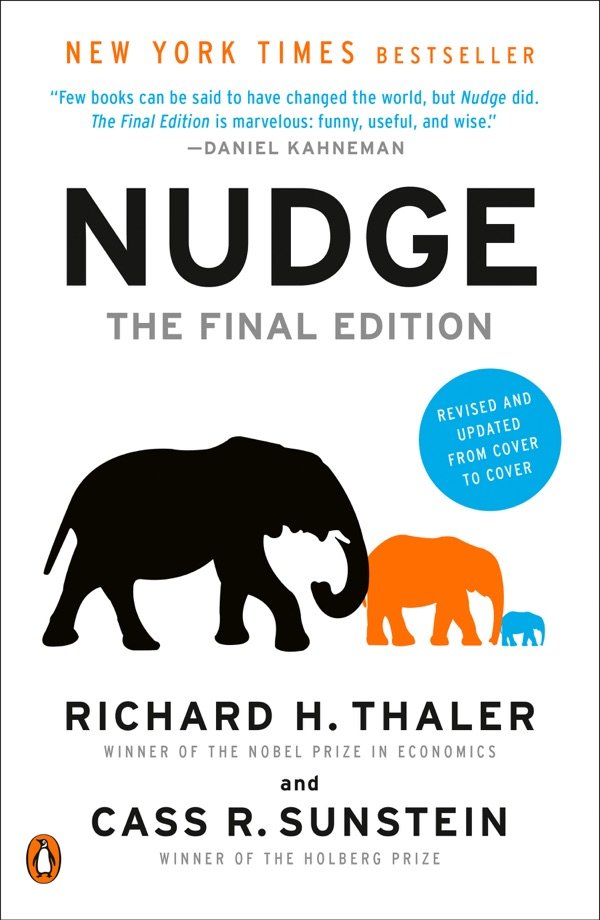
Nudge: Improving Decisions About Health, Wealth, and Happiness
von Richard H. Thaler
The combination of loss aversion with mindless choosing implies that if an option is designated as the “default,” it will attract a large market share. Default options thus act as powerful nudges. Self-control issues are most likely to arise when choices and their consequences are separated in time. At one extreme are what might be called investment goods, such as exercise, flossing, and dieting. For these goods the costs are borne immediately, but the benefits are delayed. For investment goods, most people err on the side of doing too little.
The combination of loss aversion with mindless choosing implies that if an option is designated as the “default,” it will attract a large market share. Default options thus act as powerful nudges.
Self-control issues are most likely to arise when choices and their consequences are separated in time. At one extreme are what might be called investment goods, such as exercise, flossing, and dieting. For these goods the costs are borne immediately, but the benefits are delayed. For investment goods, most people err on the side of doing too little.
Drawing on some well-established findings in social science, we show that in many cases, individuals make pretty bad decisions—decisions they would not have made if they had paid full attention and possessed complete information, unlimited cognitive abilities, and complete self-control.
One strategy to use is what Amos Tversky (1972) called “elimination by aspects.” Someone using this strategy first decides what aspect is most important (say, commuting distance), establishes a cutoff level (say, no more than a thirty-minute commute), then eliminates all the alternatives that do not come up to this standard.
A good system of choice architecture helps people to improve their ability to map and hence to select options that will make them better off. One way to do this is to make the information about various options more comprehensible, by transforming numerical information into units that translate more readily into actual use.
"The combination of loss aversion with mindless choosing implies that if an option is designated as the “default,” it will attract a large market share. Default options thus act as powerful nudges."
"Self-control issues are most likely to arise when choices and their consequences are separated in time. At one extreme are what might be called investment goods, such as exercise, flossing, and dieting. For these goods the costs are borne immediately, but the benefits are delayed. For investment goods, most people err on the side of doing too little."
"Drawing on some well-established findings in social science, we show that in many cases, individuals make pretty bad decisions—decisions they would not have made if they had paid full attention and possessed complete information, unlimited cognitive abilities, and complete self-control."
"The false assumption is that almost all people, almost all of the time, make choices that are in their best interest or at the very least are better than the choices that would be made by someone else. We claim that this assumption is false—indeed, obviously false. In fact, we do not think that anyone believes it on reflection. Suppose that a chess novice were to play against an experienced player. Predictably, the novice would lose precisely because he made inferior choices—choices that could easily be improved by some helpful hints."
"Social influences come in two basic categories. The first involves information. If many people do something or think something, their actions and their thoughts convey information about what might be best for you to do or think. The second involves peer pressure. If you care about what other people think about you (perhaps in the mistaken belief that they are paying some attention to what you are doing—see below), then you might go along with the crowd to avoid their wrath or curry their favor."
"One strategy to use is what Amos Tversky (1972) called “elimination by aspects.” Someone using this strategy first decides what aspect is most important (say, commuting distance), establishes a cutoff level (say, no more than a thirty-minute commute), then eliminates all the alternatives that do not come up to this standard."
"A good system of choice architecture helps people to improve their ability to map and hence to select options that will make them better off. One way to do this is to make the information about various options more comprehensible, by transforming numerical information into units that translate more readily into actual use."
- →One strategy to use is what Amos Tversky (1972) called “elimination by aspects.” Someone using this strategy first decides what aspect is most important (say, commuting distance), establishes a cutoff level (say, no more than a thirty-minute commute), then eliminates all the alternatives that do not come up to this standard.
- →A good system of choice architecture helps people to improve their ability to map and hence to select options that will make them better off. One way to do this is to make the information about various options more comprehensible, by transforming numerical information into units that translate more readily into actual use.
- →Those doors are bad architecture because they violate a simple psychological principle with a fancy name: stimulus response compatibility. The idea is that you want the signal you receive (the stimulus) to be consistent with the desired action. When there are inconsistencies, performance suffers and people blunder.
- →Once I have a mug, I don’t want to give it up. But if I don’t have one, I don’t feel an urgent need to buy one. What this means is that people do not assign specific values to objects. When they have to give something up, they are hurt more than they are pleased if they acquire the very same thing.
Ähnliche Bücher gesucht?
Beschreibe deine Situation. Die Suche findet das passende Buch aus der gesamten Bibliothek.