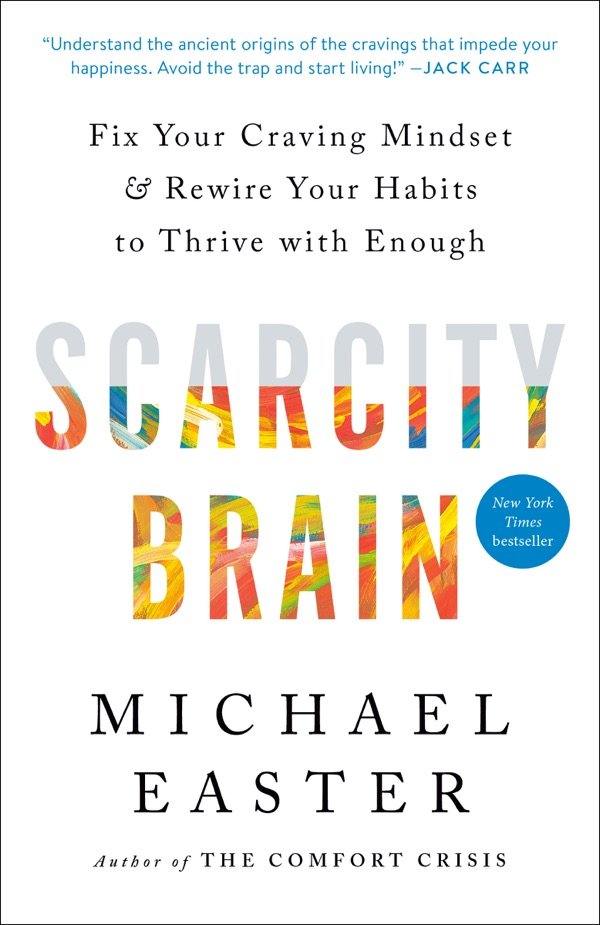
Scarcity Brain: Fix Your Craving Mindset and Rewire Your Habits to Thrive with Enough
von Michael Easter
We can shift scarcity loops into abundance loops. That is, find hobbies that have the three parts of the scarcity loop but help us do things that are good for us. Like what Zerra does with her shed hunts or what Hanke did with Pokémon Go. Many activities in nature thrust us into the loop. For example, fishing, bird watching, rock collecting, and more all mimic the scarcity loop. No, the repeatability isn’t as rapid as we’ll find online in TikTok or slot machines—we won’t be catching fish or seeing bald eagles every two seconds—but the harder work the activities require can make them more rewarding. Along the way, we’re doing what’s always been good for us. Researchers in the U.K., for example, analyzed the lyrics of 150,000 popular songs released between 1965 and 2015. They wrote, “The usage of [the word] ‘love,’ for example, practically halved in 50 years.” The word “hate” didn’t appear in popular songs until 1990 and now finds itself in 20 to 30 hits a year. Similarly, the words “joy” and “happy” fell while “pain” and “sorrow” grew. Another group analyzed millions of news headlines and found that they got significantly more negative. Global unhappiness hit a record high in 2021. One extensive study found “negative feelings—worry, sadness, and anger—have been rising around the world.”
For example, closing a big deal we’ve worked hard on, finishing faster than we expected in a 10K race, or creating something of value. Tracy said, “We feel authentic pride even if no one sees what we’ve done. But if someone happens to see the great thing we did, then it feels extra good.” Authentic pride boosts creativity and long-term mental and physical health and gives us lasting influence.
UCLA scientists say part of the reason we tend to collect so much stuff is that we don’t have a biological governor that tells us we’ve overbought. If we’re eating or drinking, we frequently overdo it, but eventually we’ll fill up and have to pause. But this isn’t so with stuff (or influence or information, for that matter). We can always repeat. Quickly. And get a storage unit.
“Technology is here. It’s not moving away,” Hanke told me. “So it’s up to us to try to shape it into something that’s helpful to us and not destructive to us. If we just leave it alone and let whatever happens happen, lots of bad things are going to occur. It’s going to take huge amounts of conscious effort repeated over and over forever to keep it under control.” He
When pressed, the happiness researchers recognize that millions of people throughout history have found immense meaning and satisfaction in the deep work of solitude. But they warn that solitude is not something for “average people.” I disagree. The monks disagree. Thousands of years of myth and cultural tradition disagree. Who, exactly, is average?
Problematic use of new technology, in particular, has recently boomed. Especially the technology leveraging the scarcity loop. The data shows just over 2 percent of the world’s population is addicted to drugs or alcohol. A study in the Journal of Psychiatric Research suggests the percentage of people addicted to technology is now roughly the same.
"We can shift scarcity loops into abundance loops. That is, find hobbies that have the three parts of the scarcity loop but help us do things that are good for us. Like what Zerra does with her shed hunts or what Hanke did with Pokémon Go. Many activities in nature thrust us into the loop. For example, fishing, bird watching, rock collecting, and more all mimic the scarcity loop. No, the repeatability isn’t as rapid as we’ll find online in TikTok or slot machines—we won’t be catching fish or seeing bald eagles every two seconds—but the harder work the activities require can make them more rewarding. Along the way, we’re doing what’s always been good for us."
"Researchers in the U.K., for example, analyzed the lyrics of 150,000 popular songs released between 1965 and 2015. They wrote, “The usage of [the word] ‘love,’ for example, practically halved in 50 years.” The word “hate” didn’t appear in popular songs until 1990 and now finds itself in 20 to 30 hits a year. Similarly, the words “joy” and “happy” fell while “pain” and “sorrow” grew. Another group analyzed millions of news headlines and found that they got significantly more negative. Global unhappiness hit a record high in 2021. One extensive study found “negative feelings—worry, sadness, and anger—have been rising around the world.”"
"Thomas Aquinas, the thirteenth-century Dominican monk and philosopher, put it this way: “Beneath the multitudinous and even conflicting desires of [people] we can see the one desire which gives unity and meaning, force and decision to all human desires. All [people] seek what they seek for one reason: they think it will satisfy them, they believe that the accomplishment of their desires will make them happy. “Happiness,” he wrote, “is the goal of all human activity. The search for happiness is the common ground on which all human desires, all human ambitions meet.”"
"“There’s a zillion ways a person can recover,” said Szalavitz. “But they tend to all be getting a new passion and a new sense of meaning and purpose and community and connection. One person might fall in love with exercise. Another might get really into rock climbing. Another person might hate both of those things and need to see a specialist for an issue like childhood trauma they were managing with drugs. But it’s all about figuring out how to find your way in life again and deal with whatever led a person to become addicted in the first place.”"
"The philosopher Thi Nguyen explained that there’s a difference between knowledge and understanding. Knowledge is possessing facts. Understanding is different. “First,” wrote Nguyen in a 2021 paper, “when we understand something, we not only possess a lot of independent facts, but we see how those facts connect….Second, when we understand something, we possess some internal model or account of it which we can use to make predictions, conduct further investigations, and categorize new phenomena.”"
"Digital machines could be programmed with any odds Redd wanted. Say, 1 in 250,000 odds for a jackpot. This allowed him to offer bigger payouts. The average jackpots of the new machines swelled into the five- and six-figure range. Redd even connected machines from across the entire state of Nevada and pooled their money to offer multimillion-dollar jackpots. He called these “wide-area progressive jackpots.” They were like the Powerball lottery of slot machines."
"Temu, a casino-like online store that sells items direct to the consumer from factories in China. It’s Amazon meets TikTok meets slot machine. “To engage with Temu is to be cornered in conversation with an AI-powered salesperson who is ushering you past endless tables of assorted goods to sell, right now, with escalating special offers, chained promotions, exclusive limited-time discounts, and lots and lots of free stuff,” explained New York magazine."
- →Problematic use of new technology, in particular, has recently boomed. Especially the technology leveraging the scarcity loop. The data shows just over 2 percent of the world’s population is addicted to drugs or alcohol. A study in the Journal of Psychiatric Research suggests the percentage of people addicted to technology is now roughly the same.
- →So perhaps happiness is the dramatic effort of a long and hard walk with seemingly no destination. The terrain is rough and the weather isn’t always perfect. It’s a stroll into an abyss. But at some point along the way, by trying to make each step a bit less about our immediate desires, we realize we’re happy, even though the journey hasn’t ended.
- →These moments when we wait to learn the outcome of an unpredictable reward are, in fact, so exciting that Stanford neuroscientists discovered that they become rewarding in and of themselves. The brain’s excitement and reward circuitry react strongest during these moments where we’re waiting to find out if we got the reward.
- →These moments when we wait to learn the outcome of an unpredictable reward are, in fact, so exciting that Stanford neuroscientists discovered that they become rewarding in and of themselves. The brain’s excitement and reward circuitry react strongest during these moments where we’re waiting to find out if we got the reward.
Ähnliche Bücher gesucht?
Beschreibe deine Situation. Die Suche findet das passende Buch aus der gesamten Bibliothek.