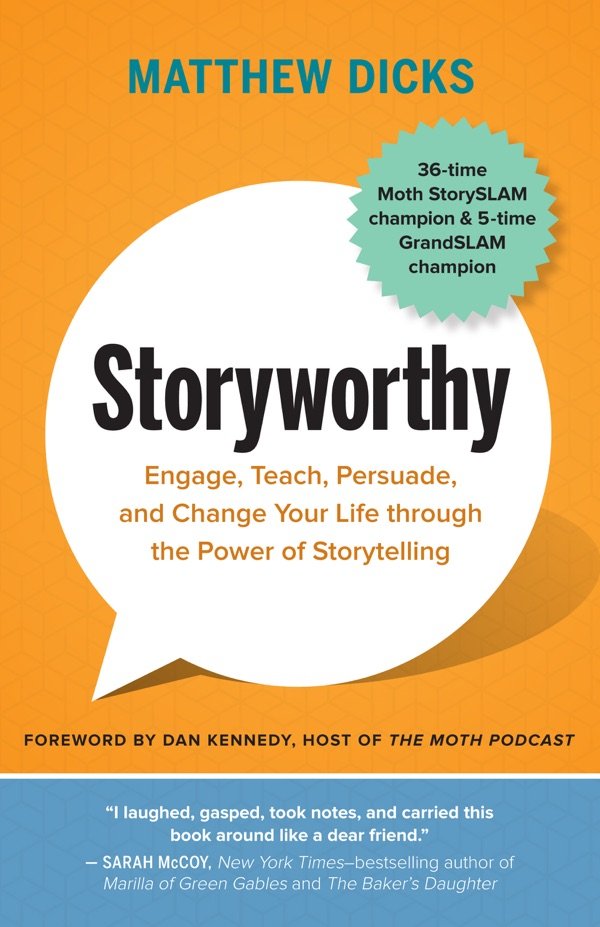
Storyworthy: Engage, Teach, Persuade, and Change Your Life through the Power of Storytelling
von Matthew Dicks
First Last Best Worst is also an excellent game for long car rides, first dates, or other moments of potential awkwardness and silence, or simply as a means of getting to know a person better. Regardless of where or how you play, I promise you that it will generate story ideas for you, and more importantly, you will find yourself filling in and filling out your life, making connections never seen before and expanding your memory beyond what you might have thought possible. Matt’s Five Rules of Drinking Stories 1. No one will ever care about your drinking stories as much as you. 2. Drinking stories never impress the type of people who one wants to impress. 3. If you have more than three excellent drinking stories from your entire life, you are incorrect in your estimation of an excellent drinking story. 4. Even the best drinking stories are seriously compromised if told during the daytime and/or at the workplace. 5. A drinking story about a moment when you were over the age of forty is often sad, pathetic, and even tragic except under the following circumstances: • It is absolutely your best drinking story of all time. • The storyteller is over seventy. Drinking stories about the elderly are acceptable in any form, because they are rare and oftentimes hilarious.
Do you see the way the sentences, paragraphs, and scene work against each other? They either oppose the previous sentence (it was this, but now it’s this) or they compile the previous sentences into a new idea (this plus this equal this). This is effective storytelling. It’s a way of making a story feel as if it’s constantly going someplace new, even if the events are linear and predictable.
The trick is to choose the Breadcrumbs that create the most wonder in the minds of your audience without giving them enough to guess correctly. Choose wisely. Breadcrumbs are particularly effective when the truly unexpected is coming. I am about to impersonate a charity worker in order to steal money from innocent homeowners. That is unexpected. The perfect moment to lay a Breadcrumb.
Let me say it again, because it’s that important: A great storyteller creates a movie in the mind of the audience. Listeners should be able to see the story in their mind’s eye at all times. At no point should the story become visually obscured or impossible to see. As the title of this chapter suggests, effective storytelling is cinema of the mind.
Don’t switch Elephants. Simply change the color. Changing the Elephant’s color provides an audience with one of the greatest surprises that a storyteller has to offer. My wife has often said that this is my preferred model for storytelling, and she’s right. I’m always most excited about a story when I can change the color of the Elephant.
This is the art of Milk Cans and a Baseball. Taking moments of potential humor and making them as funny as possible. The stack of milk cans need not be large to generate a laugh. “A car about the size of a box of Pop-Tarts” also gets a reaction. It’s only a giggle, because the tower of milk cans isn’t that tall, but it’s still a surprise.
"First Last Best Worst is also an excellent game for long car rides, first dates, or other moments of potential awkwardness and silence, or simply as a means of getting to know a person better. Regardless of where or how you play, I promise you that it will generate story ideas for you, and more importantly, you will find yourself filling in and filling out your life, making connections never seen before and expanding your memory beyond what you might have thought possible."
"Matt’s Five Rules of Drinking Stories 1. No one will ever care about your drinking stories as much as you. 2. Drinking stories never impress the type of people who one wants to impress. 3. If you have more than three excellent drinking stories from your entire life, you are incorrect in your estimation of an excellent drinking story. 4. Even the best drinking stories are seriously compromised if told during the daytime and/or at the workplace. 5. A drinking story about a moment when you were over the age of forty is often sad, pathetic, and even tragic except under the following circumstances: • It is absolutely your best drinking story of all time. • The storyteller is over seventy. Drinking stories about the elderly are acceptable in any form, because they are rare and oftentimes hilarious."
"Matt’s Five Rules of Drinking Stories 1.No one will ever care about your drinking stories as much as you. 2.Drinking stories never impress the type of people who one wants to impress. 3.If you have more than three excellent drinking stories from your entire life, you are incorrect in your estimation of an excellent drinking story. 4.Even the best drinking stories are seriously compromised if told during the daytime and/or at the workplace. 5.A drinking story about a moment when you were over the age of forty is often sad, pathetic, and even tragic except under the following circumstances: •It is absolutely your best drinking story of all time. •The storyteller is over seventy. Drinking stories about the elderly are acceptable in any form, because they are rare and oftentimes hilarious."
"To review, the strategies for preserving and enhancing surprise in a story: 1.Avoid thesis statements in storytelling. 2.Heighten the contrast between the surprise and the moment just before the surprise. 3.Use stakes to increase surprise. 4.Avoid giving away the surprise in your story by hiding important information that will pay off later (planting bombs). This is done by: •Obscuring them in a list of other details or examples. •Placing them as far away from the surprise as possible. •When possible, building a laugh around them to further camouflage their importance."
"This is why heist movies like the Ocean’s Eleven franchise explain almost every part of the robbers’ plan before they ever make a move. If you understand their plan to rob the casino, you can experience the same level of frustration, worry, fear, and suspense that the characters feel when their plans go awry. The filmmakers put the audience on Danny Ocean’s team. They know the plan, so they feel as if they are a part of the heist themselves."
"Do you see the way the sentences, paragraphs, and scene work against each other? They either oppose the previous sentence (it was this, but now it’s this) or they compile the previous sentences into a new idea (this plus this equal this). This is effective storytelling. It’s a way of making a story feel as if it’s constantly going someplace new, even if the events are linear and predictable."
"The trick is to choose the Breadcrumbs that create the most wonder in the minds of your audience without giving them enough to guess correctly. Choose wisely. Breadcrumbs are particularly effective when the truly unexpected is coming. I am about to impersonate a charity worker in order to steal money from innocent homeowners. That is unexpected. The perfect moment to lay a Breadcrumb."
- →Don’t switch Elephants. Simply change the color. Changing the Elephant’s color provides an audience with one of the greatest surprises that a storyteller has to offer. My wife has often said that this is my preferred model for storytelling, and she’s right. I’m always most excited about a story when I can change the color of the Elephant.
- →This is the art of Milk Cans and a Baseball. Taking moments of potential humor and making them as funny as possible. The stack of milk cans need not be large to generate a laugh. “A car about the size of a box of Pop-Tarts” also gets a reaction. It’s only a giggle, because the tower of milk cans isn’t that tall, but it’s still a surprise.
- →Many movies open with simple overhead views passing over an ocean, a cityscape, or a mountain pass. Many movies based in New York City open with an overhead approach of the island over water. This has nothing to do with the film but allows the director to open with momentum. Forward movement. We’re headed somewhere important.
- →I hear setups for backstory like this all the time, but none of these approaches are effective. This is not how movies work. Narrators do not appear on-screen to fill in backstories or provide pertinent details in the midst of a scene. Instead movies use flashbacks. Purposeful dialogue. Voice-over. Awful dream sequences.
Ähnliche Bücher gesucht?
Beschreibe deine Situation. Die Suche findet das passende Buch aus der gesamten Bibliothek.