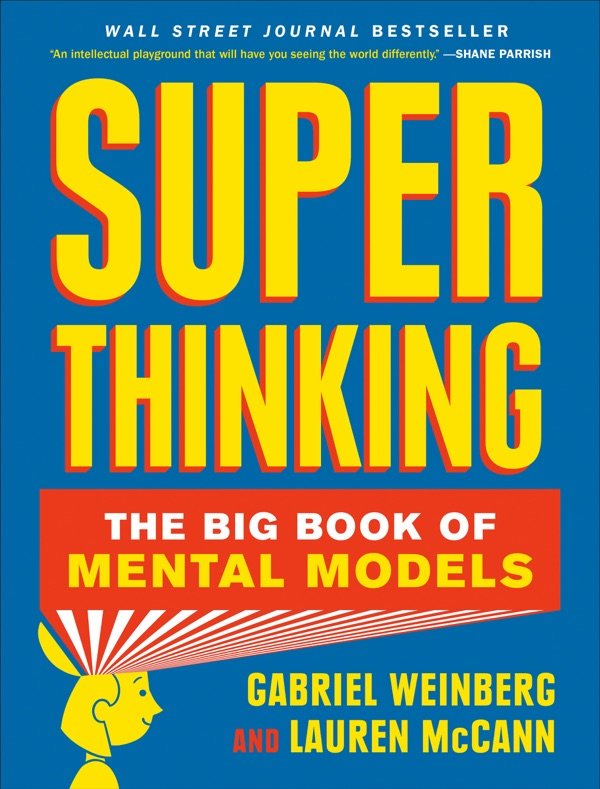
Super Thinking: The Big Book of Mental Models
von Gabriel Weinberg
When arguing from first principles, you are deliberately starting from scratch. You are explicitly avoiding the potential trap of conventional wisdom, which could turn out to be wrong. Even if you end up in agreement with conventional wisdom, by taking the first-principles approach, you will gain a much deeper understanding of the subject at hand. Ockham’s razor helps here. It advises that the simplest explanation is most likely to be true. When you encounter competing explanations that plausibly explain a set of data equally well, you probably want to choose the simplest one to investigate first.
When arguing from first principles, you are deliberately starting from scratch. You are explicitly avoiding the potential trap of conventional wisdom, which could turn out to be wrong. Even if you end up in agreement with conventional wisdom, by taking the first-principles approach, you will gain a much deeper understanding of the subject at hand.
Ockham’s razor helps here. It advises that the simplest explanation is most likely to be true. When you encounter competing explanations that plausibly explain a set of data equally well, you probably want to choose the simplest one to investigate first.
Antifragility is beyond resilience or robustness. The resilient resists shocks and stays the same; the antifragile gets better.
An oft-quoted military adage says: “No battle plan survives contact with the enemy.” And boxer Mike Tyson (prior to his 1996 bout against Evander Holyfield): “Everybody has a plan until they get punched in the mouth.”
Organizations face a similar danger because of inertia. A long-term commitment to an organizational strategy creates a lot of inertia toward that strategy. This inertia can lead to suboptimal decisions, referred to as a strategy tax.
"When arguing from first principles, you are deliberately starting from scratch. You are explicitly avoiding the potential trap of conventional wisdom, which could turn out to be wrong. Even if you end up in agreement with conventional wisdom, by taking the first-principles approach, you will gain a much deeper understanding of the subject at hand."
"Ockham’s razor helps here. It advises that the simplest explanation is most likely to be true. When you encounter competing explanations that plausibly explain a set of data equally well, you probably want to choose the simplest one to investigate first."
"Antifragility is beyond resilience or robustness. The resilient resists shocks and stays the same; the antifragile gets better."
"The central mental model to help you become a chef with your thinking is arguing from first principles. It’s the practical starting point to being wrong less, and it means thinking from the bottom up, using basic building blocks of what you think is true to build sound (and sometimes new) conclusions. First principles are the group of self-evident assumptions that make up the foundation on which your conclusions rest—the ingredients in a recipe or the mathematical axioms that underpin a formula."
"An oft-quoted military adage says: “No battle plan survives contact with the enemy.” And boxer Mike Tyson (prior to his 1996 bout against Evander Holyfield): “Everybody has a plan until they get punched in the mouth.”"
"Carl Jacobi was a nineteenth-century German mathematician who often used to say, “Invert, always invert” (actually he said, “Man muss immer umkehren,” because English wasn’t his first language). He meant that thinking about a problem from an inverse perspective can unlock new solutions and strategies. For example, most people approach investing their money from the perspective of making more money; the inverse approach would be investing money from the perspective of not losing money."
"When something happens, the proximate cause is the thing that immediately caused it to happen. In the case of the Challenger, the Rogers Commission Report showed that the proximate cause was the external hydrogen tank igniting. The root cause, by contrast, is what you might call the real reason something happened. People’s explanations for their behavior are no different: anyone can give you a reason for their behavior, but that might not be the real reason they did something."
- →Ockham’s razor helps here. It advises that the simplest explanation is most likely to be true. When you encounter competing explanations that plausibly explain a set of data equally well, you probably want to choose the simplest one to investigate first.
- →Organizations face a similar danger because of inertia. A long-term commitment to an organizational strategy creates a lot of inertia toward that strategy. This inertia can lead to suboptimal decisions, referred to as a strategy tax.
- →Another concept you will find useful when making purchasing decisions is anchoring, which describes your tendency to rely too heavily on first impressions when making decisions. You get anchored to the first piece of framing information you encounter. This tendency is commonly exploited by businesses when making offers.
- →One model that can help you figure out how to strike this balance in certain situations is the precautionary principle: when an action could possibly create harm of an unknown magnitude, you should proceed with extreme caution before enacting the policy. It’s like the medical principle of “First, do no harm.”
Ähnliche Bücher gesucht?
Beschreibe deine Situation. Die Suche findet das passende Buch aus der gesamten Bibliothek.