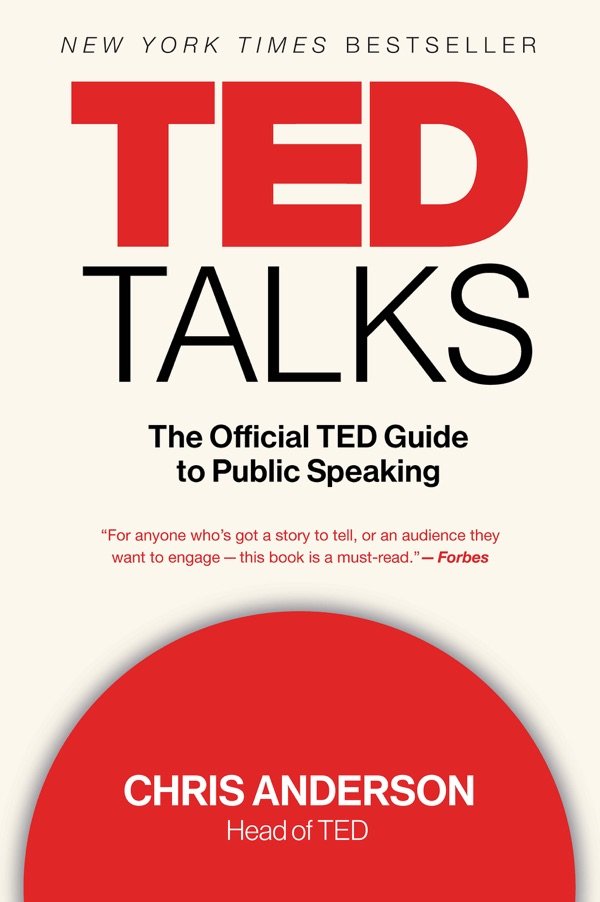
TED Talks: The Official TED Guide to Public Speaking
von Chris J. Anderson
As you work on developing your throughline, here’s a simple checklist: Is this a topic I’m passionate about? Does it inspire curiosity? Will it make a difference to the audience to have this knowledge? Is my talk a gift or an ask? Is the information fresh, or is it already out there? Can I truly explain the topic in the time slot allocated, complete with necessary examples? Do I know enough about this to make a talk worth the audience’s time? Do I have the credibility to take on this topic? What are the fifteen words that encapsulate my talk? Would those fifteen words persuade someone they’d be interested in hearing my talk? Contextual knowledge means knowing the bigger picture, knowing the way all the pieces fit together. Creative knowledge is the skill set obtained by exposure to a wide variety of other creative humans. A deeper understanding of our own humanity comes not from listening to your parents or your friends, nor to psychologists, neuroscientists, historians, evolutionary biologists, anthropologists, or spiritual teachers. It comes from listening to all of them.
A good exercise is to try to encapsulate your throughline in no more than fifteen words. And those fifteen words need to provide robust content. It’s not enough to think of your goal as, “I want to inspire the audience” or “I want to win support for my work.” It has to be more focused than that. What is the precise idea you want to build inside your listeners? What is their takeaway?
“Talk about what you know. Talk about what you know and love with all your heart. I want to hear about the subject that is most important to your life—not some random subject that you think will be a novelty. Bring me your well-worn passion of decades, not some fresh, radical gimmick, and trust me—I will be captivated.”
You can only use the tools that your audience has access to. If you start only with your language, your concepts, your assumptions, your values, you will fail. So instead, start with theirs. It’s only from that common ground that they can begin to build your idea inside their minds.
Driven by our growing connectedness, one of humankind’s most ancient abilities is being reinvented for the modern era. I’ve become convinced that tomorrow, even more than today, learning to present your ideas live to other humans will prove to be an absolutely essential skill for:
Persuasion is the act of replacing someone’s worldview with something better. And at its heart is the power of reason, capable of long-term impact. Reason is best accompanied by intuition pumps, detective stories, visuals, or other plausibility-priming devices.
"As you work on developing your throughline, here’s a simple checklist: Is this a topic I’m passionate about? Does it inspire curiosity? Will it make a difference to the audience to have this knowledge? Is my talk a gift or an ask? Is the information fresh, or is it already out there? Can I truly explain the topic in the time slot allocated, complete with necessary examples? Do I know enough about this to make a talk worth the audience’s time? Do I have the credibility to take on this topic? What are the fifteen words that encapsulate my talk? Would those fifteen words persuade someone they’d be interested in hearing my talk?"
"Contextual knowledge means knowing the bigger picture, knowing the way all the pieces fit together. Creative knowledge is the skill set obtained by exposure to a wide variety of other creative humans. A deeper understanding of our own humanity comes not from listening to your parents or your friends, nor to psychologists, neuroscientists, historians, evolutionary biologists, anthropologists, or spiritual teachers. It comes from listening to all of them."
"You haven’t really memorized your talk thoroughly until you can do an entire other activity that requires mental energy while giving your talk. Can you give your talk while measuring out the ingredients to make brownies? Can you give your talk while filing all the messy papers on your desk into a file cabinet? If you can give your talk while the cognitive load is that high on your system, you can give it well while focused on stage."
"An issue-based talk leads with morality. An idea-based talk leads with curiosity. An issue exposes a problem. An idea proposes a solution. An issue says, “Isn’t this terrible?” An idea says, “Isn’t this interesting?” It’s much easier to pull in an audience by framing the talk as an attempt to solve an intriguing riddle rather than as a plea for them to care. The first feels like a gift being offered. The second feels like an ask."
"Here’s the start of a talk thrown together without a throughline. “I want to share with you some experiences I had during my recent trip to Cape Town, and then make a few observations about life on the road . . .” Compare that with: “On my recent trip to Cape Town, I learned something new about strangers—when you can trust them, and when you definitely can’t. Let me share with you two very different experiences I had . . .”"
"Bullets belong in The Godfather. Avoid them at all costs. Dashes belong at the Olympics, not at the beginning of text. Resist underlining and italics—they’re too hard to read. Bold typefaces are OK. Drop shadows can occasionally be useful to improve legibility, especially for type on top of photos, but use the effect sparingly. Don’t use multiple type effects in the same line. It just looks terrible."
"The glorious images shown by conservation photographer Mac Stone at TEDxUF fully justify the title of his talk, “Photos that make you want to save the Everglades.” At TEDxVancouver, Jer Thorp spoke of the impact of clear infographics and proved his point with countless examples. And at TEDxSydney, biomedical animator Drew Barry used astounding 3D animations to reveal hidden processes in our cells."
- →You can only use the tools that your audience has access to. If you start only with your language, your concepts, your assumptions, your values, you will fail. So instead, start with theirs. It’s only from that common ground that they can begin to build your idea inside their minds.
- →“This is what I tell people: Practice doesn’t make perfect. Practice makes imperfection livable. Because when you know something inside out, you can PLAY with what comes your way, rather than shut it out.”
- →More system-level strategic thinking. The machines will do the grunt work, but we’ll need to figure out how best to set them up to work effectively with each other.
- →the goal of a great talk is to build an idea inside someone’s mind, then explanation is the essential tool for achieving that goal.
Ähnliche Bücher gesucht?
Beschreibe deine Situation. Die Suche findet das passende Buch aus der gesamten Bibliothek.