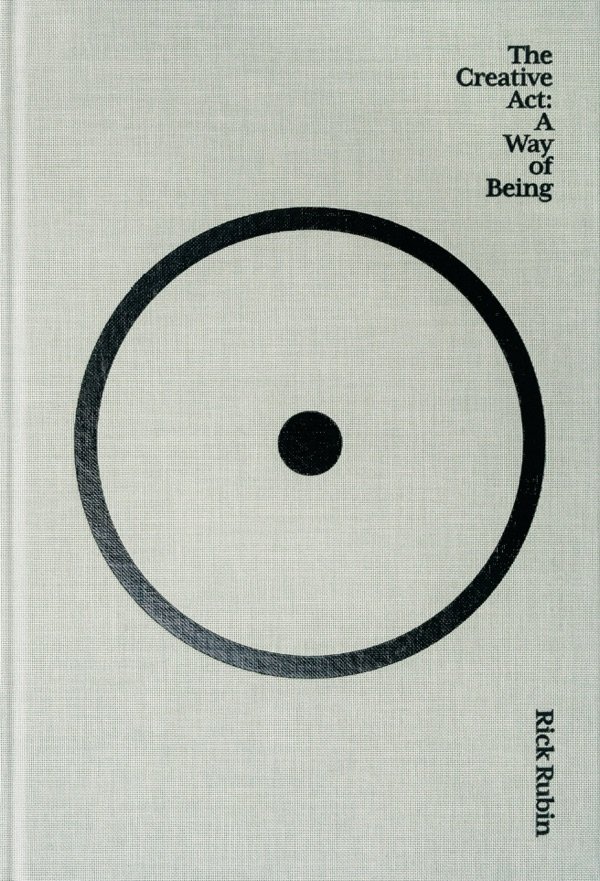
The Creative Act: A Way of Being
von Rick Rubin
It wasn’t necessarily its intelligence. It was the fact that the machine learned the game from scratch, with no coach, no human intervention, no lessons based on an expert’s past experience. The AI followed the fixed rules, not the millennia of accepted cultural norms attached to them. It didn’t take into account the three-thousand-year-old traditions and conventions of Go. It didn’t accept the narrative of how to properly play this game. It wasn’t held back by limiting beliefs. In their nature, many artists lean toward one of two categories: Experimenters or Finishers. Experimenters are partial to dreaming and play, finding it more difficult to complete and release their work. Finishers are the mirror image, a backward reflection. They move quickly to the end point with immediate clarity. They are less interested in exploring the possibilities and alternatives that the Experimentation and Craft phases can suggest.
All kinds of assumptions masquerade as laws: a suggestion from a self-help book, something heard in an interview, your favorite artist’s best tip, an expression in the culture, or something a teacher once told you. Rules direct us to average behaviors. If we’re aiming to create works that are exceptional, most rules don’t apply. __Average is nothing to aspire to.__
John Lennon once advised that if you start a song, write it through to the end in that sitting. The initial inspiration has a vitality in it that can carry you through the whole piece. Don’t be concerned if some of the parts are not yet all they can be. Get through a rough draft. A full, imperfect version is generally more helpful than a seemingly perfect fragment.
It’s commonly thought that achieving artistic mastery means working tirelessly. This is true. But it’s only half of it. There may be benefit in taking breaks, in stepping away and returning at a later point. Whether when practicing your instrument or over the course of your life’s work, recovery at the opportune time will cause greater leaps in improvement.
Living life as an artist is a practice. You are either engaging in the practice or you’re not. It makes no sense to say you’re not good at it. It’s like saying, “I’m not good at being a monk.” You are either living as a monk or you’re not. We tend to think of the artist’s work as the output. The real work of the artist is a way of being in the world.
This cycle of practice and adaptation creates multifaceted growth. You are building concentration and focus, and training your brain to learn more effectively. More easily. As a result, other skills are lifted as well. Teaching yourself to play piano will likely improve your hearing. And you may well get better at math.
"It wasn’t necessarily its intelligence. It was the fact that the machine learned the game from scratch, with no coach, no human intervention, no lessons based on an expert’s past experience. The AI followed the fixed rules, not the millennia of accepted cultural norms attached to them. It didn’t take into account the three-thousand-year-old traditions and conventions of Go. It didn’t accept the narrative of how to properly play this game. It wasn’t held back by limiting beliefs."
"In their nature, many artists lean toward one of two categories: Experimenters or Finishers. Experimenters are partial to dreaming and play, finding it more difficult to complete and release their work. Finishers are the mirror image, a backward reflection. They move quickly to the end point with immediate clarity. They are less interested in exploring the possibilities and alternatives that the Experimentation and Craft phases can suggest."
"Art is about the maker. Its aim: to be an expression of who we are. This makes competition absurd. Every artist’s playing field is specific to them. You are creating the work that best represents you. Another artist is making the work that best represents them. The two cannot be measured against one another. Art relates to the artist making it, and the unique contribution they are bringing to the culture."
"All kinds of assumptions masquerade as laws: a suggestion from a self-help book, something heard in an interview, your favorite artist’s best tip, an expression in the culture, or something a teacher once told you. Rules direct us to average behaviors. If we’re aiming to create works that are exceptional, most rules don’t apply. __Average is nothing to aspire to.__"
"John Lennon once advised that if you start a song, write it through to the end in that sitting. The initial inspiration has a vitality in it that can carry you through the whole piece. Don’t be concerned if some of the parts are not yet all they can be. Get through a rough draft. A full, imperfect version is generally more helpful than a seemingly perfect fragment."
"It’s commonly thought that achieving artistic mastery means working tirelessly. This is true. But it’s only half of it. There may be benefit in taking breaks, in stepping away and returning at a later point. Whether when practicing your instrument or over the course of your life’s work, recovery at the opportune time will cause greater leaps in improvement."
"Living life as an artist is a practice. You are either engaging in the practice or you’re not. It makes no sense to say you’re not good at it. It’s like saying, “I’m not good at being a monk.” You are either living as a monk or you’re not. We tend to think of the artist’s work as the output. The real work of the artist is a way of being in the world."
- →The best artists tend to be the ones with the most sensitive antennae to draw in the energy resonating at a particular moment. Many great artists first develop sensitive antennae not to create art but to protect themselves. They have to protect themselves because everything hurts more. They feel everything more deeply.
- →If we focus on what’s going on inside ourselves—sensations, emotions, the patterns of our thoughts—a wealth of material can be found. Our inner world is every bit as interesting, beautiful, and surprising as nature itself. It is, after all, born of nature.
- →If you have an idea you’re excited about and you don’t bring it to life, it’s not uncommon for the idea to find its voice through another maker. This isn’t because the other artist stole your idea, but because the idea’s time has come.
- →The only practice that matters is the one you consistently do, not the practice of any other artist. Find your most generative method, apply it, and then let it go when it is no longer of use. There is no wrong way to make art.
Ähnliche Bücher gesucht?
Beschreibe deine Situation. Die Suche findet das passende Buch aus der gesamten Bibliothek.