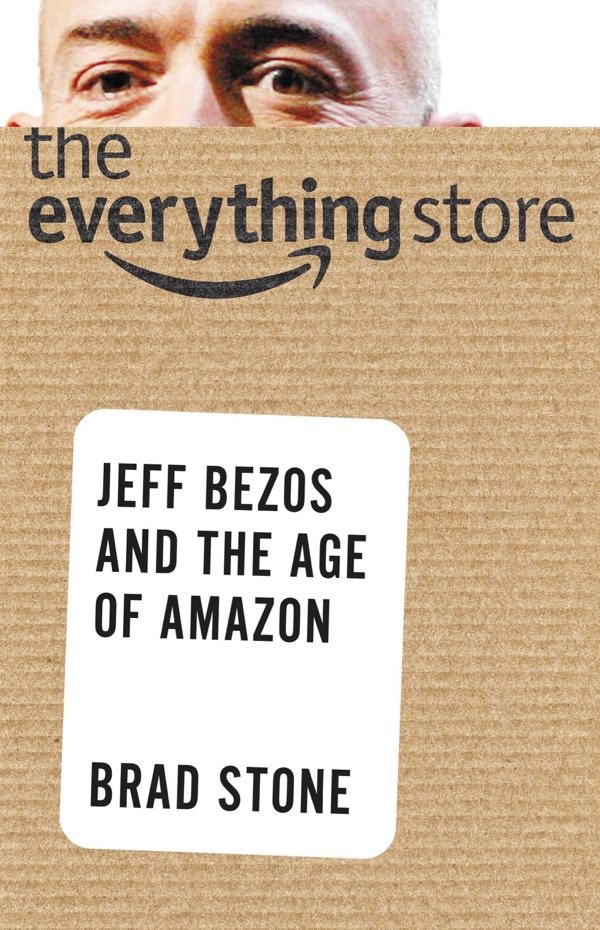
The Everything Store: Jeff Bezos and the Age of Amazon
von Brad Stone
Have Backbone; Disagree and Commit Leaders are obligated to respectfully challenge decisions when they disagree, even when doing so is uncomfortable or exhausting. Leaders have conviction and are tenacious. They do not compromise for the sake of social cohesion. Once a decision is determined, they commit wholly. Frugality We try not to spend money on things that don’t matter to customers. Frugality breeds resourcefulness, self-sufficiency and invention. There are no extra points for headcount, budget size or fixed expense.
Have Backbone; Disagree and Commit Leaders are obligated to respectfully challenge decisions when they disagree, even when doing so is uncomfortable or exhausting. Leaders have conviction and are tenacious. They do not compromise for the sake of social cohesion. Once a decision is determined, they commit wholly.
Frugality We try not to spend money on things that don’t matter to customers. Frugality breeds resourcefulness, self-sufficiency and invention. There are no extra points for headcount, budget size or fixed expense.
“If you look at why Amazon is so different than almost any other company that started early on the Internet, it’s because Jeff approached it from the very beginning with that long-term vision,” Hillis continues. “It was a multidecade project. The notion that he can accomplish a huge amount with a larger time frame, if he is steady about it, is fundamentally his philosophy.”
But through it all, Bezos never showed anxiety or appeared to worry about the wild swings in public sentiment. “We were all running around the halls with our hair on fire thinking, What are we going to do?” says Mark Britto, a senior vice president. But not Jeff. “I have never seen anyone so calm in the eye of a storm. Ice water runs through his veins,” Britto says.
Like a lot of other technology companies at the time, Amazon got an education in the wisdom of moving to a simpler and more flexible technology infrastructure, called service-oriented architecture. In this kind of framework, every feature and service is treated as an independent piece and each can easily be updated or replaced without breaking the whole.
"Have Backbone; Disagree and Commit Leaders are obligated to respectfully challenge decisions when they disagree, even when doing so is uncomfortable or exhausting. Leaders have conviction and are tenacious. They do not compromise for the sake of social cohesion. Once a decision is determined, they commit wholly."
"Frugality We try not to spend money on things that don’t matter to customers. Frugality breeds resourcefulness, self-sufficiency and invention. There are no extra points for headcount, budget size or fixed expense."
"Around the same time he was ripping televisions off the walls, Bezos made two significant changes to the corporate culture. As part of his ongoing quest for a better allocation of his own time, he decreed that he would no longer have one-on-one meetings with his subordinates. These meetings tended to be filled with trivial updates and political distractions, rather than problem solving and brainstorming. Even today, Bezos rarely meets alone with an individual colleague."
"“You don’t feel thirty percent smarter when the stock goes up by thirty percent, so when the stock goes down you shouldn’t feel thirty percent dumber,” he said at an all-hands meeting. He quoted Benjamin Graham, the British-born investor who inspired Warren Buffett: “In the short term, the stock market is a voting machine. In the long run, it’s a weighing machine” that measures a company’s true value. If Amazon stayed focused on the customer, Bezos declared, the company would be fine."
"“We are genuinely customer-centric, we are genuinely long-term oriented and we genuinely like to invent. Most companies are not those things. They are focused on the competitor, rather than the customer. They want to work on things that will pay dividends in two or three years, and if they don’t work in two or three years they will move on to something else. And they prefer to be close-followers rather than inventors, because it’s safer. So if you want to capture the truth about Amazon, that is why we are different. Very few companies have all of those three elements.”"
"Bezos had imbibed Walton’s book thoroughly and wove the Walmart founder’s credo about frugality and a “bias for action” into the cultural fabric of Amazon. In the copy he brought to Kathryn Dalzell, he had underlined one particular passage in which Walton described borrowing the best ideas of his competitors. Bezos’s point was that every company in retail stands on the shoulders of the giants that came before it. The book clearly resonated with Amazon’s founder. On the last page, a section completed a few weeks before his death, Walton wrote:"
"Bezos refined the formula even further. Every time a new feature or product was proposed, he decreed that the narrative should take the shape of a mock press release. The goal was to get employees to distill a pitch into its purest essence, to start from something the customer might see—the public announcement—and work backward. Bezos didn’t believe anyone could make a good decision about a feature or a product without knowing precisely how it would be communicated to the world—and what the hallowed customer would make of it."
- →Have Backbone; Disagree and Commit Leaders are obligated to respectfully challenge decisions when they disagree, even when doing so is uncomfortable or exhausting. Leaders have conviction and are tenacious. They do not compromise for the sake of social cohesion. Once a decision is determined, they commit wholly.
- →The Innovator’s Dilemma, by Harvard professor Clayton Christensen. Christensen wrote that great companies fail not because they want to avoid disruptive change but because they are reluctant to embrace promising new markets that might undermine their traditional businesses and that do not appear to satisfy their short-term growth requirements.
- →“I think the reason Kindle succeeded while others failed is that we were obsessive, not about trying to build the sexiest gadget in the world, but rather [about building] something that actually fulfilled what people wanted,” says Russ Grandinetti, a faithful Jeff Bot who later joined the Kindle team.
- →Wilke subscribed to the principles laid out in a seminal book about constraints in manufacturing, Eliyahu M. Goldratt’s The Goal, published in 1984. The book, cloaked in the guise of an entertaining novel, instructs manufacturers to focus on maximizing the efficiency of their biggest bottlenecks.
Ähnliche Bücher gesucht?
Beschreibe deine Situation. Die Suche findet das passende Buch aus der gesamten Bibliothek.