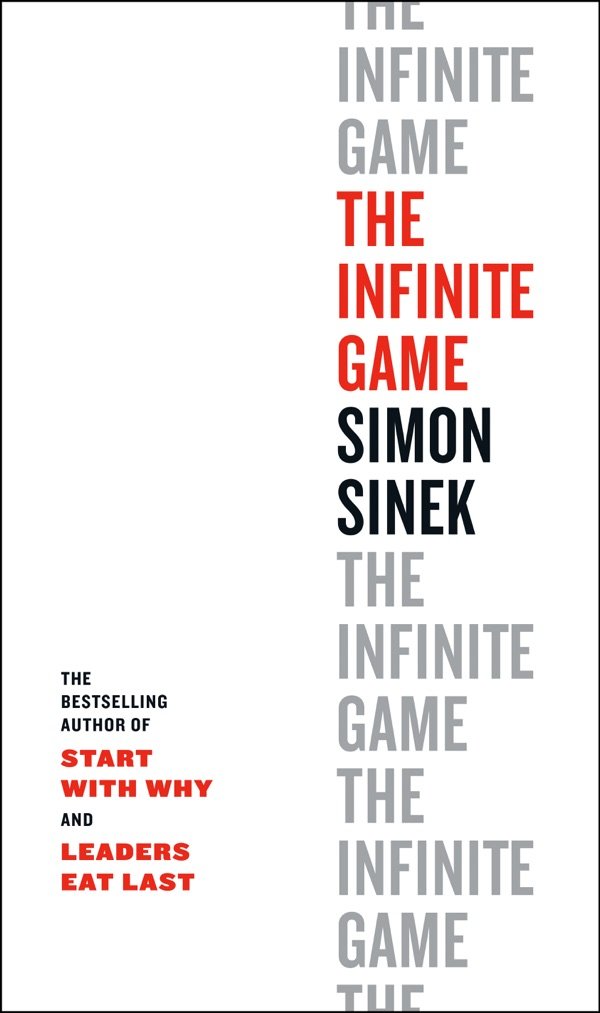
The Infinite Game
von Simon Sinek
Which means, to succeed in the Infinite Game of business, we have to stop thinking about who wins or who’s the best and start thinking about how to build organizations that are strong enough and healthy enough to stay in the game for many generations to come. Will, in contrast, is intangible and harder to measure. When we talk about will, we’re talking about the feelings people have when they come to work. Will encompasses morale, motivation, inspiration, commitment, desire to engage, desire to offer discretionary effort and so on. Will generally comes from inside sources like the quality of leadership and the clarity and strength of the Just Cause. Will represents the sum of all the human elements that contribute to the health of the organization.
Which means, to succeed in the Infinite Game of business, we have to stop thinking about who wins or who’s the best and start thinking about how to build organizations that are strong enough and healthy enough to stay in the game for many generations to come.
Simply put: The responsibility of business is to use its will and resources to advance a cause greater than itself, protect the people and places in which it operates and generate more resources so that it can continue doing all those things for as long as possible. An organization can do whatever it likes to build its business so long as it is responsible for the consequences of its actions.
In the Infinite Game of business, when our leaders maintain a finite mindset or put too much focus on finite objectives, they may be able to achieve a number one ranking with an arbitrary metric over an arbitrary time frame. But that doesn’t necessarily mean they are doing the things they need to ensure that the company can keep playing for as long as possible.
Lead with an Infinite Mindset There are three factors we must always consider when deciding how we want to lead: We don’t get to choose whether a particular game is finite or infinite. We do get to choose whether or not we want join the game. Should we choose to join the game, we can choose whether we want to play with a finite or an infinite mindset.
There’s a great irony in all this. When we apply finite-minded solutions to address an ethical fading problem that finite-minded thinking created, we get more ethical fading. When we use process and structure to fix cultural problems what we often get is more lying and cheating. Little lies become bigger lies. And the behavior becomes normalized.
"Which means, to succeed in the Infinite Game of business, we have to stop thinking about who wins or who’s the best and start thinking about how to build organizations that are strong enough and healthy enough to stay in the game for many generations to come."
"Will, in contrast, is intangible and harder to measure. When we talk about will, we’re talking about the feelings people have when they come to work. Will encompasses morale, motivation, inspiration, commitment, desire to engage, desire to offer discretionary effort and so on. Will generally comes from inside sources like the quality of leadership and the clarity and strength of the Just Cause. Will represents the sum of all the human elements that contribute to the health of the organization."
"When we lead with a finite mindset in an infinite game, it leads to all kinds of problems, the most common of which include the decline of trust, cooperation and innovation. Leading with an infinite mindset in an infinite game, in contrast, really does move us in a better direction. Groups that adopt an infinite mindset enjoy vastly higher levels of trust, cooperation and innovation and all the subsequent benefits."
"Simply put: The responsibility of business is to use its will and resources to advance a cause greater than itself, protect the people and places in which it operates and generate more resources so that it can continue doing all those things for as long as possible. An organization can do whatever it likes to build its business so long as it is responsible for the consequences of its actions."
"In the Infinite Game of business, when our leaders maintain a finite mindset or put too much focus on finite objectives, they may be able to achieve a number one ranking with an arbitrary metric over an arbitrary time frame. But that doesn’t necessarily mean they are doing the things they need to ensure that the company can keep playing for as long as possible."
"Lead with an Infinite Mindset There are three factors we must always consider when deciding how we want to lead: We don’t get to choose whether a particular game is finite or infinite. We do get to choose whether or not we want join the game. Should we choose to join the game, we can choose whether we want to play with a finite or an infinite mindset."
"There’s a great irony in all this. When we apply finite-minded solutions to address an ethical fading problem that finite-minded thinking created, we get more ethical fading. When we use process and structure to fix cultural problems what we often get is more lying and cheating. Little lies become bigger lies. And the behavior becomes normalized."
- →Which means, to succeed in the Infinite Game of business, we have to stop thinking about who wins or who’s the best and start thinking about how to build organizations that are strong enough and healthy enough to stay in the game for many generations to come.
- →There’s a great irony in all this. When we apply finite-minded solutions to address an ethical fading problem that finite-minded thinking created, we get more ethical fading. When we use process and structure to fix cultural problems what we often get is more lying and cheating. Little lies become bigger lies. And the behavior becomes normalized.
- →Disruption, remember, is often a symptom of a finite mindset. Leaders playing with a finite mindset often miss the opportunity to use a disruptive event in their industry to clarify their Cause. Instead, they double down on the finite game and simply start copying what the other players are doing with the hope that it will work for them too.
- →Markets will rise and fall, people will come and go, technologies will evolve, products and services will adapt to consumer tastes and market demands. We need something with permanence for us to rally around. Something that can withstand change and crisis. To keep us in the Infinite Game, our Cause must be durable, resilient and timeless.
Ähnliche Bücher gesucht?
Beschreibe deine Situation. Die Suche findet das passende Buch aus der gesamten Bibliothek.