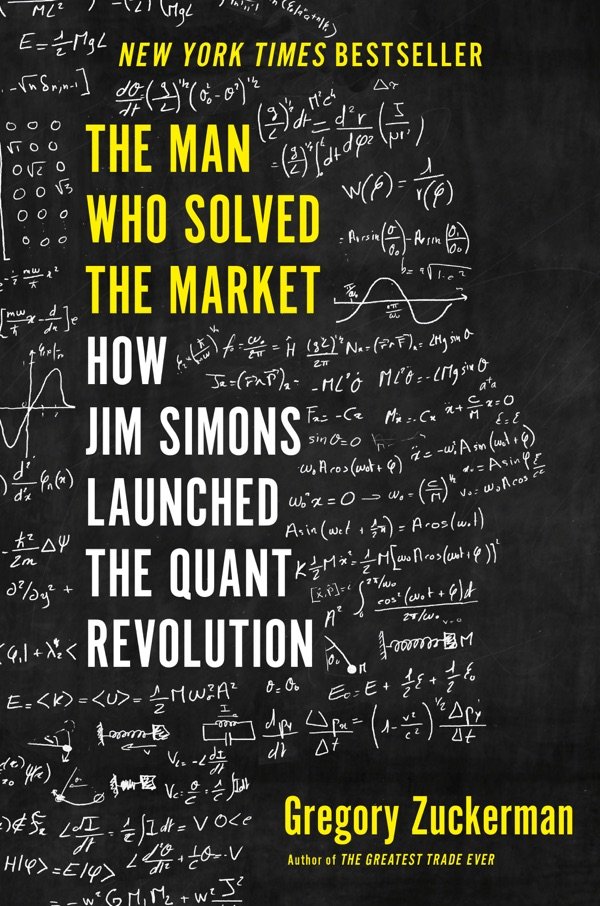
The Man Who Solved the Market: How Jim Simons Launched the Quant Revolution
von Gregory Zuckerman
By 1997, Medallion’s staffers had settled on a three-step process to discover statistically significant moneymaking strategies, or what they called their trading signals. Identify anomalous patterns in historic pricing data; make sure the anomalies were statistically significant, consistent over time, and nonrandom; and see if the identified pricing behavior could be explained in a reasonable way. “What you’re really modeling is human behavior,” explains Penavic, the researcher. “Humans are most predictable in times of high stress—they act instinctively and panic. Our entire premise was that human actors will react the way humans did in the past … we learned to take advantage.”
“What you’re really modeling is human behavior,” explains Penavic, the researcher. “Humans are most predictable in times of high stress—they act instinctively and panic. Our entire premise was that human actors will react the way humans did in the past … we learned to take advantage.”
“Be guided by beauty … it can be the way a company runs, or the way an experiment comes out, or the way a theorem comes out, but there’s a sense of beauty when something is working well, almost an aesthetic to it.”
Later, Renaissance would fully embrace stochastic differential equations for risk management and options pricing, but, for now, they couldn’t find a way to profit from these techniques, frustrating Carmona.
They posited that the market had as many as eight underlying “states”—such as “high variance,” when stocks experienced larger-than-average moves, and “good,” when shares generally rose.
“I don’t want to have to worry about the market every minute. I want models that will make money while I sleep,” Simons said. “A pure system without humans interfering.”
"By 1997, Medallion’s staffers had settled on a three-step process to discover statistically significant moneymaking strategies, or what they called their trading signals. Identify anomalous patterns in historic pricing data; make sure the anomalies were statistically significant, consistent over time, and nonrandom; and see if the identified pricing behavior could be explained in a reasonable way."
"“What you’re really modeling is human behavior,” explains Penavic, the researcher. “Humans are most predictable in times of high stress—they act instinctively and panic. Our entire premise was that human actors will react the way humans did in the past … we learned to take advantage.”"
"“Be guided by beauty … it can be the way a company runs, or the way an experiment comes out, or the way a theorem comes out, but there’s a sense of beauty when something is working well, almost an aesthetic to it.”"
"Later, Renaissance would fully embrace stochastic differential equations for risk management and options pricing, but, for now, they couldn’t find a way to profit from these techniques, frustrating Carmona."
"They posited that the market had as many as eight underlying “states”—such as “high variance,” when stocks experienced larger-than-average moves, and “good,” when shares generally rose."
"“I don’t want to have to worry about the market every minute. I want models that will make money while I sleep,” Simons said. “A pure system without humans interfering.”"
"“We’re right 50.75 percent of the time … but we’re 100 percent right 50.75 percent of the time,” Mercer told a friend. “You can make billions that way.”"
- →Later, Renaissance would fully embrace stochastic differential equations for risk management and options pricing, but, for now, they couldn’t find a way to profit from these techniques, frustrating Carmona.
- →“The lesson was: Do what you like in life, not what you feel you ‘should’ do,” Simons says. “It’s something I never forgot.”
- →No one ever made a decision because of a number. They need a story.
Ähnliche Bücher gesucht?
Beschreibe deine Situation. Die Suche findet das passende Buch aus der gesamten Bibliothek.