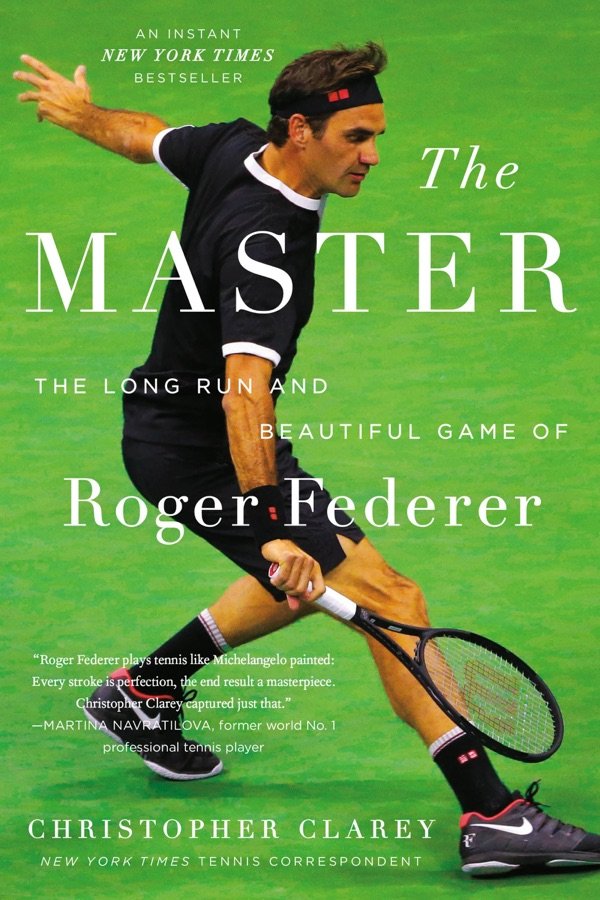
The Master: The Long Run and Beautiful Game of Roger Federer
von Christopher Clarey
What fascinated me about Roger then and still is that he manages to live in the present. He has a great ability to take things as they come. He lives a moment, experiences it fully, takes pleasure in it and finishes it and then moves on to the next. It’s for that reason you have the feeling that things happen very naturally with him. It’s a talent, and to be honest it’s a talent that even today fascinates me more than his tennis.” “The number one requirement to succeed at this level is I think the constant desire and open-mindedness to master and improve and evolve yourself in every aspect,” Djokovic told me recently. “I know Roger has talked about this a lot, and I think it’s something most top athletes in all sports can agree on. Stagnation is regression.”
“The number one requirement to succeed at this level is I think the constant desire and open-mindedness to master and improve and evolve yourself in every aspect,” Djokovic told me recently. “I know Roger has talked about this a lot, and I think it’s something most top athletes in all sports can agree on. Stagnation is regression.”
When he gives advice to young players, he often recommends that they take the opportunity to leave home for a stretch to build their sense of self-reliance, a key trait in a brutally competitive individual sport where trusting yourself can be every bit as important as trusting your forehand.
But he also sensed something in himself that many great athletes who chose tennis have sensed: a desire for control, for agency. “I wanted to have the victory or defeat in my own hands without having to depend on others,” Federer explained.
People talk about tactics,” Federer said. “But a lot of the time at this level it just comes down to instinct. It happens so fast that you have to hit the shot almost without thinking. There’s of course some luck involved.”
Federer is widely perceived as a natural, and yet he is a meticulous planner who has learned to embrace routine and self-discipline, plotting out his schedule well in advance and in considerable detail.
"What fascinated me about Roger then and still is that he manages to live in the present. He has a great ability to take things as they come. He lives a moment, experiences it fully, takes pleasure in it and finishes it and then moves on to the next. It’s for that reason you have the feeling that things happen very naturally with him. It’s a talent, and to be honest it’s a talent that even today fascinates me more than his tennis.”"
"“The number one requirement to succeed at this level is I think the constant desire and open-mindedness to master and improve and evolve yourself in every aspect,” Djokovic told me recently. “I know Roger has talked about this a lot, and I think it’s something most top athletes in all sports can agree on. Stagnation is regression.”"
"When he gives advice to young players, he often recommends that they take the opportunity to leave home for a stretch to build their sense of self-reliance, a key trait in a brutally competitive individual sport where trusting yourself can be every bit as important as trusting your forehand."
"But he also sensed something in himself that many great athletes who chose tennis have sensed: a desire for control, for agency. “I wanted to have the victory or defeat in my own hands without having to depend on others,” Federer explained."
"People talk about tactics,” Federer said. “But a lot of the time at this level it just comes down to instinct. It happens so fast that you have to hit the shot almost without thinking. There’s of course some luck involved.”"
"Federer is widely perceived as a natural, and yet he is a meticulous planner who has learned to embrace routine and self-discipline, plotting out his schedule well in advance and in considerable detail."
"Federer’s motto was: “It’s nice to be important but more important to be nice.” Nadal and his family subscribed to: “You are not special because of who you are but because of what you do.”"
- →When he gives advice to young players, he often recommends that they take the opportunity to leave home for a stretch to build their sense of self-reliance, a key trait in a brutally competitive individual sport where trusting yourself can be every bit as important as trusting your forehand.
- →Federer’s motto was: “It’s nice to be important but more important to be nice.” Nadal and his family subscribed to: “You are not special because of who you are but because of what you do.”
- →“The reason Roger is so interesting is because he’s so interested,” Paul Annacone, his former coach, once told me.
Ähnliche Bücher gesucht?
Beschreibe deine Situation. Die Suche findet das passende Buch aus der gesamten Bibliothek.