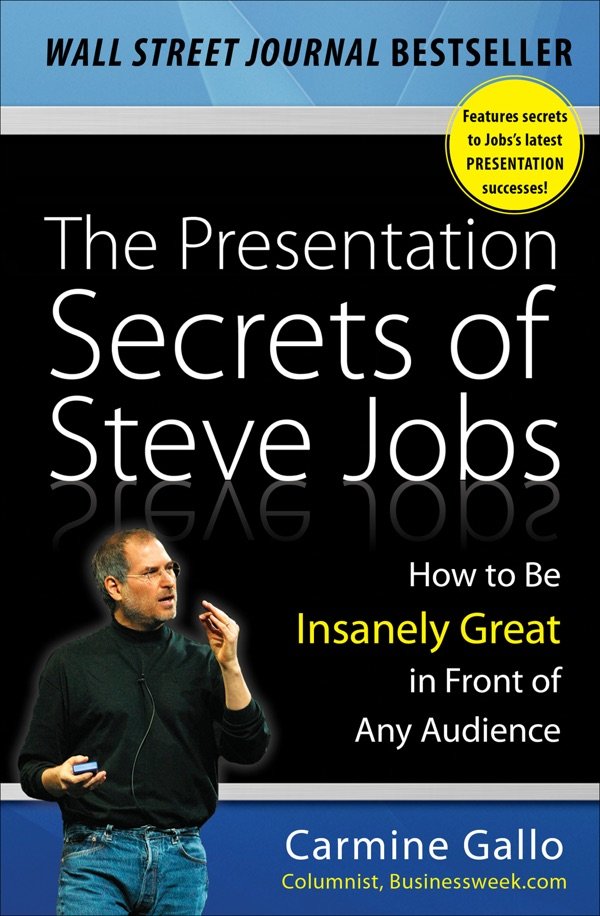
The Presentation Secrets of Steve Jobs
von Carmine Gallo
According to Buckingham, a leader carries a vivid image in his or her head of what a future could be. “Leaders are fascinated by the future. You are a leader if, and only if, you are restless for change, impatient for progress, and deeply dissatisfied with the status quo.” He explains, “As a leader, you are never satisfied with the present, because in your head you can see a better future, and the friction between ‘what is’ and ‘what could be’ burns you, stirs you up, propels you forward. This is leadership.”14 Jobs’s vision must have certainly burned him, stirred him, and propelled him forward. Jobs once told John Sculley he dreamed that every person in the world would own an Apple computer. But Jobs did not stop there. He shared that dream with all who would listen. You can speak the way Jobs does, but it takes practice. Jobs makes an elaborate presentation look easy because he puts in the time. In The Second Coming of Steve Jobs, Paul Vais, a NeXT executive, was quoted as saying, “Every slide was written like a piece of poetry. We spent hours on what most people would consider low-level detail. Steve would labor over the presentation. We’d try to orchestrate and choreograph everything and make it more alive than it really is.”8 Making your presentation “more alive” takes practice. Once you accept this simple principle, your presentations will stand out in a sea of mediocrity.
Nobody really cares about your product or Apple’s products or Microsoft’s or any other company’s, for that matter. What people care about is solving problems and making their lives a little better. As in the smartphone example in Table 6.1, Jobs describes the pain they’re feeling, gives them a reason for their pain (usually caused by competitors), and, as you will learn in Scene 7, offers a cure.
Vary your vocal delivery by adding inflection to your voice, raising or lowering your volume, as well as speeding up and slowing down. Also, let your content breathe. Pause. Nothing is as dramatic as a well-placed pause. » Record yourself. Watch your body language, and listen to your vocal delivery. Watching yourself on video is the best way to improve your presentation skills.
Including video clips in your presentation will help you stand out. You can show ads, employee testimonials, scenes of the product or of people using the product, and even customer endorsements. What could be more persuasive than hearing directly from a satisfied customer—if not in person, then through a short video clip embedded in your presentation?
Make note of how Jobs asks rhetorical questions to advance the story. “Why do we need a revolutionary user interface?” he asked before introducing the problem. He even raises problems to his own solution. When he introduced the concept of replacing the keyboard with a touch screen, he rhetorically asked, “How are we going to communicate with this?”
REPORTER: OK, so where would we start? CARMINE: You can deliver a presentation like Steve Jobs [repeat the headline at least twice in a conversation] if you follow these three steps: First, create the story. Second, deliver the experience. And third, package the material. Let’s talk about the first step, creating the story . . .
"According to Buckingham, a leader carries a vivid image in his or her head of what a future could be. “Leaders are fascinated by the future. You are a leader if, and only if, you are restless for change, impatient for progress, and deeply dissatisfied with the status quo.” He explains, “As a leader, you are never satisfied with the present, because in your head you can see a better future, and the friction between ‘what is’ and ‘what could be’ burns you, stirs you up, propels you forward. This is leadership.”14 Jobs’s vision must have certainly burned him, stirred him, and propelled him forward. Jobs once told John Sculley he dreamed that every person in the world would own an Apple computer. But Jobs did not stop there. He shared that dream with all who would listen."
"You can speak the way Jobs does, but it takes practice. Jobs makes an elaborate presentation look easy because he puts in the time. In The Second Coming of Steve Jobs, Paul Vais, a NeXT executive, was quoted as saying, “Every slide was written like a piece of poetry. We spent hours on what most people would consider low-level detail. Steve would labor over the presentation. We’d try to orchestrate and choreograph everything and make it more alive than it really is.”8 Making your presentation “more alive” takes practice. Once you accept this simple principle, your presentations will stand out in a sea of mediocrity."
"Introduce the antagonist early in your presentation. Always establish the problem before revealing your solution. You can do so by painting a vivid picture of your customers’ pain point. Set up the problem by asking, “Why do we need this?” » Spend some time describing the problem in detail. Make it tangible. Build the pain. » Create an elevator pitch for your product using the four-step method described in this chapter. Pay particular attention to question number 2, “What problem do you solve?” Remember, nobody cares about your product. People care about solving their problems."
"In That Craziness, We See Genius I think you always had to be a little different to buy an Apple computer. I think the people who do buy them are the creative spirits in this world. They are the people who are not out just to get a job done; they’re out to change the world. We make tools for those kinds of people . . . We are going to serve the people who have been buying our products since the beginning. A lot of times, people think they’re crazy. But in that craziness, we see genius. And those are the people we’re making tools for.4 —STEVE JOBS"
"“We’re a product company. We love great products. In order to explain what our product is, we have to contrast it to what products are out there right now and what people use,” said Jobs.4 This last sentence reveals Jobs’s approach to crafting a persuasive story. Explanations of new products or services require context, a relevance to a problem in your customer’s life that is causing that person “pain.” Once the pain is established, your listener will be much more receptive to a product or service that will alleviate that pain."
"Jobs emphasizes nearly every sentence with a gesture that complements his words. Some old-fashioned speaking coaches still instruct clients to keep their hands at their sides. I’m not sure where this started, but it’s the kiss of death for any speaker hoping to captivate an audience. Keeping your hands at your sides will make you look stiff, formal, and, frankly, a little weird. Extraordinary communicators such as Jobs use more gestures than the average speaker, not fewer. There’s even research to back up this observation."
"Make note of the words and figures on the slides in the table. The words on the slide match the exact words that Jobs uses to deliver his message. When Jobs says, “We’re going to talk about music,” the only word the audience sees is “Music.” The words act as a complement. If you deliver a point and your slide has too many words—and words that do not match what you say—your audience will have a hard time focusing on both you and the slide."
- →The antagonist gives your audience the big picture. “Don’t start with the details. Start with the key ideas and, in a hierarchical fashion, form the details around these larger notions,” writes Medina in his book Brain Rules.7 In presentations, start with the big picture—the problem—before filling in the details (your solution).
- →The problem need not take long to establish. Jobs generally takes just a few minutes to introduce the antagonist. You can do so in as little as thirty seconds. Simply create a one-sentence answer for the following four questions: (1) What do you do? (2) What problem do you solve? (3) How are you different? (4) Why should I care?
- →“Well-prepared” speakers do not memorize answers to hundreds of potential questions. Instead, they prepare answers to categories of questions. The way a question is phrased is secondary. Think about it this way: your goal is to launch a minipresentation within a presentation.
- →“The single most important thing you can do to dramatically improve your presentations is to have a story to tell before you work on your PowerPoint file.”3 Atkinson advocates a three-step storyboard approach to creating presentations: Writing → Sketching → Producing
Ähnliche Bücher gesucht?
Beschreibe deine Situation. Die Suche findet das passende Buch aus der gesamten Bibliothek.