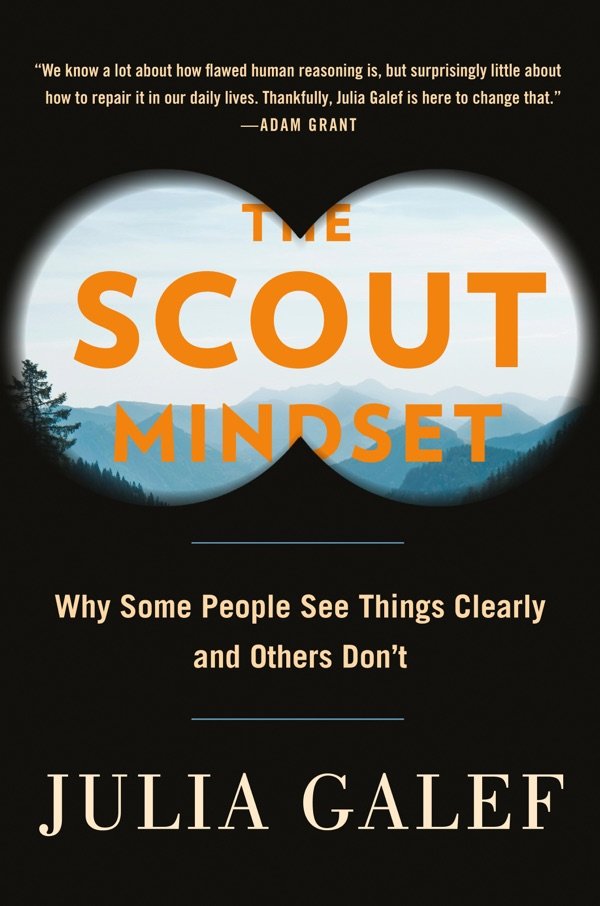
The Scout Mindset: Why Some People See Things Clearly and Others Don't
von Julia Galef
I went through all of Spock’s appearances in Star Trek: The Original Series, Star Trek: The Animated Series, and the Star Trek movies, searching for the words probability, percent, odds, chance, possible, impossible, likely, unlikely, probable, and improbable. In total, I found twenty-three instances in which Spock made a prediction with a corresponding confidence level, and in which the prediction was proven either true or false. You can read the full details of Spock’s predictions and how I categorized them in Appendix A, but here’s the headline summary: When Spock thinks something is impossible, it happens 83 percent of the time. When Spock thinks something is very unlikely, it happens 50 percent of the time. When Spock thinks something is unlikely, it happens 50 percent of the time. When Spock thinks something is likely, it happens 80 percent of the time. When Spock thinks something is more than 99.5 percent likely, it happens 17 percent of the time.9 As you can see, he’s not doing great. The only confidence level at which he seems to be well calibrated is when he judges something to be “likely”; those predictions actually do come true at a rate that matches his confidence level. Other
It prompted me to go back through the studies I had been planning to cite in my favor, and scrutinize their methodology for flaws, just as I had done with the pro-soldier mindset study. (Sadly, this ended up disqualifying most of them.) I call this type of thought experiment the selective skeptic test: Imagine this evidence supported the other side. How credible would you find it then?
Picquart’s process of coming to realize that Dreyfus was innocent is a striking example of what cognitive scientists sometimes call accuracy motivated reasoning. In contrast to directionally motivated reasoning, which evaluates ideas through the lenses of “Can I believe it?” and “Must I believe it?,” accuracy motivated reasoning evaluates ideas through the lens of “Is it true?”
Personally, I find all those facets of scout mindset inspiring—the willingness to prioritize impact over identity; the confidence to be unconfident; the courage to face reality. But if I were to name one single facet I find most inspiring, it’s the idea of being intellectually honorable: wanting the truth to win out, and putting that principle above your own ego.
What thought experiments do is simply reveal that your reasoning changes as your motivations change. That the principles you’re inclined to invoke or the objections that spring to your mind depend on your motives: the motive to defend your image or your in-group’s status; the motive to advocate for a self-serving policy; fear of change or rejection.
The best description of motivated reasoning I’ve ever seen comes from psychologist Tom Gilovich. When we want something to be true, he said, we ask ourselves, “Can I believe this?,” searching for an excuse to accept it. When we don’t want something to be true, we instead ask ourselves, “Must I believe this?,” searching for an excuse to reject it.
"I went through all of Spock’s appearances in Star Trek: The Original Series, Star Trek: The Animated Series, and the Star Trek movies, searching for the words probability, percent, odds, chance, possible, impossible, likely, unlikely, probable, and improbable. In total, I found twenty-three instances in which Spock made a prediction with a corresponding confidence level, and in which the prediction was proven either true or false. You can read the full details of Spock’s predictions and how I categorized them in Appendix A, but here’s the headline summary: When Spock thinks something is impossible, it happens 83 percent of the time."
"When Spock thinks something is very unlikely, it happens 50 percent of the time. When Spock thinks something is unlikely, it happens 50 percent of the time. When Spock thinks something is likely, it happens 80 percent of the time. When Spock thinks something is more than 99.5 percent likely, it happens 17 percent of the time.9 As you can see, he’s not doing great. The only confidence level at which he seems to be well calibrated is when he judges something to be “likely”; those predictions actually do come true at a rate that matches his confidence level. Other"
"One is epistemic confidence, or certainty— how sure you are about what’s true. This is the kind of confidence we explored in chapter 6. If you say, “I’m 99 percent sure he is lying,” or “I guarantee this will work,” or “There’s no way the Republicans can win,” you’re displaying a lot of epistemic confidence. Separately, there’s social confidence, or self-assurance: Are you at ease in social situations? Do you act like you deserve to be there, like you’re secure in yourself and your role in the group? Do you speak as if you’re worth listening to?"
"Even those of us who aren’t professional persuaders have plenty of things we might like our friends, family, and coworkers to believe: I’m a good person. I deserve your sympathy. I’m trying my hardest. I’m a valuable employee. My career is really taking off. The more we can get ourselves to genuinely believe those claims, and the more evidence and arguments we can collect to support them, the easier it will be for us to persuade other people of them (or so the logic goes). As Johnson used to say: “What convinces is conviction.”16"
"If you have a scout identity, that’s how it feels when you realize you have to change your mind. It’s not that it’s easy; it still stings a little to realize that you made a mistake or that the person you’ve been arguing with actually has a point. But that slight sting is a reminder that you’re living up to your standards, that you’re becoming stronger. And so the sensation becomes pleasurable, in the same way sore muscles can be pleasurable for someone making progress toward getting in shape."
"Scout mindset is what allows you to recognize when you are wrong, to seek out your blind spots, to test your assumptions and change course. It’s what prompts you to honestly ask yourself questions like “Was I at fault in that argument?” or “Is this risk worth it?” or “How would I react if someone from the other political party did the same thing?” As the late physicist Richard Feynman once said, “The first principle is that you must not fool yourself—and you are the easiest person to fool.”"
"Catastrophic climate change is a nondiversifiable risk, Litterman said. That means there’s nothing you can invest in that could hedge against the possibility of it happening. In normal circumstances, investors are willing to pay huge sums of money to avoid nondiversifiable risks. And by that same logic, Litterman argued, we as a society should be willing to invest a large amount of money in preventing the possibility of catastrophic climate change."
- →The best description of motivated reasoning I’ve ever seen comes from psychologist Tom Gilovich. When we want something to be true, he said, we ask ourselves, “Can I believe this?,” searching for an excuse to accept it. When we don’t want something to be true, we instead ask ourselves, “Must I believe this?,” searching for an excuse to reject it.
- →We use motivated reasoning not because we don’t know any better, but because we’re trying to protect things that are vitally important to us—our ability to feel good about our lives and ourselves, our motivation to try hard things and stick with them, our ability to look good and persuade, and our acceptance in our communities.
- →I call David’s thought experiment the status quo bias test: Imagine your current situation was no longer the status quo. Would you then actively choose it? If not, that’s a sign that your preference for your situation is less about its particular merits and more about a preference for the status quo.*
- →When you notice yourself making a claim with certainty (“There’s no way . . .”), ask yourself how sure you really are. 3. The next time a worry pops into your head and you’re tempted to rationalize it away, instead make a concrete plan for how you would deal with it if it came true.
Ähnliche Bücher gesucht?
Beschreibe deine Situation. Die Suche findet das passende Buch aus der gesamten Bibliothek.