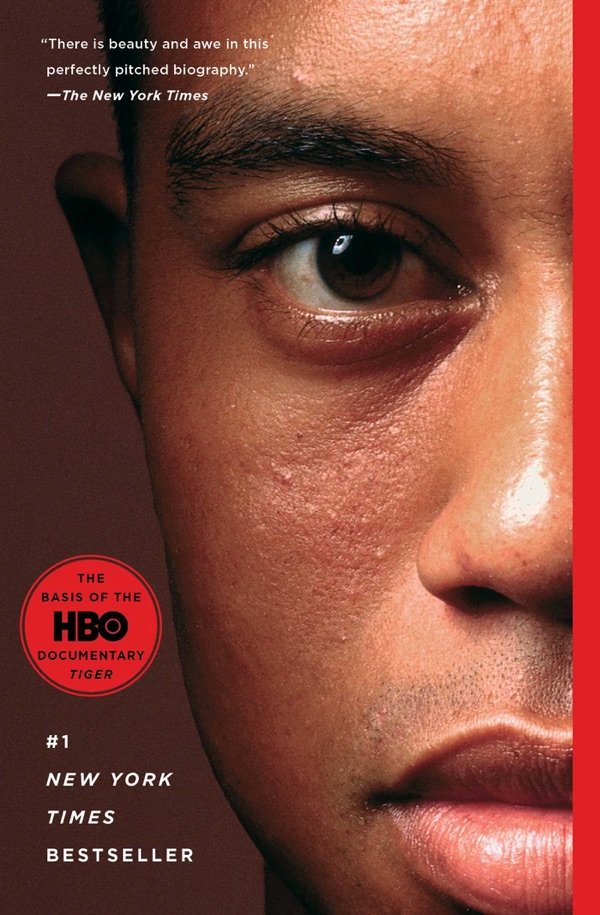
Tiger Woods
von Jeff Benedict
Nearly one-quarter of the Enquirer’s weekly sales occur at Walmart. Almost three-quarters of all sales are generated at chain stores. It’s a readership base that doesn’t play much golf and isn’t particularly interested in Tiger Woods—but like many people, they’re titillated by indiscretions and are definitely interested in highly successful individuals who fail. “These are people who live their lives failing, so they want to read negative things about people who have gone up and then come down,” Pecker told the New Yorker in 2017. Conte said Woods’s injury history could be a sign of PEDs in the form of mineral depletion. “When you use anabolic steroids, it depletes the body of copper,” said Conte. “So while you’re simultaneously building your muscles with nitrogen and promoting protein synthesis from the use of steroids, you’re weakening connective tissue, ligaments, and tendons. So when you describe his [injury] history, could that possibly be a result of his using anabolic steroids, and the answer is yes.”
The quest for total control led him to form some compulsive habits of his own. By the spring of 1997, Tiger was consumed with practicing and working out. A typical practice day for him entailed hitting six hundred balls, working on his short game and putting, playing a round (sometimes on his own), and working out in the gym for two to three hours. “That was the life I wanted,” he said.
Tiger’s mind-set had always been what separated him from everyone else. Players flat-out feared him. He had the biggest muscles, the fastest swing speed, the best overall game, the bodyguards, the toughest caddie, the biggest corporate backers, the shrewdest agent, the most money, the prettiest wife; it was all part of the outsize image that he leveraged to intimidate opponents.
At age twenty-six, Tiger had won seven majors faster than anyone in history. Perhaps even more telling, he had never finished second in a major—meaning that when he was in contention in the final round, he simply didn’t lose. In contrast, Jack Nicklaus had six second-place finishes in a major championship by the time he was twenty-six years old.
Retaining Brody Wilkinson was the single most important piece of advice that Merchant ever gave to Tiger. The firm would go on to handle Tiger’s resources for decades, enabling him to build a vast fortune and avoid the mistakes made by so many celebrated athletes who earn millions in their early twenties only to end up broke after retirement.
For Tiger, even the most basic human civilities—a simple hello or thank you—routinely went missing from his vocabulary. A nod was too much to expect. Tiger didn’t learn all of this behavior from Jordan. If anything, this sense of entitlement had been originally authored by Earl. Tiger’s relationship with Jordan simply provided reinforcement.
"Nearly one-quarter of the Enquirer’s weekly sales occur at Walmart. Almost three-quarters of all sales are generated at chain stores. It’s a readership base that doesn’t play much golf and isn’t particularly interested in Tiger Woods—but like many people, they’re titillated by indiscretions and are definitely interested in highly successful individuals who fail. “These are people who live their lives failing, so they want to read negative things about people who have gone up and then come down,” Pecker told the New Yorker in 2017."
"Conte said Woods’s injury history could be a sign of PEDs in the form of mineral depletion. “When you use anabolic steroids, it depletes the body of copper,” said Conte. “So while you’re simultaneously building your muscles with nitrogen and promoting protein synthesis from the use of steroids, you’re weakening connective tissue, ligaments, and tendons. So when you describe his [injury] history, could that possibly be a result of his using anabolic steroids, and the answer is yes.”"
"Tiger, on the other hand, had learned to play on public courses, and his biggest influence was his father, whose very unorthodox methods instilled in him a killer instinct—a mean streak—of the sort that one might expect to find in a boxer. His father was no CEO. His mother was an immigrant from a distant land. His family had little money and few connections. Their only real chance for upward mobility rested squarely on Tiger’s golf game."
"With pen in hand, Deford made this observation about Woods at the end of his brilliant year: “Tiger is such an extraordinary champion and so widely admired that we have granted him a sort of spiritual amnesty. His persona is still insulated by his deeds, his misjudgments by his youth. Sometime soon, though, we will weary of the tedium of his persistent success and start peering more deeply into that heavenly smile and those steely eyes."
"Tiger’s lack of sentimentality and personal connection to others can be traced directly to his mother. “I am a loner, and so is Tiger,” Kultida said. “We don’t waste time with people we don’t like. I don’t have many close friends. Never have. I’m independent and strong-willed. That way, you survive.” Kultida took that attitude to the golf course. She preached “kill them” and “take their heart” when it came to her son’s golf opponents."
"Kindergarten was still months away, but Tiger was already starting to learn a valuable lesson: Superior athletes don’t have to pay for things. Private lessons, greens fees, equipment—these expenses were part of the socioeconomics that normally limited the game of golf to kids from families that belonged to country clubs. Tiger was never going to be a country-club kid. But that wasn’t going to hold him back."
"“I’ve thought a lot about him over the years, because we’ve had some serious ups and downs,” Roberts said in 2016. “There’s more ‘fuck you’ in Tiger Woods than in any athlete I’ve ever covered. In those days, it felt like a one-way street with him. He demanded respect but wasn’t willing to offer any in return. He burns with hate toward people that he feels have wronged him or are not on his side.”"
- →At age twenty-six, Tiger had won seven majors faster than anyone in history. Perhaps even more telling, he had never finished second in a major—meaning that when he was in contention in the final round, he simply didn’t lose. In contrast, Jack Nicklaus had six second-place finishes in a major championship by the time he was twenty-six years old.
- →Retaining Brody Wilkinson was the single most important piece of advice that Merchant ever gave to Tiger. The firm would go on to handle Tiger’s resources for decades, enabling him to build a vast fortune and avoid the mistakes made by so many celebrated athletes who earn millions in their early twenties only to end up broke after retirement.
- →Earl was always looking for ways to give his son an edge. Tiger was in grade school when his father furnished him with a cassette player and motivational self-help tapes. In addition to offering words of empowerment, the cassettes were filled with soft music and the sounds of nature, such as water flowing through a creek.
- →But Tiger’s parents were done with her. They didn’t want anyone to hold their son back. And Tiger wasn’t going to fight that battle, not even for the love of his life. He didn’t call Dina the next night, or the night after that. Once he had ended the relationship, he never spoke to her again.
Ähnliche Bücher gesucht?
Beschreibe deine Situation. Die Suche findet das passende Buch aus der gesamten Bibliothek.