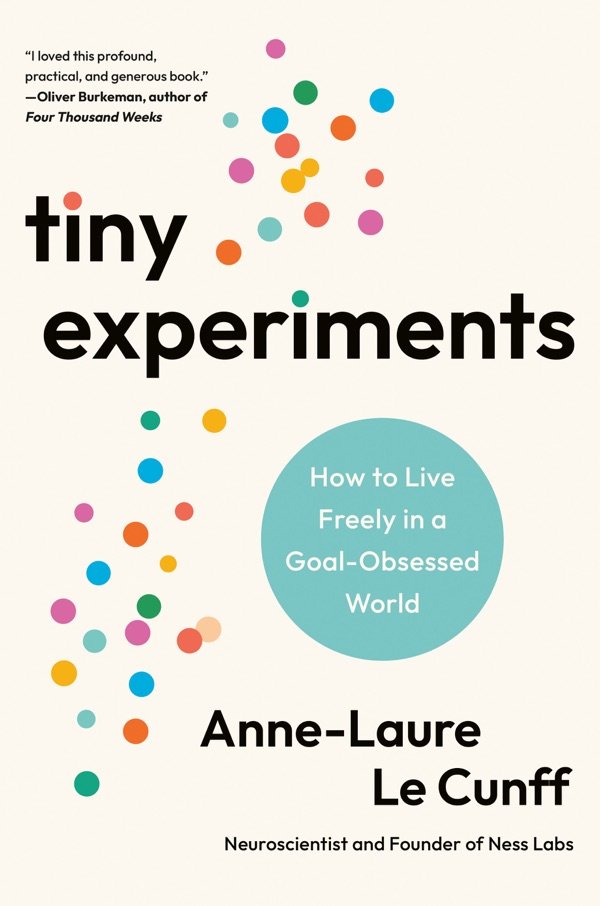
Tiny Experiments: How to Live Freely in a Goal-Obsessed World
von Anne-Laure Le Cunff
To put the principles of intentional imperfection into practice, you just need to adjust those three ambition dials: Identify perfectionist patterns. Before you can start embracing imperfection, you need to become aware of when and how you are unrealistically striving for perfection. If you feel stretched, write down your current commitments—all of them—and describe what success would look like for each. Challenge your unrealistic targets. Looking at the list of highly ambitious objectives you have committed to is usually enough to convince you that you cannot possibly accomplish them all at once. But you can dig a bit deeper if you need more proof. How much effort would it require to complete each of these projects to your standards? Do you really have enough hours in the day to do everything on this list? Or have you already subconsciously decided to forgo other activities like socializing or working out? Pretend you are helping a friend out and be brutally honest with yourself. Choose progress over perfection. This is where the intentional part comes into play. Decide on the parts of your life and work where you will drop the ball to achieve excellence in other areas. It doesn’t have to be forever; maybe you’ll decide to focus on a certain aspect of your life for the next week, or perhaps it will be only for today or tonight. Cynicism: Doomscrolling, passing up opportunities, poking fun at earnest people. Like the Beast before he meets Belle, we see transformation as a source of meaningless work, and we abandon any desire to build a good life. Why suffer when we can just survive? Escapism: Retail therapy, binge watching, dream planning. Like Peter Pan, we confine ourselves to an island where we can break free from the burden of our responsibilities, an idealized place to get away from the uncertainty of our lives. Perfectionism: Self-coercion, information hoarding, toxic productivity. We treat ourselves the way the stepmother treats Cinderella—“from morning until evening, she had to perform difficult work, rising early, carrying water, making the fire, cooking and washing”—with no rest or time for ourselves.
Sommer doesn’t consider her public platform a distraction from her scientific research. She agrees that the key is to integrate learning in public with the work you do already. “I’m already creating video lectures for my students, so I can do more videos for social media. I don’t hold myself to a strict schedule. I just focus on sharing authentic content, building social support and connection.”
Nobody likes to worry their loved ones, and social conformity may seem to offer the path of least resistance. But it isn’t without costs. For the sake of external validation or simply to appease other people, you may find yourself following the Crowdpleaser script and pursuing a conformist path instead of following your curiosity. You might live a dream life, but whose dream is it?
For instance, I used to put off preparing presentation materials until the last minute. After journaling several times about it, I now know that my fear of public speaking is lurking behind that procrastination. Nowadays I can skip the journaling and give myself a little pep talk or practice conscious movement, which helps me proceed with the work.
Sometimes procrastination can help reveal our innate curiosities. In addition to diagnosing why you are procrastinating—head, heart, or hand—you can take a moment to consider what you often find yourself doing when putting things off. Are you reading about a particular topic, exploring a hobby, or like Amy, connecting with other people?
A generative approach to work recognizes the importance of playfulness alongside professionalism. Playfulness fosters creativity, exploration, and innovation. Finding joy in the present act of doing work can lead to discoveries that positively impact our career, others, and the world around us in ways we may not have initially imagined.
"To put the principles of intentional imperfection into practice, you just need to adjust those three ambition dials: Identify perfectionist patterns. Before you can start embracing imperfection, you need to become aware of when and how you are unrealistically striving for perfection. If you feel stretched, write down your current commitments—all of them—and describe what success would look like for each. Challenge your unrealistic targets. Looking at the list of highly ambitious objectives you have committed to is usually enough to convince you that you cannot possibly accomplish them all at once. But you can dig a bit deeper if you need more proof. How much effort would it require to complete each of these projects to your standards? Do you really have enough hours in the day to do everything on this list? Or have you already subconsciously decided to forgo other activities like socializing or working out? Pretend you are helping a friend out and be brutally honest with yourself. Choose progress over perfection. This is where the intentional part comes into play. Decide on the parts of your life and work where you will drop the ball to achieve excellence in other areas. It doesn’t have to be forever; maybe you’ll decide to focus on a certain aspect of your life for the next week, or perhaps it will be only for today or tonight."
"Cynicism: Doomscrolling, passing up opportunities, poking fun at earnest people. Like the Beast before he meets Belle, we see transformation as a source of meaningless work, and we abandon any desire to build a good life. Why suffer when we can just survive? Escapism: Retail therapy, binge watching, dream planning. Like Peter Pan, we confine ourselves to an island where we can break free from the burden of our responsibilities, an idealized place to get away from the uncertainty of our lives. Perfectionism: Self-coercion, information hoarding, toxic productivity. We treat ourselves the way the stepmother treats Cinderella—“from morning until evening, she had to perform difficult work, rising early, carrying water, making the fire, cooking and washing”—with no rest or time for ourselves."
"Closing the loop can be as simple as hosting a debrief meeting or writing an internal memo at work—where you can again use the Plus Minus Next template, explain what went well, what could have been handled better, and what you will focus on next. For bigger projects, you could consider writing a case study including interviews with key stakeholders. Sending a few thank-you notes is also a great way to close the loop. Whatever format you choose, the aim is to bring your experiment to a clear and deliberate conclusion, distill the lessons learned, and share them in a way that benefits others."
"Linear goals promise certainty—if we just stick to the plan and climb, we will arrive safely at the expected destination. But life rarely follows such rigid and predictable patterns. Experiments are built for the in-betweens; they propel you forward even without a fixed destination, in constant conversation with your inner self and the outer world. By having the courage to leave the shore, we trade the illusion of control for the possibility of discovery. Rather than resisting uncertainty, we befriend it. The first step is to rekindle your curiosity to imagine new possibilities."
"There are no limitations as to what you can include in your field notes. Here are some ideas to inspire you: Insights: Your moments of curiosity, random thoughts, new ideas, and questions that spark your interest. Energy: Your shifts in energy levels throughout the day, as well as what gives you energy or drains your energy. Mood: Your emotions during or after an experience, whether it’s a meeting, a workout, a podcast, etc. Encounters: Your social interactions or new connections and any insights or feelings that arose from them."
"When you consistently finish what you start and reflect on the lessons learned, even if the outcome wasn’t what you expected, people see you as someone who takes initiative, follows through, and gleans insights from every experience. Closing the loop demonstrates dependability and accountability, as well as your ability to help others navigate similar challenges—traits that build trust and open doors to new opportunities. This reputation can lead to more like-minded people seeking you out as a potential collaborator."
"#3. Prioritize Impact Over Image “When I quit The New York Times to be a full-time mother, the voices of the world said that I was nuts. When I quit it again to be a full-time novelist, they said I was nuts again,” said author Anna Quindlen. “But I am not nuts. I am happy. I am successful on my own terms. Because if your success is not on your own terms, if it looks good to the world but does not feel good in your heart, it is not success at all.”"
- →Sometimes procrastination can help reveal our innate curiosities. In addition to diagnosing why you are procrastinating—head, heart, or hand—you can take a moment to consider what you often find yourself doing when putting things off. Are you reading about a particular topic, exploring a hobby, or like Amy, connecting with other people?
- →To live in Kairos time, we need to shift the focus from what we do with our time to how we experience each moment—what you might call mindful productivity. It’s a simple idea, that making the most of our time isn’t about doing more but about being more: more present, more engaged, and more attuned to the quality of our experiences.
- →Sequential focus isn’t the same as time-blocking, where you segment your day in advance with predefined tasks. Rather, sequential focus leans into the ebb and flow of your cognitive capacity, prompting you to evaluate constantly: Given my current attention and working memory, what is the most sensible task to undertake right now?
- →How can you manage these cognitive bottlenecks? The key is to use sequential focus—doing one thing at a time—by accepting that you can’t maintain equal effort across all the essential aspects of your life, deciding moment to moment what your priority is (your family, work, or yourself) and giving that your undivided attention.
Ähnliche Bücher gesucht?
Beschreibe deine Situation. Die Suche findet das passende Buch aus der gesamten Bibliothek.