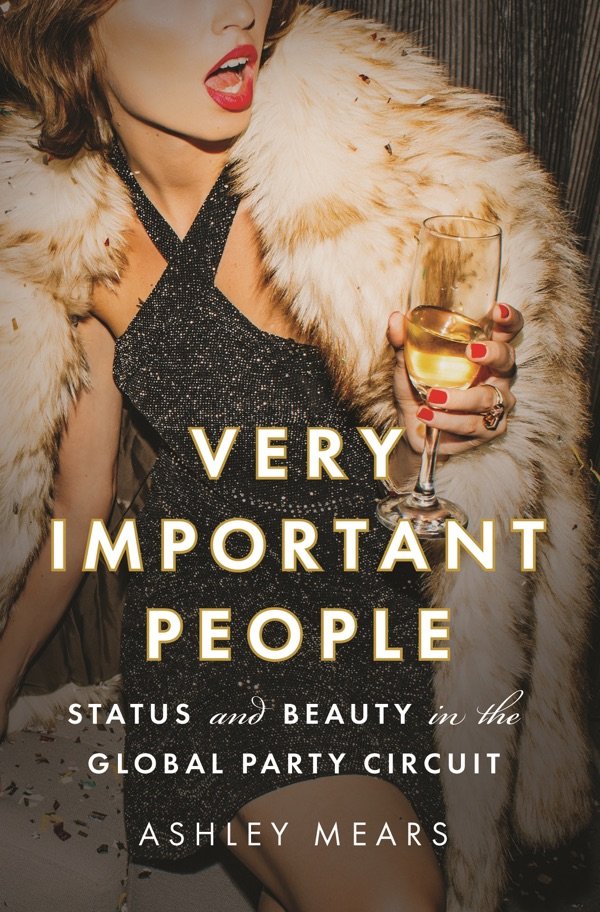
Very Important People: Status and Beauty in the Global Party Circuit
von Ashley Mears
“It’s kinda sad when I listen to it, you’re like my shrink now. When I listen to what I’m saying it’s pretty pathetic actually … It’s horrible, everyone has in common an awareness it’s superficial but at the same time there’s something really powerful and attractive. It’s power. It’s fake power, but why do you take drugs or cocaine? It makes you feel invincible. When you [get] to the club and you take a table, all the doors are open to you.” It is perhaps counterintuitive to think of consumption as a means of producing value. Consumption has historically been defined as a loss of value, even as waste. Early uses of the word consumption in seventeenth-century Europe were pejorative, signaling an impulse “to devour” or “to use up.”1 Pulmonary tuberculosis, a disease in which the body wasted away, was commonly called “consumption” until the early twentieth century.
It takes an incredible amount of labor to enable conspicuous leisure, and this labor upholds a gendered economy of value in which women’s bodies are assessed against men’s money. Bottle trains of champagne may seem irrational to a modern economist, but to an economic sociologist they are a type of ritual performance at the heart of hierarchical systems of prestige and masculine domination.
While Rubin wrote about sexual slavery and systems of trafficking in which women had zero agency or freedom of mobility, her analysis usefully describes systems of consensual traffic today. Women’s beauty offers returns to men in a range of industries that men control. In financial industries in the States and across Asia, the bodies of sex workers help financiers to forge business deals.
In the nightlife business, Dre is known as an image promoter. This means he works freelance, contracting with multiple nightclubs and restaurants throughout the city to bring in a so-called “quality crowd,” understood to consist of attractive women, rich men, celebrities, and other well-connected people. In theory, the crowd he brings in enhances the image of the club and, ultimately,
To satisfy these uniquely mobile newly rich, whole towns, islands, and local economies have transformed into centers for wasteful consumption. At VIP parties from Las Vegas to Dubai, from Miami to Cannes, you will see the rich wasting money without restraint and showcasing their economic power on a carefully curated and free-floating global stage.
The average bonus for anyone working in financial securities in the late 1980s was around $13,000. By 2006, just before the Great Recession hit, it was $191,360.15 That year at Merrill Lynch, a twenty-something analyst with a base salary of $130,000 collected a bonus of $250,000. A thirty-something trader with a $180,000 salary got $5 million.
"“It’s kinda sad when I listen to it, you’re like my shrink now. When I listen to what I’m saying it’s pretty pathetic actually … It’s horrible, everyone has in common an awareness it’s superficial but at the same time there’s something really powerful and attractive. It’s power. It’s fake power, but why do you take drugs or cocaine? It makes you feel invincible. When you [get] to the club and you take a table, all the doors are open to you.”"
"It is perhaps counterintuitive to think of consumption as a means of producing value. Consumption has historically been defined as a loss of value, even as waste. Early uses of the word consumption in seventeenth-century Europe were pejorative, signaling an impulse “to devour” or “to use up.”1 Pulmonary tuberculosis, a disease in which the body wasted away, was commonly called “consumption” until the early twentieth century."
"Blondes “break.” Girls “get used up.” Women “fall off” and “lose their looks.” All terms of destruction and loss to describe the process of girls growing up. That age “progressively destroys” women, but not men, is the crux of what Susan Sontag termed the double standard of aging, back in 1972.34 It is a pernicious standard of the VIP club, and of any other arena in which women are valued for their beauty."
"It takes an incredible amount of labor to enable conspicuous leisure, and this labor upholds a gendered economy of value in which women’s bodies are assessed against men’s money. Bottle trains of champagne may seem irrational to a modern economist, but to an economic sociologist they are a type of ritual performance at the heart of hierarchical systems of prestige and masculine domination."
"While Rubin wrote about sexual slavery and systems of trafficking in which women had zero agency or freedom of mobility, her analysis usefully describes systems of consensual traffic today. Women’s beauty offers returns to men in a range of industries that men control. In financial industries in the States and across Asia, the bodies of sex workers help financiers to forge business deals."
"In the nightlife business, Dre is known as an image promoter. This means he works freelance, contracting with multiple nightclubs and restaurants throughout the city to bring in a so-called “quality crowd,” understood to consist of attractive women, rich men, celebrities, and other well-connected people. In theory, the crowd he brings in enhances the image of the club and, ultimately,"
"To satisfy these uniquely mobile newly rich, whole towns, islands, and local economies have transformed into centers for wasteful consumption. At VIP parties from Las Vegas to Dubai, from Miami to Cannes, you will see the rich wasting money without restraint and showcasing their economic power on a carefully curated and free-floating global stage."
- →Women were conduits of men’s power, Rubin argued, because men control the exchange systems through which women circulate as gifts. Women are largely cut out from the value that their exchange generates.
- →Because in this rarefied world there is an unspoken but widely understood logic: girls are valuable; women are not.
Ähnliche Bücher gesucht?
Beschreibe deine Situation. Die Suche findet das passende Buch aus der gesamten Bibliothek.