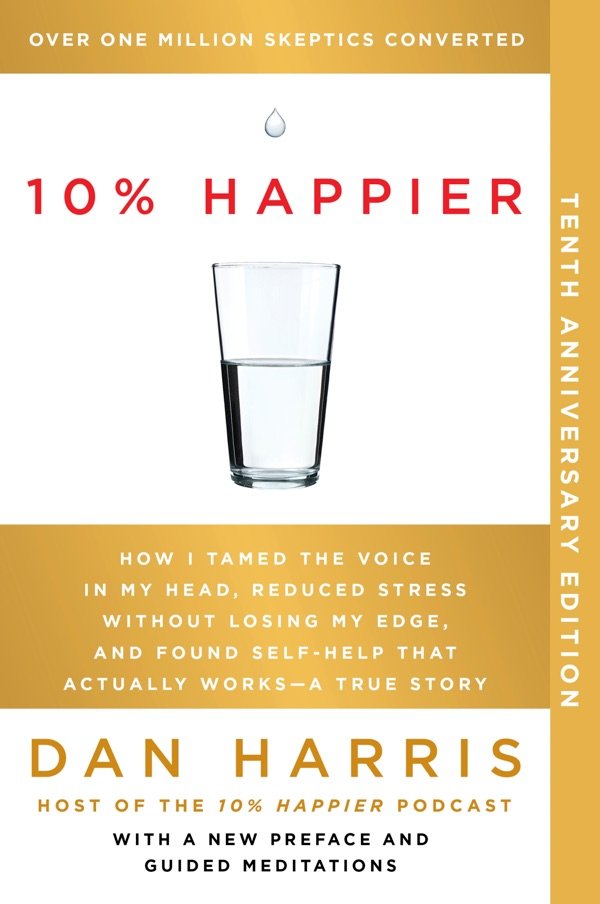
10% Happier
von Dan Harris
Striving is fine, as long as it’s tempered by the realization that, in an entropic universe, the final outcome is out of your control. If you don’t waste your energy on variables you cannot influence, you can focus much more effectively on those you can. When you are wisely ambitious, you do everything you can to succeed, but you are not attached to the outcome—so that if you fail, you will be maximally resilient, able to get up, dust yourself off, and get back in the fray. That, to use a loaded term, is enlightened self-interest. It’s not like I’d never been aware of my thoughts before. I’d had plenty of experience with being scared and knowing I was scared. What made this different was that I was able to see my thoughts for what they were: just thoughts, with no concrete reality. It’s not that my worry suddenly ceased, I just wasn’t as taken in by it. I recognized the truth of this situation: I had no idea what was going to happen to my face, and reflexively believing the worst-case scenarios coughed up by ego certainly wasn’t going to help.
What mindfulness does is create some space in your head so you can, as the Buddhists say, “respond” rather than simply “react.” In the Buddhist view, you can’t control what comes up in your head; it all arises out of a mysterious void. We spend a lot of time judging ourselves harshly for feelings that we had no role in summoning. The only thing you can control is how you handle it.
“Make the present moment your friend rather than your enemy. Because many people live habitually as if the present moment were an obstacle that they need to overcome in order to get to the next moment. And imagine living your whole life like that, where always this moment is never quite right, not good enough because you need to get to the next one. That is continuous stress.”
The Way of the Worrier 1. Don’t Be a Jerk 2. When Necessary, Hide the Zen 3. Meditate 4. The Price of Security Is Insecurity—Until It’s Not Useful 5. Equanimity Is Not the Enemy of Creativity 6. Don’t Force It 7. Humility Prevents Humiliation 8. Go Easy with the Internal Cattle Prod 9. Nonattachment to Results 10.
My favorite Buddhist catchphrase, however, was the one they used to describe the churning of the ego: “monkey mind.” I’ve always been a sucker for animal metaphors, and I thought this one was perfect. Our minds are like furry little gibbons: always agitated, never at rest.
It’s not that I never got annoyed anymore. In fact, when you’re mindful, you actually feel irritation more keenly. However, once you unburden yourself from the delusion that people are deliberately trying to screw you, it’s easier to stop getting carried away.
"Striving is fine, as long as it’s tempered by the realization that, in an entropic universe, the final outcome is out of your control. If you don’t waste your energy on variables you cannot influence, you can focus much more effectively on those you can. When you are wisely ambitious, you do everything you can to succeed, but you are not attached to the outcome—so that if you fail, you will be maximally resilient, able to get up, dust yourself off, and get back in the fray. That, to use a loaded term, is enlightened self-interest."
"It’s not like I’d never been aware of my thoughts before. I’d had plenty of experience with being scared and knowing I was scared. What made this different was that I was able to see my thoughts for what they were: just thoughts, with no concrete reality. It’s not that my worry suddenly ceased, I just wasn’t as taken in by it. I recognized the truth of this situation: I had no idea what was going to happen to my face, and reflexively believing the worst-case scenarios coughed up by ego certainly wasn’t going to help."
"Our entire lives, he argued, are governed by a voice in our heads. This voice is engaged in a ceaseless stream of thinking—most of it negative, repetitive, and self-referential. It squawks away at us from the minute we open our eyes in the morning until the minute we fall asleep at night, if it allows us to sleep at all. Talk, talk, talk: the voice is constantly judging and labeling everything in its field of vision. Its targets aren’t just external; it often viciously taunts us, too."
"But as soon as we find ourselves in the airport gate area, having ingested 470 calories’ worth of sugar and fat before dinner, we don’t bother to examine the lie that fuels our lives. We tell ourselves we’ll sleep it off, take a run, eat a healthy breakfast, and then, finally, everything will be complete. We live so much of our lives pushed forward by these “if only” thoughts, and yet the itch remains. The pursuit of happiness becomes the source of our unhappiness."
"What mindfulness does is create some space in your head so you can, as the Buddhists say, “respond” rather than simply “react.” In the Buddhist view, you can’t control what comes up in your head; it all arises out of a mysterious void. We spend a lot of time judging ourselves harshly for feelings that we had no role in summoning. The only thing you can control is how you handle it."
"“Make the present moment your friend rather than your enemy. Because many people live habitually as if the present moment were an obstacle that they need to overcome in order to get to the next moment. And imagine living your whole life like that, where always this moment is never quite right, not good enough because you need to get to the next one. That is continuous stress.”"
"The Way of the Worrier 1. Don’t Be a Jerk 2. When Necessary, Hide the Zen 3. Meditate 4. The Price of Security Is Insecurity—Until It’s Not Useful 5. Equanimity Is Not the Enemy of Creativity 6. Don’t Force It 7. Humility Prevents Humiliation 8. Go Easy with the Internal Cattle Prod 9. Nonattachment to Results 10."
- →My favorite Buddhist catchphrase, however, was the one they used to describe the churning of the ego: “monkey mind.” I’ve always been a sucker for animal metaphors, and I thought this one was perfect. Our minds are like furry little gibbons: always agitated, never at rest.
- →It’s not that I never got annoyed anymore. In fact, when you’re mindful, you actually feel irritation more keenly. However, once you unburden yourself from the delusion that people are deliberately trying to screw you, it’s easier to stop getting carried away.
- →Marturano recommended something radical: do only one thing at a time. When you’re on the phone, be on the phone. When you’re in a meeting, be there. Set aside an hour to check your email, and then shut off your computer monitor and focus on the task at hand.
- →The final step—“non-identification”—meant seeing that just because I was feeling angry or jealous or fearful, that did not render me a permanently angry or jealous person. These were just passing states of mind.
Ähnliche Bücher gesucht?
Beschreibe deine Situation. Die Suche findet das passende Buch aus der gesamten Bibliothek.