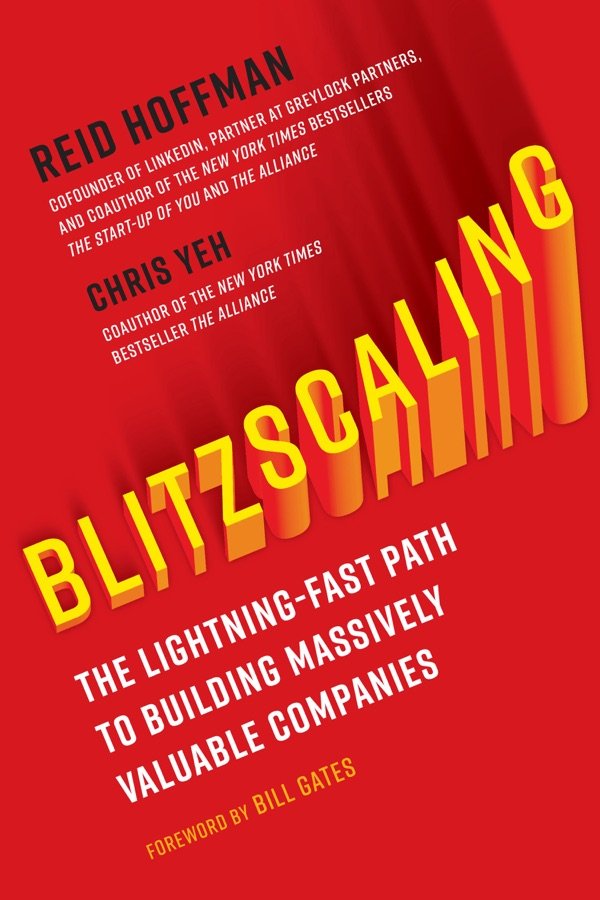
Blitzscaling: The Lightning-Fast Path to Building Massively Valuable Companies
von Reid Hoffman
But prioritizing speed over efficiency—even in the face of uncertainty—is especially important when your business model depends on having lots of members and getting feedback from them. If you get in early and start getting that feedback and your competitors don’t, then you’re on the path to success. In any business where scale really matters, getting in early and doing it fast can make the difference. When a start-up matures to the point where it has a killer product, a clear and sizable market, and a robust distribution channel, it has the opportunity to become a “scale-up,” which is a world-changing company that touches millions or even billions of lives. Often, the fastest and most direct path from start-up to scale-up is the hypergrowth produced by blitzscaling.
When a start-up matures to the point where it has a killer product, a clear and sizable market, and a robust distribution channel, it has the opportunity to become a “scale-up,” which is a world-changing company that touches millions or even billions of lives. Often, the fastest and most direct path from start-up to scale-up is the hypergrowth produced by blitzscaling.
For successful blitzscaling, the competitive advantage comes from the growth factors built into the business model, such as network effects, whereby the first company to achieve critical scale triggers a feedback loop that allows it to dominate a winner-take-all or winner-take-most market and achieve a lasting first-scaler advantage.
Virality almost always requires a product that is either free or freemium (i.e., free up to a certain point, after which the user has to pay to upgrade—Dropbox, for example, offers 2 GB of free storage). We can’t recall a single instance of a company that grew to a massive scale by leveraging the virality of a paid product.
In the Family stage, you should hire only generalists. You can certainly follow the traditional approach of recruiting from elite colleges or hiring ex-McKinsey analysts, but you should also try to focus on people with prior experience at early-stage start-ups who list a broad range of responsibilities and accomplishments.
Another, less obvious benefit to this model is that once a subscription business achieves scale, the predictability of its revenue streams allows it to be more aggressive with long-term investments, since it isn’t obliged to maintain large cash balances to weather short-term variations in the business.
"But prioritizing speed over efficiency—even in the face of uncertainty—is especially important when your business model depends on having lots of members and getting feedback from them. If you get in early and start getting that feedback and your competitors don’t, then you’re on the path to success. In any business where scale really matters, getting in early and doing it fast can make the difference."
"When a start-up matures to the point where it has a killer product, a clear and sizable market, and a robust distribution channel, it has the opportunity to become a “scale-up,” which is a world-changing company that touches millions or even billions of lives. Often, the fastest and most direct path from start-up to scale-up is the hypergrowth produced by blitzscaling."
"For successful blitzscaling, the competitive advantage comes from the growth factors built into the business model, such as network effects, whereby the first company to achieve critical scale triggers a feedback loop that allows it to dominate a winner-take-all or winner-take-most market and achieve a lasting first-scaler advantage."
"Virality almost always requires a product that is either free or freemium (i.e., free up to a certain point, after which the user has to pay to upgrade—Dropbox, for example, offers 2 GB of free storage). We can’t recall a single instance of a company that grew to a massive scale by leveraging the virality of a paid product."
"In the Family stage, you should hire only generalists. You can certainly follow the traditional approach of recruiting from elite colleges or hiring ex-McKinsey analysts, but you should also try to focus on people with prior experience at early-stage start-ups who list a broad range of responsibilities and accomplishments."
"Another, less obvious benefit to this model is that once a subscription business achieves scale, the predictability of its revenue streams allows it to be more aggressive with long-term investments, since it isn’t obliged to maintain large cash balances to weather short-term variations in the business."
"Blitzscaling is a strategy and set of techniques for driving and managing extremely rapid growth that prioritize speed over efficiency in an environment of uncertainty. Put another way, it’s an accelerant that allows your company to grow at a furious pace that knocks the competition out of the water."
- →Virality almost always requires a product that is either free or freemium (i.e., free up to a certain point, after which the user has to pay to upgrade—Dropbox, for example, offers 2 GB of free storage). We can’t recall a single instance of a company that grew to a massive scale by leveraging the virality of a paid product.
- →In the Family stage, you should hire only generalists. You can certainly follow the traditional approach of recruiting from elite colleges or hiring ex-McKinsey analysts, but you should also try to focus on people with prior experience at early-stage start-ups who list a broad range of responsibilities and accomplishments.
- →It’s important not to confuse critical mass with first-mover advantage. Being first to launch in a market might earn you congratulations on being a product visionary, but if you aren’t also the first to scale, you’ll end up as a footnote in a Wikipedia article about your competitor who did.
- →When you start a new company, the key product/market fit question you need to answer is whether you have discovered a nonobvious market opportunity where you have a unique advantage or approach, and one that competing players won’t see until you’ve had a chance to build a healthy lead.
Ähnliche Bücher gesucht?
Beschreibe deine Situation. Die Suche findet das passende Buch aus der gesamten Bibliothek.