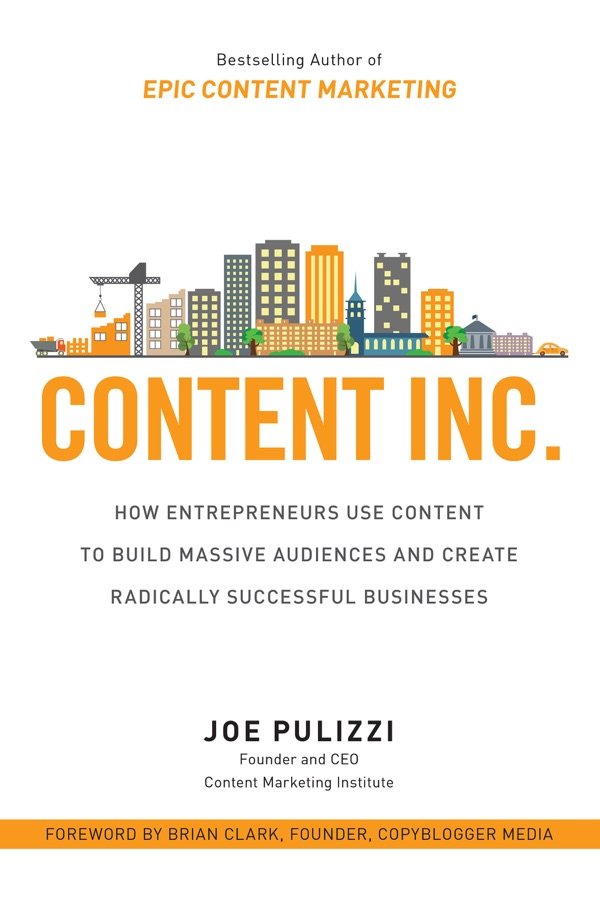
Content Inc.: How Entrepreneurs Use Content to Build Massive Audiences and Create Radically Successful Businesses
von Joe Pulizzi
By focusing on building an audience first and defining products and services second, an entrepreneur can change the rules of the game and significantly increase the odds of financial and personal success. The sweet spot. Mixing a knowledge area or skill with a passion area. The content tilt. Looking at the traditional content niche defined as slightly off-center, to create a true differentiation area. Building the base. Consistent publishing in one core channel. Harvesting audience. Converting the publishing activity to the asset of subscribers. Diversification. At the proper time, expanding the publishing process to additional channels. Monetization. Monetizing the audience through the selection of products or services that will be the source of revenue and profit for the business.
By focusing on building an audience first and defining products and services second, an entrepreneur can change the rules of the game and significantly increase the odds of financial and personal success.
Put yourself on a deadline so that every week you will finish one story. It is only by going through a volume of work that you will close that gap, and your work will be as good as your ambitions. And I took longer to figure out how to do this than anyone I’ve ever met. It’s gonna take awhile. It’s normal to take awhile. You’ve just gotta fight your way through.
In the movie The Grand Budapest Hotel, the job of the lobby boy was to know the clientele so well that he could anticipate their needs. That is your role now. Your job is to learn your audience so well that you’ll be able to develop ongoing content that is so good, the people in your audience are not even aware they needed it in the first place.
Copyblogger takes off—despite the fact that I’m again completely unknown in the field—because people were frustrated with typical blogging and online copywriting advice. I merged the two topics together and advocated the heresy (at the time) that you should sell products and services with content instead of relying on advertising.
Every one of them had the habit of reaching decisions promptly and of changing these decisions slowly, if and when they were changed. Unsuccessful people, the book says, have a habit, without exception, of reaching decisions, if at all, very slowly and of changing these decisions quickly and often.
"By focusing on building an audience first and defining products and services second, an entrepreneur can change the rules of the game and significantly increase the odds of financial and personal success."
"The sweet spot. Mixing a knowledge area or skill with a passion area. The content tilt. Looking at the traditional content niche defined as slightly off-center, to create a true differentiation area. Building the base. Consistent publishing in one core channel. Harvesting audience. Converting the publishing activity to the asset of subscribers. Diversification. At the proper time, expanding the publishing process to additional channels. Monetization. Monetizing the audience through the selection of products or services that will be the source of revenue and profit for the business."
"As Brian Clark discusses in the Foreword of this book, Content Inc. models can better monetize the program when they get to their MVA, or minimum viable audience. As he explains: “An MVA is the point when your audience starts growing itself through social sharing and word-of-mouth. Even better, it’s also when you start getting the feedback that tells you what product or service your audience actually wants to buy.”"
"Put yourself on a deadline so that every week you will finish one story. It is only by going through a volume of work that you will close that gap, and your work will be as good as your ambitions. And I took longer to figure out how to do this than anyone I’ve ever met. It’s gonna take awhile. It’s normal to take awhile. You’ve just gotta fight your way through."
"In the movie The Grand Budapest Hotel, the job of the lobby boy was to know the clientele so well that he could anticipate their needs. That is your role now. Your job is to learn your audience so well that you’ll be able to develop ongoing content that is so good, the people in your audience are not even aware they needed it in the first place."
"Copyblogger takes off—despite the fact that I’m again completely unknown in the field—because people were frustrated with typical blogging and online copywriting advice. I merged the two topics together and advocated the heresy (at the time) that you should sell products and services with content instead of relying on advertising."
"Every one of them had the habit of reaching decisions promptly and of changing these decisions slowly, if and when they were changed. Unsuccessful people, the book says, have a habit, without exception, of reaching decisions, if at all, very slowly and of changing these decisions quickly and often."
- →Copyblogger takes off—despite the fact that I’m again completely unknown in the field—because people were frustrated with typical blogging and online copywriting advice. I merged the two topics together and advocated the heresy (at the time) that you should sell products and services with content instead of relying on advertising.
- →You’ve identified your sweet spot. You’ve “tilted” to find an area of content noncompetition. You’ve selected the platform and built the base. You’ve started to build subscribers, and you’ve even begun to launch content on additional platforms. Now is when the model monetizes against the platform.
- →If Content Inc is going to work for you, your content must be different. It must fill a content hole that is not being filled by someone else. As Peter Thiel suggests, we must find a problem area that no one else is solving and exploit that area with content.
- →In addition to his knowledge areas, Joseph is also a skilled graphic designer. Skill is defined by dictionary.com as “the ability to do something well” or an area that a person has “expertise or competence” in. Simply put, skill is knowledge used properly.
Ähnliche Bücher gesucht?
Beschreibe deine Situation. Die Suche findet das passende Buch aus der gesamten Bibliothek.