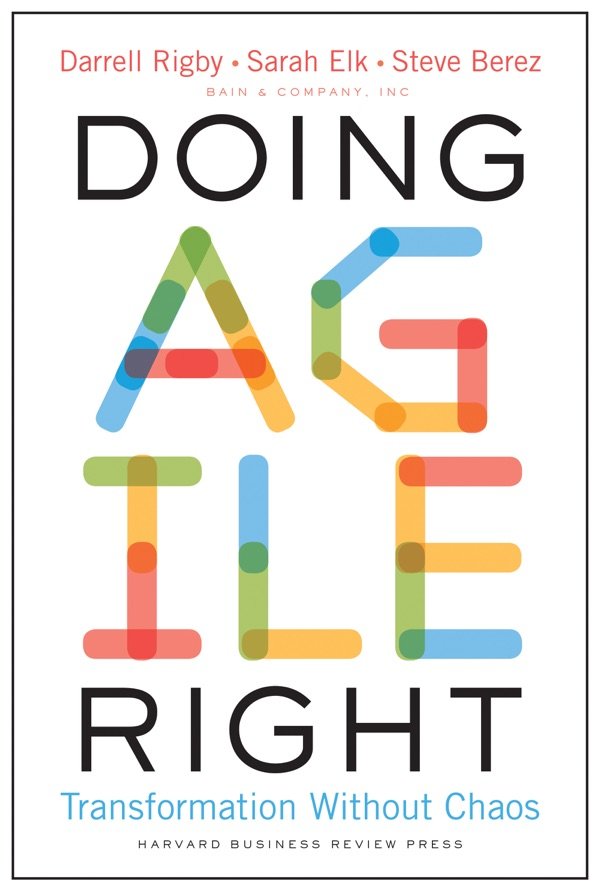
Doing Agile Right: Transformation Without Chaos
von Darrell Rigby
Agile at scale focuses on improving the performance of agile teams while allowing bureaucracy and innovation efforts to coexist. Agile enterprises, in contrast, focus on creating agile business systems: they transform bureaucracy and innovation efforts into symbiotic partners that collaborate to deliver better results. Insufficient focus on innovation leads to a static enterprise that will fail to adapt to changing conditions. Insufficient emphasis on operations creates chaos—poor quality, high costs, and dangerous risks to customers and to the business.
Agile at scale focuses on improving the performance of agile teams while allowing bureaucracy and innovation efforts to coexist. Agile enterprises, in contrast, focus on creating agile business systems: they transform bureaucracy and innovation efforts into symbiotic partners that collaborate to deliver better results.
Insufficient focus on innovation leads to a static enterprise that will fail to adapt to changing conditions. Insufficient emphasis on operations creates chaos—poor quality, high costs, and dangerous risks to customers and to the business.
Lean is a source of considerable confusion because people apply the term to two very different approaches: lean production systems (also known as Lean Six Sigma), and lean product development (also known as lean start-up).
At the beginning of an agile journey, the hardest truth for many executives to accept is that where to go and how to get there are not just unknown, they are unknowable.
The time it takes an agile team to release an innovation is determined by two factors, the time required to work on the innovation and the time spent waiting on others.
"Agile at scale focuses on improving the performance of agile teams while allowing bureaucracy and innovation efforts to coexist. Agile enterprises, in contrast, focus on creating agile business systems: they transform bureaucracy and innovation efforts into symbiotic partners that collaborate to deliver better results."
"Insufficient focus on innovation leads to a static enterprise that will fail to adapt to changing conditions. Insufficient emphasis on operations creates chaos—poor quality, high costs, and dangerous risks to customers and to the business."
"Lean is a source of considerable confusion because people apply the term to two very different approaches: lean production systems (also known as Lean Six Sigma), and lean product development (also known as lean start-up)."
"At the beginning of an agile journey, the hardest truth for many executives to accept is that where to go and how to get there are not just unknown, they are unknowable."
"The time it takes an agile team to release an innovation is determined by two factors, the time required to work on the innovation and the time spent waiting on others."
"The best approach is not to choose agile over all other management approaches but to learn when, where, and how to use it in combination with other tools."
"But the worst problem is that copycats have not learned the keystone of agile success: the ability to continuously learn, evolve, improve, and grow."
- →Agile at scale focuses on improving the performance of agile teams while allowing bureaucracy and innovation efforts to coexist. Agile enterprises, in contrast, focus on creating agile business systems: they transform bureaucracy and innovation efforts into symbiotic partners that collaborate to deliver better results.
- →Insufficient focus on innovation leads to a static enterprise that will fail to adapt to changing conditions. Insufficient emphasis on operations creates chaos—poor quality, high costs, and dangerous risks to customers and to the business.
- →Lean is a source of considerable confusion because people apply the term to two very different approaches: lean production systems (also known as Lean Six Sigma), and lean product development (also known as lean start-up).
- →The best approach is not to choose agile over all other management approaches but to learn when, where, and how to use it in combination with other tools.
Ähnliche Bücher gesucht?
Beschreibe deine Situation. Die Suche findet das passende Buch aus der gesamten Bibliothek.