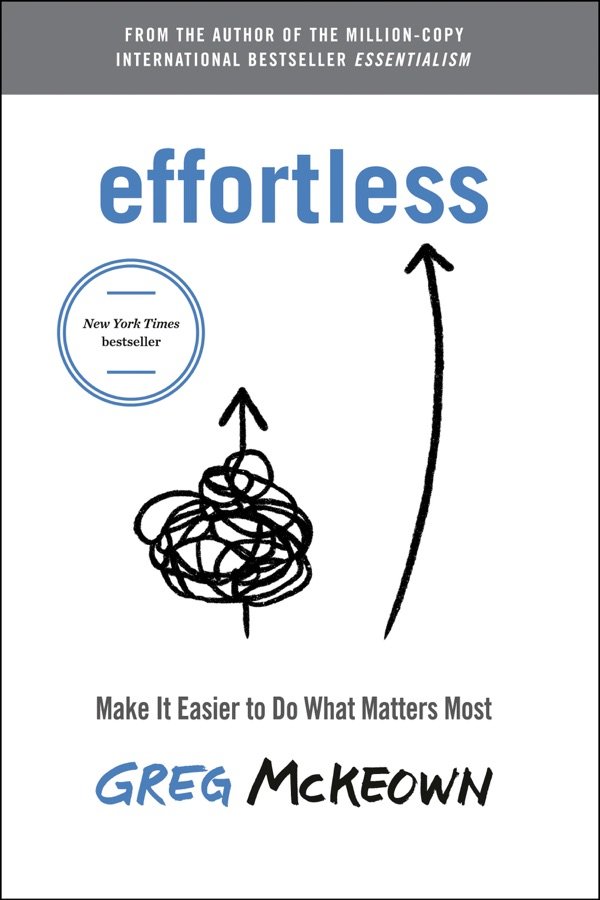
Effortless: Make It Easier to Do What Matters Most
von Greg McKeown
A student who learns the fundamental principles of any discipline can then easily apply that understanding in a variety of ways over time. An entrepreneur who learns what their customers really want can apply that knowledge to any number of different products and services. A manager who learns how to unify their team can apply that approach with many future teams. A person who understands how to make a decision can make decisions forever. often did. Armed with our building blocks of joy, we decided to build a new experience we’d look forward to: We got out the dark-chocolate-covered almonds. We put on “Feeling Good” by Michael Bublé in the background (on repeat). We treated it more like a date than a mundane obligation. That was when I noticed an element of the meeting I’d previously overlooked: the whole exercise involved tidying up a messy area, the family finances! Just noticing that creating order out of chaos was a part of the experience gave me a tangible and immediate benefit. We turned a task we had in the past barely endured into a ritual we looked forward to.
After a couple of days of using this rule, I noticed I would start to catch myself midcomplaint and quickly finish my sentence with words of gratitude. It wasn’t long before I would catch myself simply thinking about complaining—and I would think of something I was thankful for instead. At first this shift was deliberate and hard; then it was deliberate and easier; then, eventually, effortless.
There is no such thing as an effortless relationship. But there are ways we can make it easier to keep a relationship strong. We don’t need to agree with the other person on everything. But we do need to be present with them, to really notice them, to give them our full attention—maybe not always, but as frequently as we can. Being present is, as Eckhart Tolle has said, “ease itself.”10
This one simple difference between their approaches can explain why Amundsen’s team made it to the top while Scott’s team perished. Setting a steady, consistent, sustainable pace was ultimately what allowed the party from Norway to reach their destination “without particular effort,” as Roland Hunford, the author of a fascinating book on this race to the South Pole, explains.
The results revealed, perhaps unsurprisingly, that professional athletes were better at processing complex, fast-moving information than the other groups. But even more useful for those of us unlikely to make the NBA was the fact that all groups improved, very quickly, with practice.7 Everyone got better at focusing on the important and ignoring the irrelevant.
If you take away just one message from this book, I hope it is this: life doesn’t have to be as hard and complicated as we make it. Each of us has, as Robert Frost wrote, “promises to keep, / And miles to go before I sleep.”1 No matter what challenges, obstacles, or hardships we encounter along the way, we can always look for the easier, simpler path.
"A student who learns the fundamental principles of any discipline can then easily apply that understanding in a variety of ways over time. An entrepreneur who learns what their customers really want can apply that knowledge to any number of different products and services. A manager who learns how to unify their team can apply that approach with many future teams. A person who understands how to make a decision can make decisions forever."
"often did. Armed with our building blocks of joy, we decided to build a new experience we’d look forward to: We got out the dark-chocolate-covered almonds. We put on “Feeling Good” by Michael Bublé in the background (on repeat). We treated it more like a date than a mundane obligation. That was when I noticed an element of the meeting I’d previously overlooked: the whole exercise involved tidying up a messy area, the family finances! Just noticing that creating order out of chaos was a part of the experience gave me a tangible and immediate benefit. We turned a task we had in the past barely endured into a ritual we looked forward to."
"Often, the most useful knowledge comes from fields other than our own. As researchers from Northwestern University’s Kellogg School of Management found in analyzing almost eighteen million scientific papers, the best new ideas usually come from combining existing knowledge in one field with an “intrusion of unusual combinations” from other disciplines.12 This is why Munger is wise to “believe in the discipline of mastering the best that other people have ever figured out.” As he puts it, “I don’t believe in just sitting down and trying to dream it all up yourself. Nobody’s that smart.”"
"“In order to move fast, I expect you’ll make some foot faults.5 I’m okay with an error rate of 10–20% … if it means you can move fast.” Ben recalls, “I felt empowered to make decisions with this ratio in mind, and it was incredibly liberating.” Not surprisingly, Reid also advocates the same philosophy in entrepreneurship and business. “If you’re not embarrassed by your first product release,” he says, “you released it too late.”6 Or put another way, “When it comes to product launches, imperfect is perfect.”"
"An employee uses daily planning software to make it easy to prioritize their day. A manager creates an agenda for their weekly meeting to ensure they cover the most important topics. An entrepreneur brings a slide deck to each pitch meeting to make it easy to remember the most salient points to cover. A teacher gives his students a list of writing tips to make it easy to write a great essay. A parent creates a chore calendar that makes it easier for the kids to remember who is responsible for what each day."
"Southwest cofounder Herb Kelleher insisted there had to be a better way: “We are sitting in a management meeting trying to figure out what to do,” he recalls, “when someone piped up and asked ‘Do we really give a damn what United thinks a ticket is?9 Isn’t it more important what we think a ticket is?’ Reflexively, we all said, ‘No, we only care what we think a ticket is.’ So then the manager says, ‘Then why don’t we just print out a single piece of paper that says ‘This is a Ticket.’”"
"Here is what I learned: trying too hard makes it harder to get the results you want. Here is what I realized: behind almost every failure of my whole life I had made the same error. When I’d failed, it was rarely because I hadn’t tried hard enough, it was because I’d been trying too hard. We are conditioned over the course of our lifetimes to believe that in order to overachieve we must also overdo. As a result, we make things harder for ourselves than they need to be."
- →When we’re struggling to name the first obvious action, we need to either make it a little easier to get started on what’s important now or make it a little harder to do something trivial instead. Looking at that first step or action through the lens of 2.5 seconds is the change that makes every other change possible. It is the habit of habits.
- →Similarly, in your own pursuit of what matters, if you want to “build a better airplane,” don’t try to get everything exactly right the first time. Instead, embrace the rubbish “no matter how ugly it is” so you can crash, repair, modify, and redesign fast. It’s a far easier path for learning, growing, and making progress on what’s essential.
- →I had always held to: that to achieve everything we want without becoming impossibly busy or overextended, we simply need to discipline ourselves to only say “yes” to essential activities and “no” to everything else. But now I found myself wondering: what does one do when they’ve stripped life down to the essentials and it’s still too much?
- →Since the end of the Cold War, the military has used the acronym VUCA to describe our global environment: one that is volatile, uncertain, complex, and ambiguous.5 In response to this new normal, the military has developed several approaches we can apply to make it easier to do what matters on our own everyday battlegrounds.
Ähnliche Bücher gesucht?
Beschreibe deine Situation. Die Suche findet das passende Buch aus der gesamten Bibliothek.