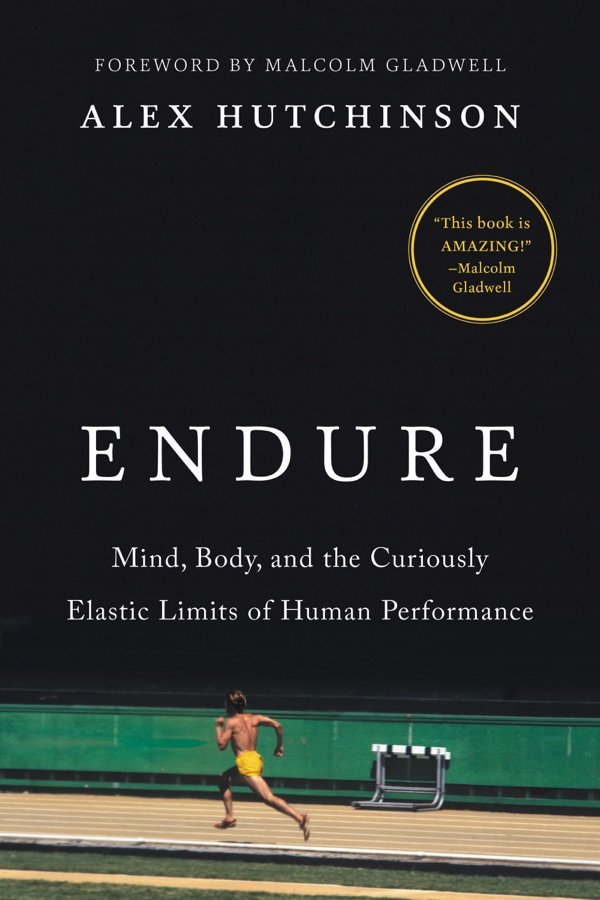
Endure: Mind, Body, and the Curiously Elastic Limits of Human Performance
von Alex Hutchinson
What’s crucial is the need to override what your instincts are telling you to do (slow down, back off, give up), and the sense of elapsed time. Taking a punch without flinching requires self-control, but endurance implies something more sustained: holding your finger in the flame long enough to feel the heat; filling the unforgiving minute with sixty seconds’ worth of distance run. The limits of endurance running, according to physiologists, could be quantified with three parameters: aerobic capacity, also known as VO2max, which is analogous to the size of a car’s engine; running economy, which is an efficiency measure like gas mileage; and lactate threshold, which dictates how much of your engine’s power you can sustain for long periods of time.
What’s crucial is the need to override what your instincts are telling you to do (slow down, back off, give up), and the sense of elapsed time. Taking a punch without flinching requires self-control, but endurance implies something more sustained: holding your finger in the flame long enough to feel the heat; filling the unforgiving minute with sixty seconds’ worth of distance run.
The limits of endurance running, according to physiologists, could be quantified with three parameters: aerobic capacity, also known as VO2max, which is analogous to the size of a car’s engine; running economy, which is an efficiency measure like gas mileage; and lactate threshold, which dictates how much of your engine’s power you can sustain for long periods of time.
This is why the psychology and physiology of endurance are inextricably linked: any task lasting longer than a dozen or so seconds requires decisions, whether conscious or unconscious, on how hard to push and when.
It turns out that, whether it’s heat or cold, hunger or thirst, or muscles screaming with the supposed poison of “lactic acid,” what matters in many cases is how the brain interprets these distress signals.
You judge what’s sustainable based not only on how you feel, but on how that feeling compares to how you expected to feel at that point in the race.
"What’s crucial is the need to override what your instincts are telling you to do (slow down, back off, give up), and the sense of elapsed time. Taking a punch without flinching requires self-control, but endurance implies something more sustained: holding your finger in the flame long enough to feel the heat; filling the unforgiving minute with sixty seconds’ worth of distance run."
"The limits of endurance running, according to physiologists, could be quantified with three parameters: aerobic capacity, also known as VO2max, which is analogous to the size of a car’s engine; running economy, which is an efficiency measure like gas mileage; and lactate threshold, which dictates how much of your engine’s power you can sustain for long periods of time."
"This is why the psychology and physiology of endurance are inextricably linked: any task lasting longer than a dozen or so seconds requires decisions, whether conscious or unconscious, on how hard to push and when."
"It turns out that, whether it’s heat or cold, hunger or thirst, or muscles screaming with the supposed poison of “lactic acid,” what matters in many cases is how the brain interprets these distress signals."
"You judge what’s sustainable based not only on how you feel, but on how that feeling compares to how you expected to feel at that point in the race."
"To their frustration, physiologists have found that the will to endure can’t be reliably tied to any single physiological variable."
"This shows that simply getting fitter doesn’t magically increase your pain tolerance; how you get fit matters: you have to suffer."
Ähnliche Bücher gesucht?
Beschreibe deine Situation. Die Suche findet das passende Buch aus der gesamten Bibliothek.