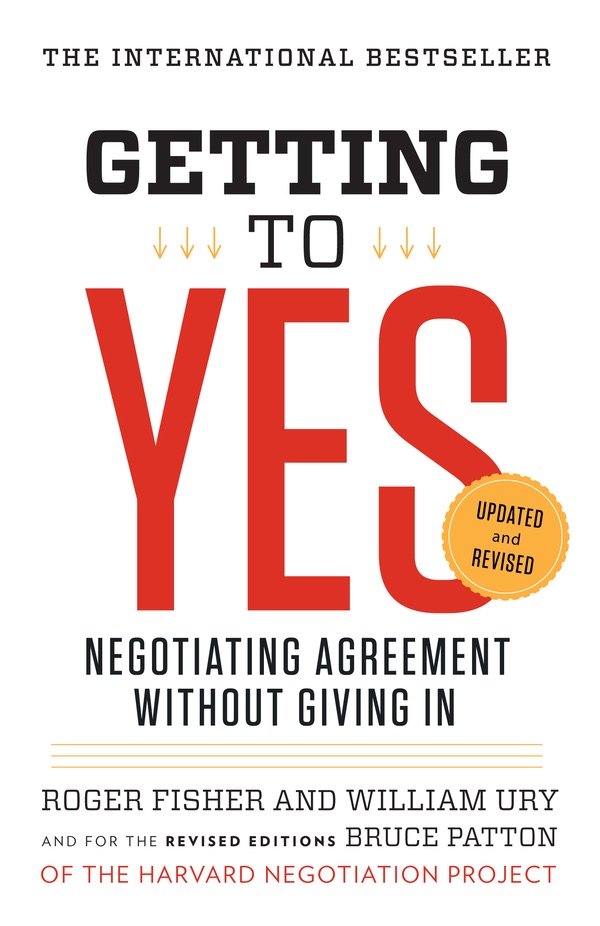
Getting to Yes: Negotiating Agreement Without Giving In
von Roger Fisher
Pressure can take many forms: a bribe, a threat, a manipulative appeal to trust, or a simple refusal to budge. In all these cases, the principled response is the same: invite them to state their reasoning, suggest objective criteria you think apply, and refuse to budge except on this basis. Never yield to pressure, only to principle. In most negotiations there are four major obstacles that inhibit the inventing of an abundance of options: (1) premature judgment; (2) searching for the single answer; (3) the assumption of a fixed pie; and (4) thinking that “solving their problem is their problem.” To overcome these constraints, you need to understand them.
Pressure can take many forms: a bribe, a threat, a manipulative appeal to trust, or a simple refusal to budge. In all these cases, the principled response is the same: invite them to state their reasoning, suggest objective criteria you think apply, and refuse to budge except on this basis. Never yield to pressure, only to principle.
In most negotiations there are four major obstacles that inhibit the inventing of an abundance of options: (1) premature judgment; (2) searching for the single answer; (3) the assumption of a fixed pie; and (4) thinking that “solving their problem is their problem.” To overcome these constraints, you need to understand them.
Generating possible BATNAs requires three distinct operations: (1) inventing a list of actions you might conceivably take if no agreement is reached; (2) improving some of the more promising ideas and converting them into practical alternatives; and (3) selecting, tentatively, the one alternative that seems best.
Failing to deal with others sensitively as human beings prone to human reactions can be disastrous for a negotiation. Whatever else you are doing at any point during a negotiation, from preparation to follow-up, it is worth asking yourself, “Am I paying enough attention to the people problem?”
To invent creative options, then, you will need to (1) separate the act of inventing options from the act of judging them; (2) broaden the options on the table rather than look for a single answer; (3) search for mutual gains; and (4) invent ways of making their decisions easy.
"Pressure can take many forms: a bribe, a threat, a manipulative appeal to trust, or a simple refusal to budge. In all these cases, the principled response is the same: invite them to state their reasoning, suggest objective criteria you think apply, and refuse to budge except on this basis. Never yield to pressure, only to principle."
"In most negotiations there are four major obstacles that inhibit the inventing of an abundance of options: (1) premature judgment; (2) searching for the single answer; (3) the assumption of a fixed pie; and (4) thinking that “solving their problem is their problem.” To overcome these constraints, you need to understand them."
"Generating possible BATNAs requires three distinct operations: (1) inventing a list of actions you might conceivably take if no agreement is reached; (2) improving some of the more promising ideas and converting them into practical alternatives; and (3) selecting, tentatively, the one alternative that seems best."
"Failing to deal with others sensitively as human beings prone to human reactions can be disastrous for a negotiation. Whatever else you are doing at any point during a negotiation, from preparation to follow-up, it is worth asking yourself, “Am I paying enough attention to the people problem?”"
"To invent creative options, then, you will need to (1) separate the act of inventing options from the act of judging them; (2) broaden the options on the table rather than look for a single answer; (3) search for mutual gains; and (4) invent ways of making their decisions easy."
"There are three steps in negotiating the rules of the negotiating game where the other side seems to be using a tricky tactic: recognize the tactic, raise the issue explicitly, and question the tactic’s legitimacy and desirability—negotiate over it."
"People: Separate the people from the problem. Interests: Focus on interests, not positions. Options: Invent multiple options looking for mutual gains before deciding what to do. Criteria: Insist that the result be based on some objective standard."
- →Pressure can take many forms: a bribe, a threat, a manipulative appeal to trust, or a simple refusal to budge. In all these cases, the principled response is the same: invite them to state their reasoning, suggest objective criteria you think apply, and refuse to budge except on this basis. Never yield to pressure, only to principle.
- →People: Separate the people from the problem. Interests: Focus on interests, not positions. Options: Invent multiple options looking for mutual gains before deciding what to do. Criteria: Insist that the result be based on some objective standard.
- →Inviting the other side to “correct me if I’m wrong” shows your openness, and if they do not correct you, it implies that they accept your description of the situation.
- →To find your way through the jungle of people problems, it is useful to think in terms of three basic categories: perception, emotion, and communication.
Ähnliche Bücher gesucht?
Beschreibe deine Situation. Die Suche findet das passende Buch aus der gesamten Bibliothek.