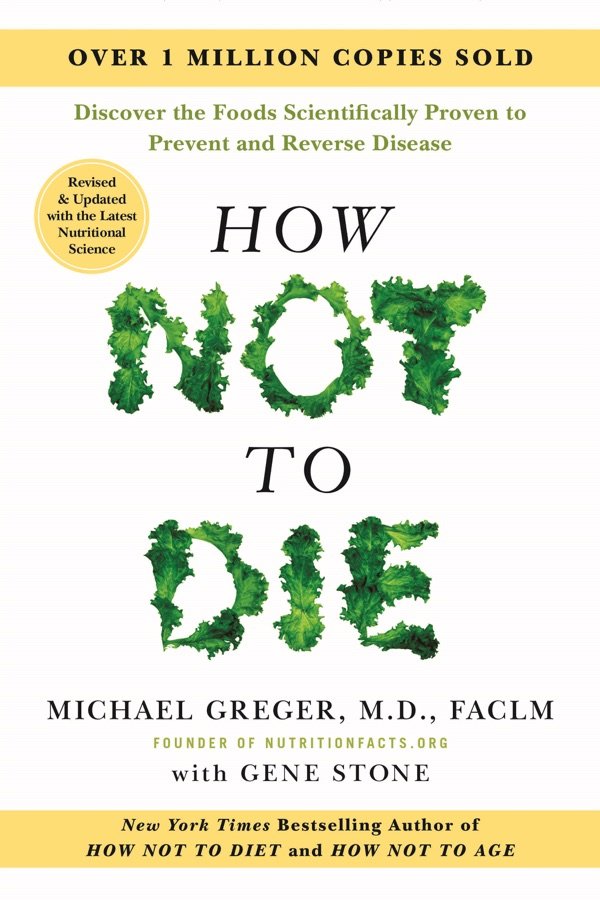
How Not to Die: Discover the Foods Scientifically Proven to Prevent and Reverse Disease
von Michael Greger
The truth is that adhering to just four simple healthy lifestyle factors can have a strong impact on the prevention of chronic diseases: not smoking, not being obese, getting a half hour of exercise a day, and eating healthier—defined as consuming more fruits, veggies, and whole grains and less meat. Those four factors alone were found to account for 78 percent of chronic disease risk. To drastically reduce LDL cholesterol levels, you need to drastically reduce your intake of three things: trans fat, which comes from processed foods and naturally from meat and dairy; saturated fat, found mainly in animal products and junk foods; and to a lesser extent dietary cholesterol, found exclusively in animal-derived foods, especially eggs.
The truth is that adhering to just four simple healthy lifestyle factors can have a strong impact on the prevention of chronic diseases: not smoking, not being obese, getting a half hour of exercise a day, and eating healthier—defined as consuming more fruits, veggies, and whole grains and less meat. Those four factors alone were found to account for 78 percent of chronic disease risk.
To drastically reduce LDL cholesterol levels, you need to drastically reduce your intake of three things: trans fat, which comes from processed foods and naturally from meat and dairy; saturated fat, found mainly in animal products and junk foods; and to a lesser extent dietary cholesterol, found exclusively in animal-derived foods, especially eggs.
That one unifying diet found to best prevent and treat many of these chronic diseases is a whole-food, plant-based diet, defined as an eating pattern that encourages the consumption of unrefined plant foods and discourages meats, dairy products, eggs, and processed foods.
People who once ate vegetarian diets but then started to eat meat at least once a week experienced a 146 percent increase in odds of heart disease, a 152 percent increase in stroke, a 166 percent increase in diabetes, and a 231 percent increase in odds for weight gain.
Weight loss through calorie restriction and an even more vigorous exercise program failed to improve telomere length, so it appears that the active ingredient is the quality, not quantity, of the food eaten.
"The truth is that adhering to just four simple healthy lifestyle factors can have a strong impact on the prevention of chronic diseases: not smoking, not being obese, getting a half hour of exercise a day, and eating healthier—defined as consuming more fruits, veggies, and whole grains and less meat. Those four factors alone were found to account for 78 percent of chronic disease risk."
"To drastically reduce LDL cholesterol levels, you need to drastically reduce your intake of three things: trans fat, which comes from processed foods and naturally from meat and dairy; saturated fat, found mainly in animal products and junk foods; and to a lesser extent dietary cholesterol, found exclusively in animal-derived foods, especially eggs."
"That one unifying diet found to best prevent and treat many of these chronic diseases is a whole-food, plant-based diet, defined as an eating pattern that encourages the consumption of unrefined plant foods and discourages meats, dairy products, eggs, and processed foods."
"People who once ate vegetarian diets but then started to eat meat at least once a week experienced a 146 percent increase in odds of heart disease, a 152 percent increase in stroke, a 166 percent increase in diabetes, and a 231 percent increase in odds for weight gain."
"Weight loss through calorie restriction and an even more vigorous exercise program failed to improve telomere length, so it appears that the active ingredient is the quality, not quantity, of the food eaten."
"In general, the dividing line between health-promoting and disease-promoting foods may be less plant- versus animal-sourced foods and more whole plant foods versus most everything else."
"What are some of the truly potassium-rich foods? The healthiest common whole-food sources are probably greens, beans, and sweet potatoes."
Ähnliche Bücher gesucht?
Beschreibe deine Situation. Die Suche findet das passende Buch aus der gesamten Bibliothek.