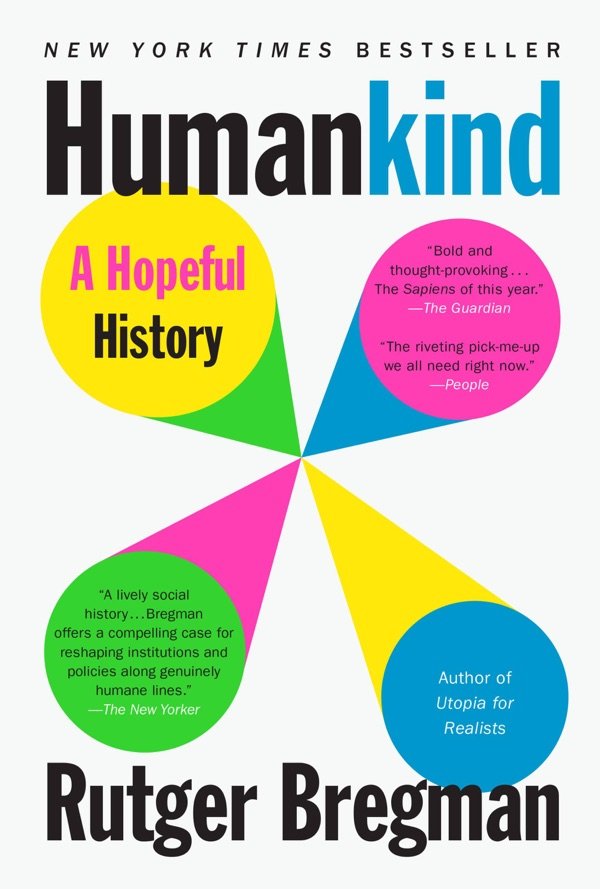
Humankind: A Hopeful History
von Rutger Bregman
An old man says to his grandson: ‘There’s a fight going on inside me. It’s a terrible fight between two wolves. One is evil – angry, greedy, jealous, arrogant, and cowardly. The other is good – peaceful, loving, modest, generous, honest, and trustworthy. These two wolves are also fighting within you, and inside every other person too.’ After a moment, the boy asks, ‘Which wolf will win?’ The old man smiles. ‘The one you feed.’ There is a persistent myth that by their very nature humans are selfish, aggressive and quick to panic. It’s what Dutch biologist Frans de Waal likes to call veneer theory: the notion that civilisation is nothing more than a thin veneer that will crack at the merest provocation.4 In actuality, the opposite is true. It’s when crisis hits – when the bombs fall or the floodwaters rise – that we humans become our best selves.
Human beings, it turns out, are ultrasocial learning machines. We’re born to learn, to bond and to play. Maybe it’s not so strange, then, that blushing is the only human expression that’s uniquely human. Blushing, after all, is quintessentially social – it’s people showing they care what others think, which fosters trust and enables cooperation.
When you are studying any matter or considering any philosophy, ask yourself only what are the facts and what is the truth that the facts bear out. Never let yourself be diverted either by what you wish to believe or by what you think would have beneficent social effects if it were believed, but look only and solely at what are the facts.
Humans, in short, are anything but poker-faced. We constantly leak emotions and are hardwired to relate to the people around us. But far from being a handicap, this is our true superpower, because sociable people aren’t only more fun to be around, in the end they’re smarter, too.
Catastrophes bring out the best in people. I know of no other sociological finding that’s backed by so much solid evidence that’s so blithely ignored. The picture we’re fed by the media is consistently the opposite of what happens when disaster strikes.
Dmitri Belyaev’s theory was that people are domesticated apes. That for tens of thousands of years, the nicest humans had the most kids. That the evolution of our species, in short, was predicated on ‘survival of the friendliest’.
"An old man says to his grandson: ‘There’s a fight going on inside me. It’s a terrible fight between two wolves. One is evil – angry, greedy, jealous, arrogant, and cowardly. The other is good – peaceful, loving, modest, generous, honest, and trustworthy. These two wolves are also fighting within you, and inside every other person too.’ After a moment, the boy asks, ‘Which wolf will win?’ The old man smiles. ‘The one you feed.’"
"There is a persistent myth that by their very nature humans are selfish, aggressive and quick to panic. It’s what Dutch biologist Frans de Waal likes to call veneer theory: the notion that civilisation is nothing more than a thin veneer that will crack at the merest provocation.4 In actuality, the opposite is true. It’s when crisis hits – when the bombs fall or the floodwaters rise – that we humans become our best selves."
"Human beings, it turns out, are ultrasocial learning machines. We’re born to learn, to bond and to play. Maybe it’s not so strange, then, that blushing is the only human expression that’s uniquely human. Blushing, after all, is quintessentially social – it’s people showing they care what others think, which fosters trust and enables cooperation."
"When you are studying any matter or considering any philosophy, ask yourself only what are the facts and what is the truth that the facts bear out. Never let yourself be diverted either by what you wish to believe or by what you think would have beneficent social effects if it were believed, but look only and solely at what are the facts."
"Humans, in short, are anything but poker-faced. We constantly leak emotions and are hardwired to relate to the people around us. But far from being a handicap, this is our true superpower, because sociable people aren’t only more fun to be around, in the end they’re smarter, too."
"Catastrophes bring out the best in people. I know of no other sociological finding that’s backed by so much solid evidence that’s so blithely ignored. The picture we’re fed by the media is consistently the opposite of what happens when disaster strikes."
"Dmitri Belyaev’s theory was that people are domesticated apes. That for tens of thousands of years, the nicest humans had the most kids. That the evolution of our species, in short, was predicated on ‘survival of the friendliest’."
- →When you are studying any matter or considering any philosophy, ask yourself only what are the facts and what is the truth that the facts bear out. Never let yourself be diverted either by what you wish to believe or by what you think would have beneficent social effects if it were believed, but look only and solely at what are the facts.
- →Humans, in short, are anything but poker-faced. We constantly leak emotions and are hardwired to relate to the people around us. But far from being a handicap, this is our true superpower, because sociable people aren’t only more fun to be around, in the end they’re smarter, too.
- →If there’s one lesson to be drawn from the nocebo effect, it’s that ideas are never merely ideas. We are what we believe. We find what we go looking for. And what we predict, comes to pass.
Ähnliche Bücher gesucht?
Beschreibe deine Situation. Die Suche findet das passende Buch aus der gesamten Bibliothek.