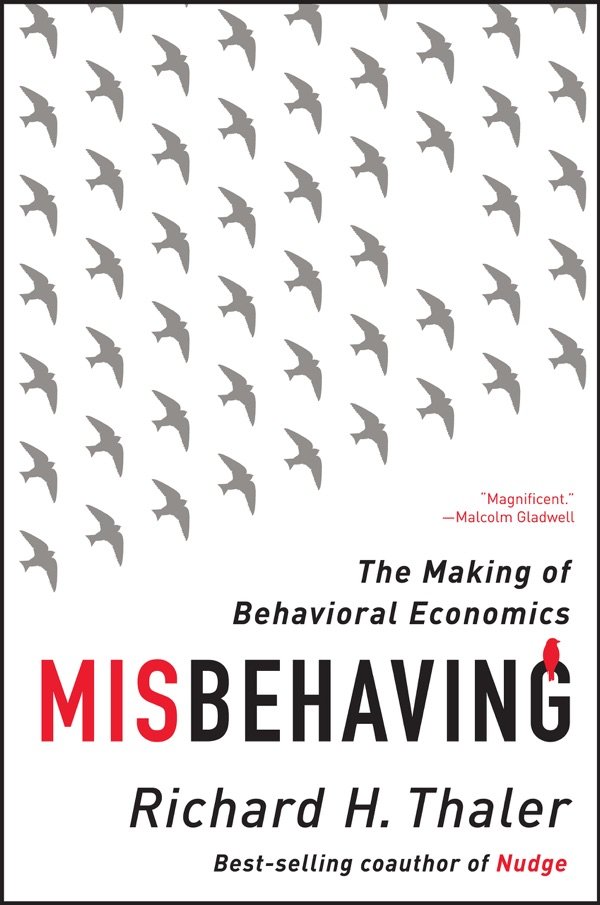
Misbehaving: The Making of Behavioral Economics
von Richard H. Thaler
Our primary goal in the paper was to use these high-stakes decisions to compare standard expected utility theory to prospect theory,† and beyond that, to consider the role of “path dependence.” Does the way the game has played out influence the choices people make? Economic theory says that it shouldn’t. The only thing that should matter is the choice the contestant is now facing, not the good or bad luck that occurred along the way. The path is an SIF. We don’t have to stop inventing abstract models that describe the behavior of imaginary Econs. We do, however, have to stop assuming that those models are accurate descriptions of behavior, and stop basing policy decisions on such flawed analyses. And we have to start paying attention to those supposedly irrelevant factors, what I will call SIFs for short.
We don’t have to stop inventing abstract models that describe the behavior of imaginary Econs. We do, however, have to stop assuming that those models are accurate descriptions of behavior, and stop basing policy decisions on such flawed analyses. And we have to start paying attention to those supposedly irrelevant factors, what I will call SIFs for short.
I called this phenomenon the “endowment effect” because, in economists’ lingo, the stuff you own is part of your endowment, and I had stumbled upon a finding that suggested people valued things that were already part of their endowment more highly than things that could be part of their endowment, that were available but not yet owned.
The planner has two sets of tools she can use to influence the actions of the doers. She can either try to influence the decisions that the doers make through rewards or penalties (financial or otherwise) that still allow them discretion, or she can impose rules, such as commitment strategies, which limit the doers’ options.
The primary reason for adding Humans to economic theories is to improve the accuracy of the predictions made with those theories. But there is another benefit that comes with including real people in the mix. Behavioral economics is more interesting and more fun than regular economics. It is the un-dismal science.
My impression was that players who were behind were attracted to small bets that offered a slim chance for a big win (such as drawing to an inside straight) but disliked big bets that risked a substantial increase to the size of their loss, even though they offered a higher probability of breaking even.
"Our primary goal in the paper was to use these high-stakes decisions to compare standard expected utility theory to prospect theory,† and beyond that, to consider the role of “path dependence.” Does the way the game has played out influence the choices people make? Economic theory says that it shouldn’t. The only thing that should matter is the choice the contestant is now facing, not the good or bad luck that occurred along the way. The path is an SIF."
"We don’t have to stop inventing abstract models that describe the behavior of imaginary Econs. We do, however, have to stop assuming that those models are accurate descriptions of behavior, and stop basing policy decisions on such flawed analyses. And we have to start paying attention to those supposedly irrelevant factors, what I will call SIFs for short."
"I called this phenomenon the “endowment effect” because, in economists’ lingo, the stuff you own is part of your endowment, and I had stumbled upon a finding that suggested people valued things that were already part of their endowment more highly than things that could be part of their endowment, that were available but not yet owned."
"The planner has two sets of tools she can use to influence the actions of the doers. She can either try to influence the decisions that the doers make through rewards or penalties (financial or otherwise) that still allow them discretion, or she can impose rules, such as commitment strategies, which limit the doers’ options."
"The primary reason for adding Humans to economic theories is to improve the accuracy of the predictions made with those theories. But there is another benefit that comes with including real people in the mix. Behavioral economics is more interesting and more fun than regular economics. It is the un-dismal science."
"My impression was that players who were behind were attracted to small bets that offered a slim chance for a big win (such as drawing to an inside straight) but disliked big bets that risked a substantial increase to the size of their loss, even though they offered a higher probability of breaking even."
"With prospect theory, Kahneman and Tversky set out to offer an alternative to expected utility theory that had no pretense of being a useful guide to rational choice; instead, it would be a good prediction of the actual choices real people make. It is a theory about the behavior of Humans."
- →The planner has two sets of tools she can use to influence the actions of the doers. She can either try to influence the decisions that the doers make through rewards or penalties (financial or otherwise) that still allow them discretion, or she can impose rules, such as commitment strategies, which limit the doers’ options.
- →Normative theories tell you the right way to think about some problem. By “right” I do not mean right in some moral sense; instead, I mean logically consistent, as prescribed by the optimizing model at the heart of economic reasoning, sometimes called rational choice theory.
- →Because learning takes practice, we are more likely to get things right at small stakes than at large stakes. This means critics have to decide which argument they want to apply. If learning is crucial, then as the stakes go up, decision-making quality is likely to go down.
- →An implication of this analysis is that the more often people look at their portfolios, the less willing they will be to take on risk, because if you look more often, you will see more losses.
Ähnliche Bücher gesucht?
Beschreibe deine Situation. Die Suche findet das passende Buch aus der gesamten Bibliothek.