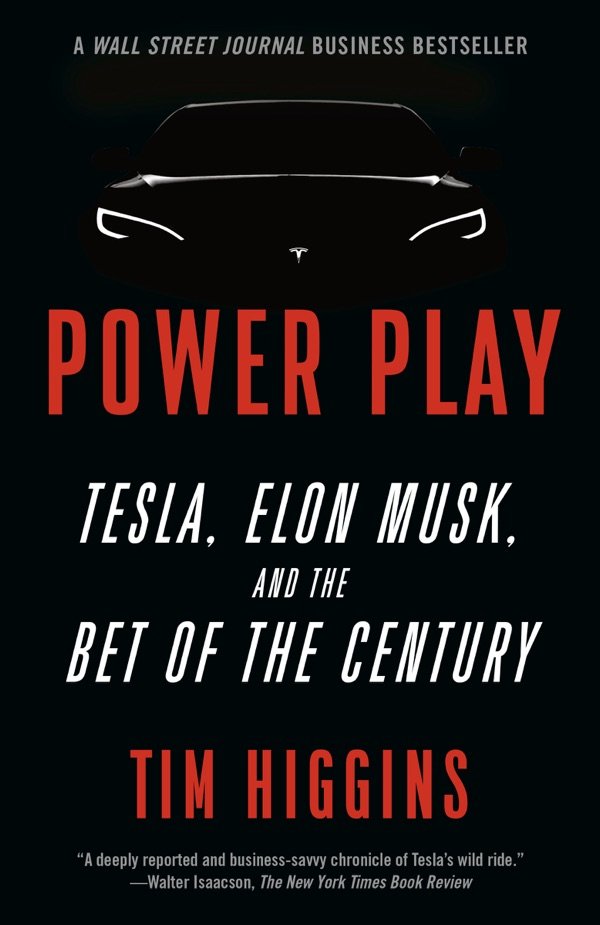
Power Play: Elon Musk, Tesla, and the Bet of the Century
von Tim Higgins
Sitting at the table picking at his dinner, Rawlinson at first blush had little in common with the coarse-spoken rocket maker before him. Musk wore T-shirts; Rawlinson preferred a sport coat. Rawlinson had polite English manners, enjoyed skiing, and stood about a foot shorter than Musk. But as the two chatted, it became clear that they held the automotive industry in similar disregard. Rawlinson talked of his frustrations with the inefficiencies he’d observed over twenty-five years working in the business, how he had spent a career trying to forge improvements, emphasizing the use of computers to speed along design and engineering. He’d also experimented with using smaller teams, to cut through corporate bureaucracy and shave months of work off the cumbersome process of creating a car. Rawlinson had begun his career at Rover Group and quickly discovered that large corporations could be dull, slow, and averse to work that’s on the cutting edge. He spent his time trying to figure out how to use computers to aid the design of his engineering, his eyes growing weary from staring at monochrome green screens for hours at a time. He eventually went to work at Jaguar, which at the time was a separate company, with teams that had begun using computer-aided vehicle development, a rarity in the 1980s. He found himself doing challenging work, and with a group still small enough that he could gain a wide variety of experience. He was especially attracted to the engineering work involved in a car’s body. It touched nearly every other function of the vehicle, giving him a broad And the stock kept rising. In just weeks, the company was worth as much as Toyota and Volkswagen combined. Musk hit his $100 billion market value payout target, then went on to clear thresholds for three more payouts (then two more by spring 2021).8 The stock passed the $700 billion market value milestone that Musk had thrown down years earlier like Babe Ruth calling his shot. It soared from a value of $100 billion to more than $800 billion in 244 days, accomplishing something it took Apple almost a decade to do. With the stock he already owned, his wealth was surging from an estimated $30 billion at the start of 2020 to around $200 billion at the start of 2021, overtaking Amazon founder Jeff Bezos’s spot as the world’s richest person, according to Bloomberg’s Billionaire Index.
Musk wanted to know what Rawlinson would do differently. “Elite fighting forces,” Rawlinson said. “Take the paratroop regiment. The big difference in a paratroop regiment is the leader is on the ground … You have direct leadership which adjusts to battlefield conditions.” Musk’s eyes widened. “Paratroopers! You mean special forces?” “Oh—” Rawlinson paused, realizing he had struck a vein. “Yes!”
He ordered each person to go around the room and tell him “who the fuck you are and what the fuck you’re doing to fix my goddamn line.”20 As he berated the team, one of the engineers had had enough and quit to Musk’s face. Musk screamed as the young engineer walked out. In another meeting, Musk walked in to find a manager that he’d grown unhappy with and said, “I thought I fired you yesterday.”
What really caught Fossi’s attention, though, was the crowd’s enthusiasm. “It struck me that this was like a religion,” Fossi recalled.2 He marveled at how Musk had forged a narrative of himself as a great tech visionary—landing rockets, disrupting industries, making the world cleaner. “This guy—he’s a prairie preacher,” Fossi said. “He’s got the revival tent up and these people are in it.”
At a company such as Renault or Audi, there would be a painful autopsy to pinpoint where the error had arisen and who was to blame. All the while the issue would navigate internal politics and multiple levels of bureaucracy, punctuated by finger-pointing and time-sucking meetings. Musk didn’t have the bandwidth for such things. His response: “Solve it, guys.”4
“The Secret Tesla Motors Master Plan.” “In keeping with a fast growing technology company, all free cash flow is plowed back into R&D to drive down the costs and bring the follow on products to market as fast as possible,” he wrote. “When someone buys the Tesla Roadster sports car, they are actually helping pay for development of the low cost family car.”
"Sitting at the table picking at his dinner, Rawlinson at first blush had little in common with the coarse-spoken rocket maker before him. Musk wore T-shirts; Rawlinson preferred a sport coat. Rawlinson had polite English manners, enjoyed skiing, and stood about a foot shorter than Musk. But as the two chatted, it became clear that they held the automotive industry in similar disregard. Rawlinson talked of his frustrations with the inefficiencies he’d observed over twenty-five years working in the business, how he had spent a career trying to forge improvements, emphasizing the use of computers to speed along design and engineering. He’d also experimented with using smaller teams, to cut through corporate bureaucracy and shave months of work off the cumbersome process of creating a car. Rawlinson had begun his career at Rover Group and quickly discovered that large corporations could be dull, slow, and averse to work that’s on the cutting edge. He spent his time trying to figure out how to use computers to aid the design of his engineering, his eyes growing weary from staring at monochrome green screens for hours at a time. He eventually went to work at Jaguar, which at the time was a separate company, with teams that had begun using computer-aided vehicle development, a rarity in the 1980s. He found himself doing challenging work, and with a group still small enough that he could gain a wide variety of experience. He was especially attracted to the engineering work involved in a car’s body. It touched nearly every other function of the vehicle, giving him a broad"
"And the stock kept rising. In just weeks, the company was worth as much as Toyota and Volkswagen combined. Musk hit his $100 billion market value payout target, then went on to clear thresholds for three more payouts (then two more by spring 2021).8 The stock passed the $700 billion market value milestone that Musk had thrown down years earlier like Babe Ruth calling his shot. It soared from a value of $100 billion to more than $800 billion in 244 days, accomplishing something it took Apple almost a decade to do. With the stock he already owned, his wealth was surging from an estimated $30 billion at the start of 2020 to around $200 billion at the start of 2021, overtaking Amazon founder Jeff Bezos’s spot as the world’s richest person, according to Bloomberg’s Billionaire Index."
"Hunter’s team in Las Vegas had spent the final three months of 2018 converting remaining deposit holders into buyers to achieve another record quarter of deliveries. It grew harder as the year dwindled, with the ranks of buyers with an appetite for the higher-priced version growing thinner and more and more customers holding out for the $35,000 model. His team was looking forward to taking some time off after closing the year. Some would quit altogether. They’d reached their goal—but also the end of their rope. Many, like Hunter himself, would be laid off, as Musk focused both on cutting costs and taking the Model 3 to Europe and China, where there were still early adopters presumably willing to pay for the more expensive versions of the Model 3."
"During a design review at the Fisker studio, Musk echoed Lloyd’s unhappiness. At one point, Musk ran a photo of a low-slung two-door McLaren F1 sports car through Photoshop, stretching the image in such a way as to make it look like a four-door sedan. Presented with Musk’s idea, Henrik Fisker marched over to a whiteboard, where he drew the silhouette of a conventionally beautiful woman. “This is the form that the designers all design their fashion clothing for,” Fisker said, according to a person in the meeting. Then, he drew the outline of a pear-shaped woman. “Eventually, they’ll make the dresses to try to fit this woman as well, so they can sell them. But it’s not the same thing.” Musk turned beet red in anger."
"Those early ones were treated as sellable, but only to people close to the company, like Jurvetson, so engineers could learn what was wrong and continue tweaking. The managers knew they were flawed; Jurvetson’s vehicle quickly broke down. (The company sent a flatbed truck to retrieve it, covering the Model S with cloth so as not to telegraph to the world that the first Model S had already crapped out.) A team was created to drive every vehicle for one hundred miles, looking for problems and seeing if the battery prematurely died—an event they internally, morbidly, dubbed infant mortality.9 Some of Straubel’s battery packs were having problems involving cooling liquid leaks, which rendered them useless.10"
"all-purpose fixer, Tim Watkins. He organized an all-hands-on-deck sales drive: Employees in recruiting were deployed to call potential customers who had inquired about buying a Model S, so-called hand-raisers. Human resources processed orders. Meanwhile, Blankenship managed delivery, tracking every car on its way to the customer. Corporate accounting dictated that a car couldn’t be counted as sold until the owner took possession of it. He kept a whiteboard tracking cars in transit. When a truck flipped over in the Midwest carrying half a dozen cars, Blankenship got a call with the bad news ten minutes later. He told an assistant to erase the cars from the board—they wouldn’t be delivered this quarter.6"
"The cells were costing an estimated $250 per kilowatt hour, down from $350 per kWh in 2009.1 That meant that the cells in a 1,300-pound battery pack with a capacity of 85 kWh, a reasonable goal for a sedan that could compete with its combustion-engine counterpart, would cost about $21,000.2 That already represented a huge chunk of the Model 3’s projected sticker price. Analysts believed automakers needed the cost to drop to around $100 per kWh before the cost of making an electric car would be comparable to that of a traditional one. As Straubel discussed his math with Musk on the airplane, the two quickly became convinced: they were going to need a factory to churn out batteries just for Tesla.3"
- →“Public company stocks, particularly if big step changes in technology are involved, go through extreme volatility, both for reasons of internal executions and for reasons that have nothing to do with anything except the economy. This causes people to be distracted by the manic-depressive nature of the stock instead of creating great products.”
- →because it would allow his company’s vehicle lineup to spell S-E-X. His senior leadership team laughed out loud at the suggestion, but it had to be tweaked when they realized Ford held the trademark to a Model E. So “E” was reversed to “3,” which was apt for a third-generation car, but which also kind of allowed him to maintain the joke.
- →“OK,” Musk said, and left it at that. Unlike his engineering colleagues, who might have to be prepared to debate with Musk the very basic elements of their decisions, Blankenship was being given wide latitude. Musk trusted him to do his job. If he failed, it was on him—and he knew there’d be hell to pay.
- →Deepak Ahuja, the new CFO formerly of Ford, went over the numbers and came away impressed. If they were able to design a vehicle with so few people, it could give Tesla a competitive edge on cost against the bigger players. “This is revolutionary,” he told Rawlinson. “I’ve never seen anything like this.”
Ähnliche Bücher gesucht?
Beschreibe deine Situation. Die Suche findet das passende Buch aus der gesamten Bibliothek.