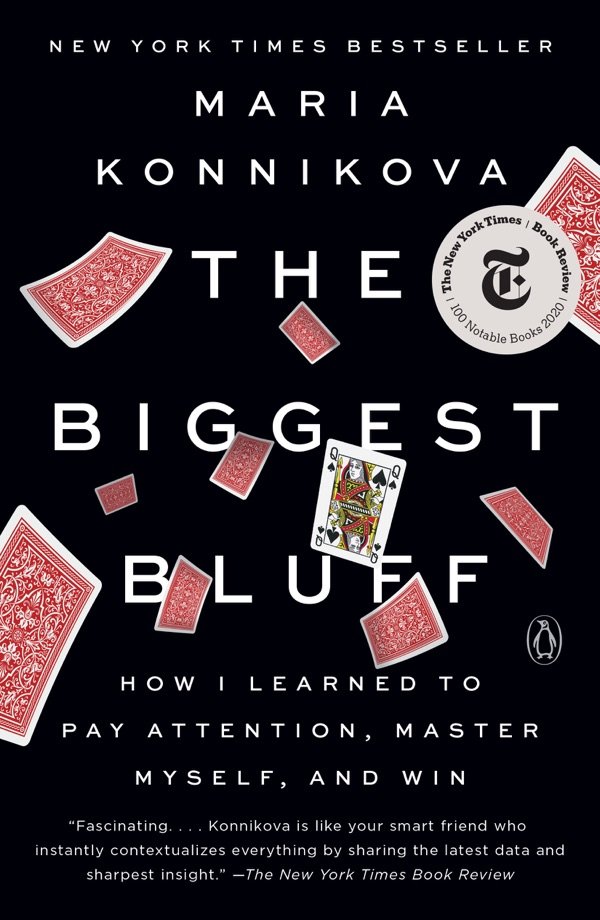
The Biggest Bluff: How I Learned to Pay Attention, Master Myself, and Win
von Maria Konnikova
It’s called the description-experience gap. In study after study, people fail to internalize numeric rules, making decisions based on things like “gut feeling” and “intuition” and “what feels right” rather than based on the data they are shown. We need to train ourselves to see the world in a probabilistic light—and even then, we often ignore the numbers in favor of our own experience. When it comes to learning, Triumph is the real foe; it’s Disaster that’s your teacher. It’s Disaster that brings objectivity. It’s Disaster that’s the antidote to that greatest of delusions, overconfidence. And ultimately, both Triumph and Disaster are impostors. They are results that are subject to chance. One of them just happens to be a better teaching tool than the other.
It’s called the description-experience gap. In study after study, people fail to internalize numeric rules, making decisions based on things like “gut feeling” and “intuition” and “what feels right” rather than based on the data they are shown. We need to train ourselves to see the world in a probabilistic light—and even then, we often ignore the numbers in favor of our own experience.
When it comes to learning, Triumph is the real foe; it’s Disaster that’s your teacher. It’s Disaster that brings objectivity. It’s Disaster that’s the antidote to that greatest of delusions, overconfidence. And ultimately, both Triumph and Disaster are impostors. They are results that are subject to chance. One of them just happens to be a better teaching tool than the other.
People failed to see what the world was telling them when that message wasn’t one they wanted to hear. They liked being the rulers of their environment. When the environment knew more than they did—well, that was no good at all. Here was the cruel truth: we humans too often think ourselves in firm control when we are really playing by the rules of chance.
“You become a big winner when you lose,” Dan says. “Everyone plays well when they’re winning. But can you control yourself and play well when you’re losing? And not by being too conservative, but trying to still be objective as to what your chances are in the hand. If you can do that, then you’ve conquered the game.”
Poker isn’t just about calibrating the strength of your beliefs. It’s also about becoming comfortable with the fact that there’s no such thing as a sure thing—ever. You will never have all the information you want, and you will have to act all the same. Leave your certainty at the door.
"It’s called the description-experience gap. In study after study, people fail to internalize numeric rules, making decisions based on things like “gut feeling” and “intuition” and “what feels right” rather than based on the data they are shown. We need to train ourselves to see the world in a probabilistic light—and even then, we often ignore the numbers in favor of our own experience."
"When it comes to learning, Triumph is the real foe; it’s Disaster that’s your teacher. It’s Disaster that brings objectivity. It’s Disaster that’s the antidote to that greatest of delusions, overconfidence. And ultimately, both Triumph and Disaster are impostors. They are results that are subject to chance. One of them just happens to be a better teaching tool than the other."
"People failed to see what the world was telling them when that message wasn’t one they wanted to hear. They liked being the rulers of their environment. When the environment knew more than they did—well, that was no good at all. Here was the cruel truth: we humans too often think ourselves in firm control when we are really playing by the rules of chance."
"“You become a big winner when you lose,” Dan says. “Everyone plays well when they’re winning. But can you control yourself and play well when you’re losing? And not by being too conservative, but trying to still be objective as to what your chances are in the hand. If you can do that, then you’ve conquered the game.”"
"Poker isn’t just about calibrating the strength of your beliefs. It’s also about becoming comfortable with the fact that there’s no such thing as a sure thing—ever. You will never have all the information you want, and you will have to act all the same. Leave your certainty at the door."
"In what’s known as the planning fallacy, we tend to be overly optimistic when we map out timelines, goals, targets, and other horizons. We look at the best-case scenario instead of using the past to determine what a more realistic scenario would look like."
"If you’re skeptical of any prescriptive advice to begin with, if “less certainty, more inquiry” is your guiding light, not only will you listen; you will adjust. You will grow. And if that’s not self-awareness and self-discipline, I don’t know what is."
- →“You become a big winner when you lose,” Dan says. “Everyone plays well when they’re winning. But can you control yourself and play well when you’re losing? And not by being too conservative, but trying to still be objective as to what your chances are in the hand. If you can do that, then you’ve conquered the game.”
- →Poker isn’t just about calibrating the strength of your beliefs. It’s also about becoming comfortable with the fact that there’s no such thing as a sure thing—ever. You will never have all the information you want, and you will have to act all the same. Leave your certainty at the door.
Ähnliche Bücher gesucht?
Beschreibe deine Situation. Die Suche findet das passende Buch aus der gesamten Bibliothek.