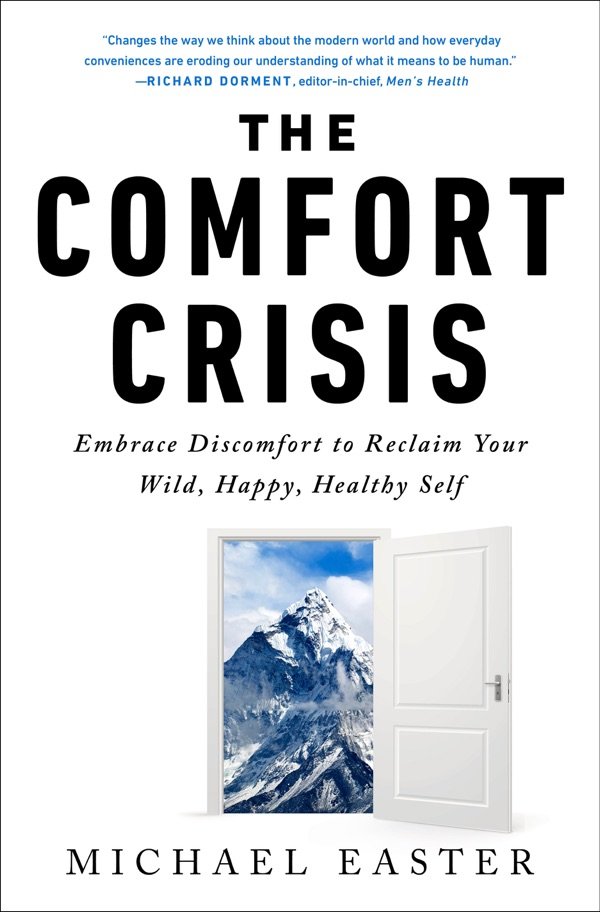
The Comfort Crisis: Embrace Discomfort To Reclaim Your Wild, Happy, Healthy Self
von Michael Easter
This idea was echoed to me recently by one of my best friends, William Allen, a former major in the US Marines and co-founder of Harpoon Ventures, a fast-rising defense-focused venture capital firm. “If you can consciously put yourself through physical discomfort and understand the higher purpose of it, the ‘why,’ the mental calluses that come along with that create what is called the Well of Fortitude,” he said. “My business partner, who happens to be a prior service US Navy SEAL, and I were able to successfully build a legitimate venture capital fund from the ground up. Not because we were special, supersmart, or had access to family money. But rather, we knew our higher purpose and were able to draw on the Well of Fortitude we built on challenging missions in the military to buffer stress, work harder, and simply endure.” — “Misogis are inward facing,” he said. “A big part of the value proposition is that I’m going to do something that’s really uncomfortable. I’m going to want to quit. And it’s going to be hard not to quit because no one is watching. But I’m not going to quit because I’m watching. And then I can reflect back on how I was the only person watching myself and I still rose to the occasion in a big way. There’s some deep satisfaction in that. Did you really do what you think is the right thing when you were the only person watching? Or do you need an audience or a big pat on the back for that? Are you not important enough to do it for you? We had this guideline before social media, and it seems more relevant today.”
I rarely, if ever, felt the sensation of discomfort. The most physically uncomfortable thing I did, exercise, was executed inside an air-conditioned building as I watched cable news channels that are increasingly bent on confirming my worldview rather than challenging it. I wouldn’t run outside unless the conditions were, well, comfortable. Neither too hot, too cold, nor too wet.
Thanks to technology, I rarely let my mind wander. I always have a phone, TV, computer, or other digital device to attend to. The average American each day touches his phone 2,617 times and spends 2 hours and 30 minutes staring at the small screen. If that seems gross, the study also identified a large group of “heavy users” who spent more than 4 hours a day on their phones.
Exercise is never exactly comfortable, but the average gym attempts to make it so. A typical workout for most people today is zoning out to reality TV while running along a motorized belt in a temperature-controlled room. Another popular machine has users make repetitive elliptical motions with their arms and legs—motions never occurring until the advent of that machine.
Then we throw “a lifetime of stress and sleep deprivation compounded with a poor diet and low activity and it seems to bring on chronic disease rather quickly,” said Schnorr. Scientists at Northwestern University wrote, “All major diseases, including cardiovascular disease, diabetes, neurodegenerative disorders, arthritis, and cancers involve chronic inflammation.”
For most modern Americans, “stress” is so often “This traffic is going to make me late to my yoga class” stress. Or “Is my neighbor making more money than me?” stress. Or “This spreadsheet is going to take forever” stress. Or “If my child doesn’t get into an Ivy League school we will all live lives of complete and utter nothingness” stress. It’s first-world stress.
"This idea was echoed to me recently by one of my best friends, William Allen, a former major in the US Marines and co-founder of Harpoon Ventures, a fast-rising defense-focused venture capital firm. “If you can consciously put yourself through physical discomfort and understand the higher purpose of it, the ‘why,’ the mental calluses that come along with that create what is called the Well of Fortitude,” he said. “My business partner, who happens to be a prior service US Navy SEAL, and I were able to successfully build a legitimate venture capital fund from the ground up. Not because we were special, supersmart, or had access to family money. But rather, we knew our higher purpose and were able to draw on the Well of Fortitude we built on challenging missions in the military to buffer stress, work harder, and simply endure.” —"
"“Misogis are inward facing,” he said. “A big part of the value proposition is that I’m going to do something that’s really uncomfortable. I’m going to want to quit. And it’s going to be hard not to quit because no one is watching. But I’m not going to quit because I’m watching. And then I can reflect back on how I was the only person watching myself and I still rose to the occasion in a big way. There’s some deep satisfaction in that. Did you really do what you think is the right thing when you were the only person watching? Or do you need an audience or a big pat on the back for that? Are you not important enough to do it for you? We had this guideline before social media, and it seems more relevant today.”"
"I found myself applying these two lessons to my everyday life. I was thinking less and noticing more. I sought more connection, silence, and solitude both at home and in nature. I spent less time in front of screeens and was more of an active listener in conversations with my wife and family. At least twice a week I’d do a ruck in the desert and find a sort of sustained Zen traveling across the miles of red-rock-and-cactus-flanked trails. And my wife was right: I could see that my modern “problems” weren’t real problems, so I was harder to rattle. Chasing that which makes humans harder to kill was, it seemed, making it easier for me to live."
"We’ve now deteriorated from helicopter parenting to snowplow parenting. These parents violently force any and all obstacles out of their child’s path. Preventing kids from exploring their edges is largely thought to be the cause of the abnormally high and growing rates of anxiety and depression in young people. A study found that anxiety and depression rates in college students rose roughly 80 percent in the generation just after helicopter parenting began. Some states have even had to pass “free-range parenting” laws after some parents were being charged with neglect for letting their kids go outside alone."
"Why? This is when the discomfort sets in. People usually fail after a handful of weeks because their bodies fight to bring them back to their starting point. When your body fat drops enough, your brain responds by making you hungrier while at the same time decreasing how satisfying your meals are. A team at the NIH recently found that for every two pounds a person loses, for example, their brain unconsciously ramps up their hunger and causes them to eat about 100 more calories. Had our bodies not developed these defense mechanisms, we likely wouldn’t have survived the crucible of evolution."
"“People are busy,” said Hopman. “I get it.” Some days you’ll have a pile of work. A walk through a park seems unfeasible. Any time away from the grind feels like too much time away from the grind. “I tell busy people about the productivity and creativity benefits of nature,” she said. Think of that short walk outside like a high-return investment in yourself. Those 20 minutes in the park may cause you to pump out, say, 20 widgets instead of the 18 you would have done had you tried to power through the day in burnout mode. And perhaps those widgets would be more creatively designed."
"“Social connection is obviously critical,” said Bowker. “But it can be dangerous if your social connections ever go away and you don’t have yourself to fall back on. If you develop that capacity to be alone, then instead of feeling lonely, you could see solitude as an opportunity to have a meaningful and enjoyable time to get to know yourself a little better. To essentially build a relationship with yourself. I know this sounds cheesy, but it’s critical. I think a goal we should all have is to try to transform feelings of loneliness into feelings of rich solitude.”"
- →Before we figured out animal husbandry and crop cultivation we were “essentially professional athletes whose livelihood required [us] to be physically active,” said Harvard anthropologists. Our ancestors didn’t “work out,” because nearly all of their waking hours were spent doing things that today we would classify as exercise.
- →“It’s important to take on challenges that are your challenges. Misogi is you against you. It’s against this phenomenon of ‘Oh, that guy did this thing in this amount of time and I’m going to try to do it faster.’ Because that’s comparison shopping. And that’s just such a shitty way to go through life.”
- →The Japanese government reports that there are half a million young Japanese who refuse to leave their bedrooms. They are called hikikomori, basically people who have sent themselves into an extended time-out. A third of them have spent more than seven years in self-isolation.
- →So, yes, we don’t have to deal with discomforts like working for our food, moving hard and heavy each day, feeling deep hunger, and being exposed to the elements. But we do have to deal with the side effects of our comfort: long-term physical and mental health problems.
Ähnliche Bücher gesucht?
Beschreibe deine Situation. Die Suche findet das passende Buch aus der gesamten Bibliothek.